


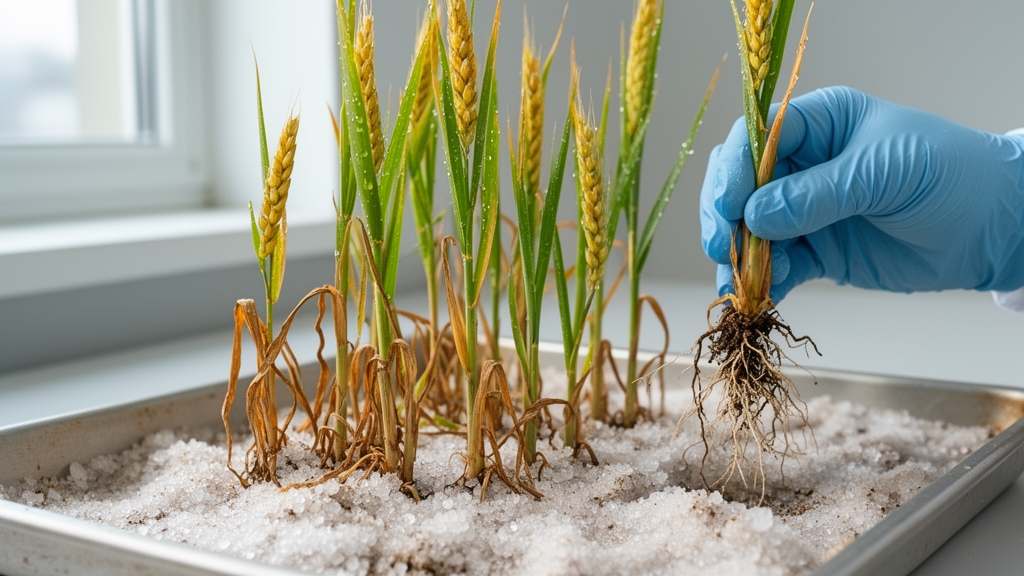
Saline-alkali stress constrains crop establishment and productivity, especially in arid and semi-arid regions, and highland barley (Hordeum vulgare L. var. nudum Hook. f), a staple cereal of the Qinghai-Tibet Plateau, is no exception. A comparative transcriptomic study published in BMC Plant Biology examined how two genotypes of this crop respond at the molecular level when their seedlings are exposed to saline-alkali stress for 24 hours, contrasting a tolerant line, L86, with a sensitive line, L38.
The stress inhibited seedling growth in both genotypes, but L86 maintained significantly greater shoot elongation than L38. RNA sequencing revealed that the tolerant genotype mounted a larger transcriptional response: L86 showed more differentially expressed genes than L38, driven largely by a greater number of upregulated genes. Functional enrichment analysis indicated that these upregulated genes in L86 were preferentially involved in glutathione metabolism; stilbenoid, diarylheptanoid, and gingerol biosynthesis; phenylpropanoid and flavonoid biosynthesis; starch and sucrose metabolism; and several amino acid metabolic pathways.
At the level of individual gene families, the two genotypes diverged sharply. Genes encoding glutathione S-transferases, enzymes linked to phenylpropanoid and flavonoid pathways, β-amylase, and trehalose-6-phosphate phosphatase showed contrasting expression patterns between L86 and L38, pointing to genotype-dependent regulation of antioxidant defense, secondary metabolism, and carbon allocation. In total, the analysis identified 189 transcription factor genes across 35 families. L86 displayed broader transcriptional activation, particularly among members of the ERF, MYB, WRKY, bHLH, and NAC families, whereas downregulated transcription factors predominated in the sensitive genotype L38.
Not every response differed between the lines. Photosynthesis- and light-harvesting-related genes were commonly downregulated in both genotypes, suggesting a shared consequence of saline-alkali exposure regardless of tolerance. Quantitative real-time PCR analysis of selected genes generally confirmed the RNA-sequencing results, adding an independent check on the expression patterns reported.
The authors conclude that the greater early-stage tolerance of L86 was associated with broader transcriptional activation and coordinated regulation of antioxidant defense, secondary metabolism, carbohydrate metabolism, amino acid metabolism, and transcription factor networks. Because the work is an early-access, peer-reviewed article that remains subject to further edits before the final version of record, the findings are best read as candidate gene discovery rather than validated functional proof. Even so, the study supplies a set of candidate genes and regulatory pathways for further functional investigation and for breeding programs aiming to improve saline-alkali tolerance in highland barley, a crop central to agriculture on the Qinghai-Tibet Plateau.
Subject of Research: Genotype-specific transcriptomic responses to saline-alkali stress in highland barley
Article Title: Comparative transcriptomics reveals genotype-specific mechanisms of saline-alkali tolerance in highland barley
Article References: Yan, M., Qu, Z.-Y., Wang, W.-H., & Lan, J.-H. (2026). Comparative transcriptomics reveals genotype-specific mechanisms of saline-alkali tolerance in highland barley. BMC Plant Biology. https://doi.org/10.1186/s12870-026-10198-1
Image Credits: AI Generated
DOI: 10.1186/s12870-026-10198-1
Keywords: highland barley, saline-alkali stress, transcriptomics, differentially expressed genes, glutathione metabolism, phenylpropanoid biosynthesis, transcription factors, Qinghai-Tibet Plateau, antioxidant defense, RNA sequencing, Comparative, reveals
News Source: Alan Morgan. (October 29, 2026). Research report: Comparative transcriptomics reveals genotype-specific mechanisms of saline-alkali tolerance in highland barley. Scienmag.



