Chemists have long sought ways to overcome curcumin’s stubborn physicochemical limitations, and a new study reports that binding the golden polyphenol to cerium may do more than solve a solubility problem. Researchers synthesized a cerium–curcumin coordination complex from cerium(III) sulfate and curcumin, characterized it with a battery of spectroscopic and structural techniques, and then tested it as a topical ointment in a mouse wound model. The complex-treated wounds closed completely within ten days, significantly outperforming free curcumin, an inert ointment base, and even a commercial fusidic acid ointment from day five onward.
The work, published in Results in Chemistry, addressed a known gap. Curcumin, the principal diarylheptanoid from turmeric, has attracted attention in wound research because experimental studies show it can modulate inflammatory signaling and oxidative stress while influencing fibroblast activity, collagen deposition, granulation tissue formation, and vascular responses. But its poor aqueous solubility, limited permeability, chemical instability, and rapid metabolic transformation restrict its effective availability at biological targets. Formulation strategies such as hydrogels, nanoparticles, and liposomes have been pursued, and metal coordination offers an alternative chemical route, since curcumin’s central β-diketone moiety chelates metal ions and coordination can substantially modify its electronic, physicochemical, and biological properties.
Cerium was a deliberate choice. The element’s accessible +3 and +4 oxidation states and strong affinity for oxygen-donor ligands have made cerium compounds, particularly cerium oxide, targets of interest for antioxidant, anti-inflammatory, antibacterial, and regenerative applications. Previous studies had combined curcumin with cerium oxide nanoparticles in hydrogel dressings, but those systems keep the two components physically separate within a delivery matrix. A discrete cerium–curcumin coordination compound, and specifically its wound-healing activity, remained far less explored.
The synthesis itself was straightforward: ethanolic curcumin solutions were combined with aqueous cerium(III) sulfate at nominal Ce:curcumin feed ratios of 1:1 and 1:2, stirred below 40 °C for six hours, and dried. The researchers were careful to note that these designations refer only to initial molar proportions and do not imply the final stoichiometry of the isolated product. The 1:1 preparation received the full characterization protocol, while the 1:2 sample was examined only by FTIR and UV–visible spectroscopy.
The analytical evidence pointed consistently toward coordination. Free curcumin absorbs broadly near 415 nm; both preparations shifted this band to roughly 420 nm, a slight bathochromic displacement indicating perturbation of the conjugated chromophore. FTIR spectra showed the broad OH stretch moving from 3506 cm−1 to around 3323–3347 cm−1, changes in the β-diketone and C–O region, and, most tellingly, a new low-frequency absorption near 465–466 cm−1 consistent with a metal–oxygen vibration, though the authors caution that sulfate vibrations may also contribute there. Powder X-ray diffraction revealed a highly crystalline product with intense low-angle reflections unlike either free curcumin or cerium oxide, and an average apparent crystallite size of 34 nm by the Scherrer equation. FESEM showed strongly aggregated crystalline domains rather than discrete nanoparticles, and EDS detected cerium at 0.3 atomic percent and sulfur at 0.7 atomic percent, confirming retention of sulfate-derived species. Thermogravimetric analysis showed a 7.81% mass loss below about 193 °C, consistent with associated or coordinated water, and a positive magnetic susceptibility confirmed weak paramagnetism expected for Ce(III) with its 4f1 configuration.
On this combined basis, the team proposed that curcumin chelates Ce(III) in an O,O-bidentate fashion through its β-diketone oxygen atoms, with sulfate groups and water completing an oxygen-rich, plausibly eight-coordinate environment. They emphasized, however, that this remains a working structural model: the data support Ce–O coordination and the participation of curcumin, sulfate, and water, but do not uniquely establish coordination number, sulfate binding mode, or exact molecular stoichiometry. Single-crystal X-ray diffraction would be required for definitive structure determination.
The biological testing began with antibacterial screening. In an agar well-diffusion assay against Staphylococcus aureus and Pseudomonas aeruginosa, the Ce–CUR formulation produced a distinct inhibition zone against S. aureus, where free curcumin and the ointment base showed none, while no zone appeared against P. aeruginosa. Because the assay used the final ointments, the observed inhibition reflects diffusion of active material from the coconut oil–paraffin matrix as well as intrinsic activity, so the absence of a zone against the Gram-negative strain cannot be taken as definitive proof of no antibacterial effect.
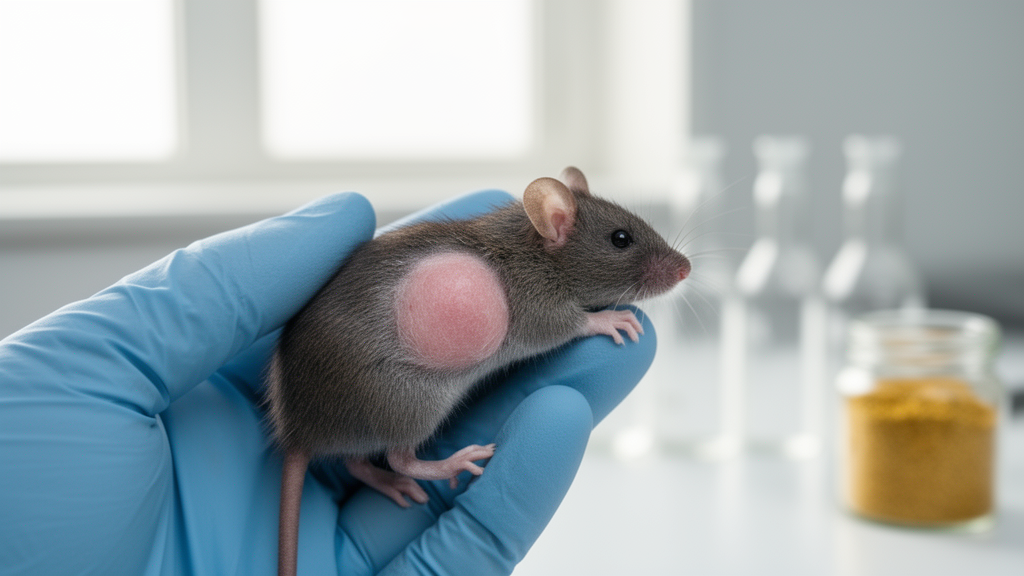
The wound experiment used twenty male BALB/c mice, eight weeks old, randomly assigned to four groups of five. Each animal received a standardized 2 cm full-thickness excisional wound on the dorsum, treated once daily for ten days with 0.1 g of the assigned formulation: ointment base alone, 2% free curcumin, 2% Ce–CUR, or 2% fusidic acid as positive control. Wound areas were quantified from digital images at days 0, 3, 5, 7, and 10, and healing percentages analyzed by two-way repeated-measures ANOVA with Dunnett’s multiple-comparison test.
The quantitative results showed a striking divergence after the first few days. On day 3, Ce–CUR achieved 11.60 ± 3.90% healing, significantly better than the negative control’s 0.96 ± 2.31% but not distinguishable from free curcumin or the positive control. By day 5, Ce–CUR reached 76.08 ± 4.10% versus 42.96 ± 2.82% for free curcumin, 13.68 ± 2.63% for the positive control, and 6.08 ± 1.91% for the base, with p < 0.0001 against all three. Day 7 showed 95.04 ± 0.83% closure for Ce–CUR, and by day 10 the Ce–CUR wounds were fully closed at 100.00 ± 0.00%, compared with 82.64 ± 3.74% for fusidic acid, 75.04 ± 2.60% for free curcumin, and 34.00 ± 2.65% for the untreated base. Treatment, time, and their interaction were all significant at p < 0.0001.
Histopathology of tissue collected on day 10 reinforced the macroscopic picture. The Ce–CUR group showed the most mature repair: a thin regenerated epidermis, apparently restored dermal architecture, well-developed hair follicle regeneration, sebaceous glands, and no apparent inflammatory-cell infiltration. Recovery of skin appendages is considered a marker of more complete tissue regeneration rather than simple wound closure. The free-curcumin group also showed advanced remodeling with marked folliculogenesis, the fusidic acid group displayed fibroplasia and prominent angiogenesis, and the negative control retained necrotic tissue, fibrin deposition, and dense leukocytic infiltration. The authors caution that further structural studies are needed to establish the exact stoichiometry and coordination geometry, and that mechanistic and longer-term investigations are warranted to clarify the basis and durability of the observed effect. As with all murine excisional studies, translation to human wound care remains unproven, but the convergence of coordination chemistry and measurable in vivo benefit makes this cerium–curcumin complex a compound worth watching.
Subject of Research: Synthesis and characterization of a cerium–curcumin coordination complex and evaluation of its wound-healing activity in a murine cutaneous wound model
Article Title: Synthesis and characterization of a cerium–curcumin coordination complex and evaluation of its wound-healing activity in a murine cutaneous wound model
Article References: Jassim, S. A., Hamza, R. H., Kadhim, S. M., & Taay, Y. M. (2026). Synthesis and characterization of a cerium–curcumin coordination complex and evaluation of its wound-healing activity in a murine cutaneous wound model. Results in Chemistry, 32, Article 104030. https://doi.org/10.1016/j.rechem.2026.104030
Image Credits: AI Generated
DOI: 10.1016/j.rechem.2026.104030
Keywords: cerium, curcumin, coordination complex, wound healing, murine model, topical formulation, antibacterial activity, histopathology, rare-earth chemistry, drug delivery, Synthesis, characterization
News Source: Bethany Barker. (October 29, 2026). Cerium–Curcumin Complex Speeds Wound Closure in Mice, Reaching Complete Healing by Day 10. Scienmag.