


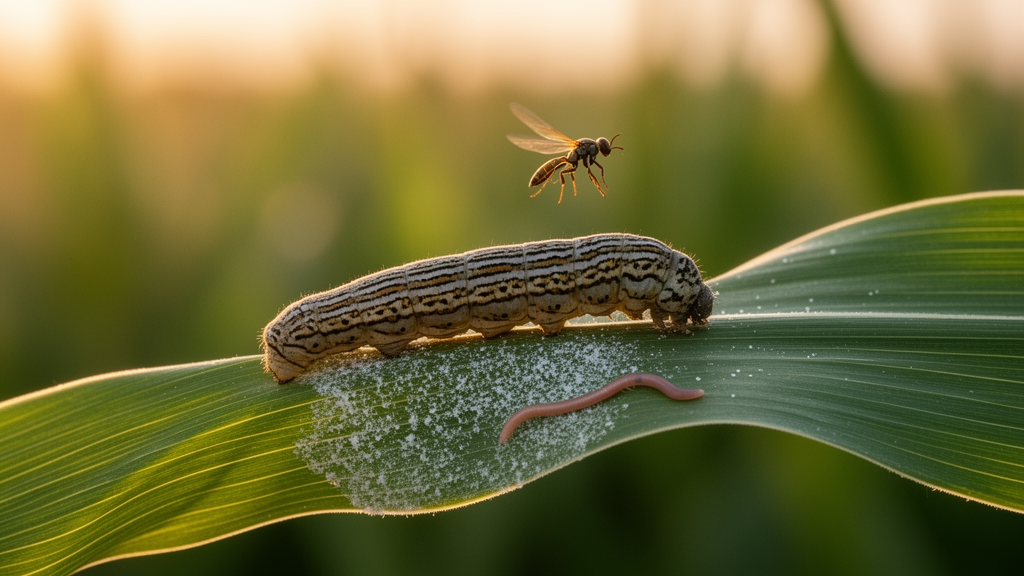
The fall armyworm, Spodoptera frugiperda, has spread from the Americas to Africa, Asia and Oceania since it was first reported outside its native range in West Africa in 2016, and a new systematic review and meta-analysis now pulls together the global evidence on biological control of this invasive pest. The review, published in the Egyptian Journal of Biological Pest Control, screened literature published between January 2016 and October 2025 and synthesized 31 studies comprising 63 trials that met strict eligibility criteria. Its central message is cautiously encouraging: several groups of natural enemies, particularly entomopathogenic fungi, entomopathogenic nematodes, Bacillus bacteria and selected parasitoids, show statistically significant effects against the pest, but the evidence is marked by extreme variability and remains heavily weighted toward laboratory conditions.
The search across Web of Science, Scopus, PubMed, CAB Abstracts, AGRIS and Google Scholar returned 337 records, of which 327 were unique. After title and abstract screening excluded 252 papers, 75 full-text articles were assessed and 44 were removed for irrelevance, lack of quantitative data or inadequate methodological reporting, leaving 31 studies. Only studies reporting both treatment and untreated control mortality with extractable sample sizes entered the quantitative synthesis; studies without untreated controls were retained in the qualitative synthesis. The authors followed PRISMA 2020 guidelines and calculated effect sizes as absolute risk differences in mortality between treated and control groups, pooled with random-effects models.
The pooled results point to meaningful average effects, though with wide uncertainty. Entomopathogenic fungi as a whole showed a pooled effect of approximately 27.14 (95% confidence interval 17.08 to 37.21). Within this group, Beauveria bassiana, tested in 12 trials, yielded a pooled effect of 28.74 (95% CI 14.43 to 43.05), while Metarhizium anisopliae, tested in 7 trials, yielded 25.10 (95% CI 10.22 to 39.97). A formal comparison found no statistically significant difference between the two fungal species, suggesting that practical factors such as availability, cost and local environmental suitability may matter more than species choice. Bacillus species, dominated by Bacillus thuringiensis, produced a pooled effect of 25.23 (95% CI 12.97 to 37.50) across five studies, with all individual studies reporting positive effects ranging from 6.21 to 40.74.
Entomopathogenic nematodes showed a pooled effect of 25.48 (95% CI 8.26 to 42.71) across eight studies of Heterorhabditis bacteriophora and Steinernema carpocapsae. The subgroup results diverged, however: H. bacteriophora reached a statistically significant pooled effect of 22.05 (95% CI 8.97 to 35.13), whereas S. carpocapsae’s pooled estimate of 30.73 had a confidence interval crossing zero (−6.94 to 68.41) and was not statistically significant. Publication bias testing for nematodes was borderline (Egger’s test t = 2.01, p = 0.08), and a trim-and-fill adjustment identified two potentially missing studies, lowering the adjusted estimate to 18.93 (95% CI 2.17 to 35.69). The authors therefore advise treating the unadjusted nematode estimate as a likely upper bound.
A recurring caveat runs through every quantitative result: heterogeneity was extreme. The I² statistic exceeded 99% for the fungal analyses, reached 99.95% for nematodes and 97.72% for bacteria, meaning nearly all observed variation reflects genuine differences between studies rather than sampling error. The authors attribute this to strain-level differences in virulence, variation in larval instars targeted, differing application rates and formulations, and the predominance of laboratory assays, which maximize pathogen–host contact and minimize environmental stress. They explicitly state that the pooled estimates should be read as average effects across heterogeneous ecological contexts, not as precise predictions of field performance or universal efficacy benchmarks.
Parasitoids were assessed qualitatively because the number of studies and the diversity of outcome measures made meta-analysis infeasible. The egg parasitoid Telenomus remus emerged as the most frequently studied species and a consistent performer: in laboratory trials it parasitized up to 77.6% of single-layered fall armyworm eggs, and it can penetrate egg masses covered with protective scales, which most Trichogramma species cannot. Field studies were more mixed. In Ghana, releases of roughly 15,000 T. remus per season achieved egg-mass parasitism of 33% in the major rainy season and 72 to 100% in the minor season, yet parasitism did not differ significantly between release and control plots. In Niger, augmentative releases in sorghum raised parasitism to 64% relative to unreleased fields. The egg–larval parasitoid Chelonus bifoveolatus achieved parasitism, pupation and emergence rates above 90%, 75% and 82% respectively across egg ages in laboratory tests, and the larval parasitoid Bracon brevicornis, released at 4,000 adults per hectare in Indian maize fields, reduced infestation by 54% after three weekly releases.
Viral agents could not be meta-analyzed owing to limited data, but individual studies were notable. Spodoptera frugiperda multiple nucleopolyhedrovirus (SfMNPV) is highly host-specific, and mixing it with S. frugiperda granulovirus increased pathogenicity roughly twelvefold, cutting the mean time to death from about seven days to three. SfMNPV also remained fully effective when mixed with the herbicide atrazine, and combined applications of SfMNPV with the fungus Metarhizium rileyi at half the recommended concentration kept foliar damage below the 30% economic threshold, compared with 43% damage in untreated plots. These compatibility findings suggest practical routes for integrating viral biopesticides into existing spray programs, though the authors stress that firm conclusions await more research.
The geographic and methodological distribution of the evidence carries its own warnings. Egypt contributed the most studies with six, followed by Brazil, China, Indonesia and Pakistan with three each; India and Colombia had two, and fifteen other countries one each. Research is concentrated in invaded regions of Africa and Asia, while South America, the pest’s native range, is thinly represented, limiting understanding of naturally occurring enemy complexes. Risk-of-bias assessment adapted from Cochrane guidance rated most studies as low risk in randomization, intervention adherence, missing data and outcome measurement, but selective reporting of results was the principal concern, with several studies presenting incomplete outcome sets or only favorable responses. The authors note that effect direction is therefore robust while magnitudes warrant moderate caution.
The review also acknowledges an unusual methodological feature: preliminary data extraction for a subset of studies was performed with an AI tool, NotebookLM, with every AI-extracted data point independently verified by two reviewers against the original publications. Seven errors, about 4.3% of extracted data points, involving misread table structures or decimal placements, were identified and corrected, and no fabricated data were detected. A planned meta-regression to explain the heterogeneity, examining moderators such as larval instar, application method and geography, proved infeasible because primary studies inconsistently reported these covariates, a gap the authors flag for future bioassay reporting standards.
The authors conclude that entomopathogenic fungi, nematodes, Bacillus-based biopesticides and selected parasitoids are credible components of integrated pest management for fall armyworm, with parasitoids acting as longer-term population regulators, fungi and nematodes as rapid mortality agents, and bacteria and viruses as preventive suppressants of early larval instars. But they are emphatic that deployment recommendations must rest on local validation rather than global pooled estimates. Standardized bioassays, expanded multi-location field trials, better formulation and delivery systems, exploration of understudied taxa and coordinated international research are identified as priorities before these agents can be scaled with confidence against one of the world’s most destructive invasive crop pests.
Subject of Research: Systematic review and meta-analysis of biological control agents against the invasive fall armyworm Spodoptera frugiperda
Article Title: Biological control of the fall armyworm Spodoptera frugiperda (J. E. Smith), (Lepidoptera: Noctuidae) globally: systematic review and meta-analysis
Article References: Al-Elimi, M. H., Abdelrahman, R. M., Fathy, Z., & El-Mandarawy, M. B. R. (2026). Biological control of the fall armyworm Spodoptera frugiperda (J. E. Smith), (Lepidoptera: Noctuidae) globally: systematic review and meta-analysis. Egyptian Journal of Biological Pest Control, 36(1), Article 23. https://doi.org/10.1186/s41938-026-00901-7
Image Credits: AI Generated
DOI: 10.1186/s41938-026-00901-7
Keywords: fall armyworm, Spodoptera frugiperda, biological control, entomopathogenic fungi, Beauveria bassiana, Metarhizium anisopliae, entomopathogenic nematodes, Bacillus thuringiensis, parasitoids, meta-analysis, integrated pest management, systematic review
News Source: Roger Howard. (October 29, 2026). Fungi, nematodes and parasitoids show promise against fall armyworm, review finds. Scienmag.



