


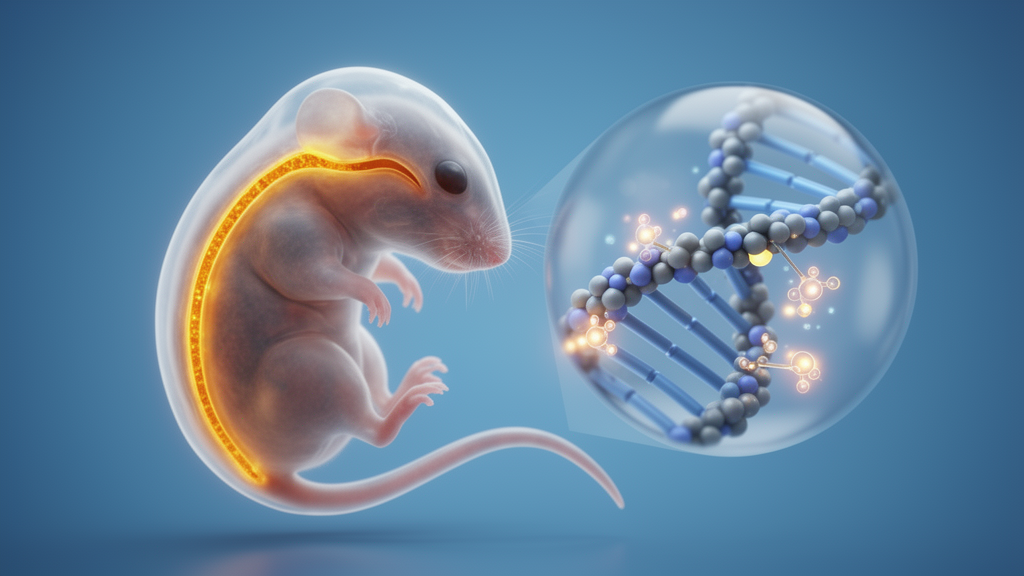
Maternal diabetes has long been recognized as a risk factor for neural tube defects, severe congenital malformations that arise when the embryonic neural tube fails to close properly. A new mouse study, published open access in Epigenetics & Chromatin, now points to a specific epigenetic mechanism behind the cranial form of these defects: an abnormal rise in the histone modification H3K18 crotonylation, which appears to silence two genes needed for neural cell proliferation.
The researchers established maternal diabetes in mice by injecting streptozotocin at embryonic day 5.5, then examined embryos between embryonic days 8.5 and 10.5, the critical window for neural tube closure. Embryos from diabetic dams developed both cranial and spinal neural tube defects, with cranial defects markedly predominant, so the team focused its analyses on cranial neural tissue from affected embryos.
In that tissue, the researchers found a significant accumulation of crotonyl-coenzyme A, the metabolite that donates the crotonyl group, accompanied by elevated levels of lysine crotonylation overall and of histone H3 lysine 18 crotonylation in particular. Maternal hyperglycemia also downregulated the enzymes HDAC1 and HDAC2, which normally remove such marks; together with the crotonyl-CoA buildup, this promoted a global increase in H3K18cr across cranial neural tissues.
The paradox came at the level of individual genes. Despite the global elevation, H3K18cr enrichment was reduced at the promoters of AKT and PIKFYVE in cranial neural tube defect embryos. That local loss of the activating mark correlated with transcriptional silencing of the two genes, a change the authors link to the development of cranial neural tube defects.
To probe the mechanism further, the team turned to HT-22 hippocampal neurons grown in culture. Exogenous glucose and crotonate reproduced the metabolic and epigenetic alterations seen in the embryos, driving crotonyl-CoA accumulation and a global increase in H3K18cr. Yet at the AKT and PIKFYVE promoters, H3K18cr levels fell, and the cells showed suppressed proliferation.
The authors conclude that maternal diabetes induces neural tube defects, at least in part, through aberrant elevation of H3K18cr, which suppresses AKT and PIKFYVE expression and impairs neural cell proliferation. They describe the work as revealing a potential regulatory mechanism by which abnormal H3K18cr elevation contributes to cranial neural tube defects induced by maternal diabetes.
Several caveats frame these findings. The core results come from a streptozotocin-induced mouse model and from a neuronal cell line treated with glucose and crotonate, so the mechanism has not been demonstrated in human embryos. The study identifies correlations between promoter-level H3K18cr loss and gene silencing, and the authors themselves characterize the pathway as a potential mechanism rather than a fully established causal chain. The article is also being shared early as a peer-reviewed accepted manuscript that may undergo further edits before the final version of record.
Even with those limitations, the study adds a specific molecular candidate to the list of pathways connecting maternal hyperglycemia to embryonic malformation.
Subject of Research: Epigenetic mechanisms linking maternal diabetes to cranial neural tube defects in mice
Article Title: Maternal diabetes causes embryonic cranial neural tube defects is associated with elevated H3K18cr and reduced AKT/PIKFYVE
Article References: Liu, Z., Li, J., Shi, J., Cao, Z., Xie, Q., Zhao, Y., Gu, X., Liu, M., Yang, Y., Fang, A., Yang, Y., Li, J., & Liu, Z. (2026). Maternal diabetes causes embryonic cranial neural tube defects is associated with elevated H3K18cr and reduced AKT/PIKFYVE. Epigenetics & Chromatin. https://doi.org/10.1186/s13072-026-00697-8
Image Credits: AI Generated
DOI: 10.1186/s13072-026-00697-8
Keywords: maternal diabetes, neural tube defects, H3K18 crotonylation, crotonyl-CoA, HDAC1, HDAC2, AKT, PIKFYVE, epigenetics, mouse model, HT-22 neurons, embryonic development
News Source: Juliet Wilcox. (October 29, 2026). Maternal Diabetes Linked to Cranial Neural Tube Defects via Elevated H3K18cr. Scienmag.



