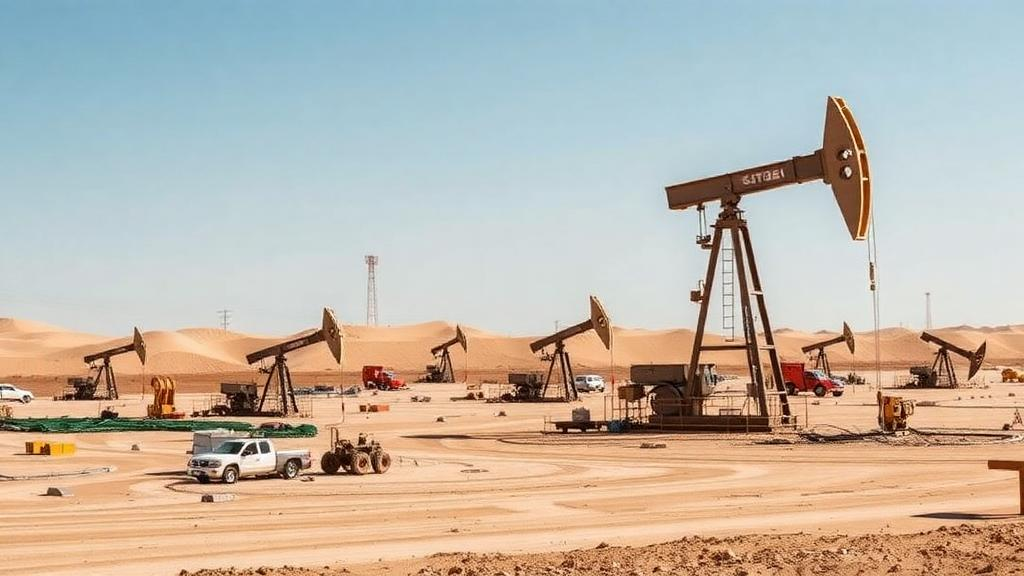
Sand flowing into a well alongside oil, gas or geothermal fluids is one of the quiet threats of the energy transition. A new open-access study in Geomechanics and Geophysics for Geo-Energy and Geo-Resources reports a machine-learning model designed to predict the point at which sand production begins, using a large dataset of fluid-and-sand flow simulations.
The research, led by Yuqi Song and P. G. Ranjith with colleagues, focuses on a quantity called the critical drawdown pressure gradient: the pressure difference a well can tolerate before sand grains start to mobilise and flow toward the wellbore. According to the abstract, this threshold depends on the particle size distribution of the sand, the true triaxial stresses acting on the formation, and the width of the slots in sand-control equipment such as slotted liners or wire-wrapped screens.
To build the underlying dataset, the team used a validated computational fluid dynamics and discrete element method (CFD-DEM) numerical model, implemented in Particle Flow Code (PFC) software. The coupled approach simulates fluid flowing through an assembly of individual sand grains behind sand-control equipment, capturing how particles detach, move and interact with slots under different stress conditions. The simulations were run under true triaxial stresses, meaning the three principal stresses acting on the rock could each be set independently rather than assumed equal.
From this simulation dataset, the researchers developed a machine-learning model using SPSS to predict the critical drawdown pressure quickly. The stated aim is speed: instead of running a new coupled simulation for every well or completion design, an engineer could obtain a fast estimate of the sanding threshold from the trained model.
The analysis identified which input variables matter most. Extreme values of the particle size distribution — specifically D0, D10 and D100, which describe the finest and coarsest fractions of the sand — emerged as key factors, along with the mid-value D70. Perhaps more strikingly, the stress along the short axis of the slot was found to significantly affect the critical drawdown pressure gradient, highlighting how the orientation of stresses relative to the sand-control screen shapes the onset of sanding.
The authors report that the model improves sand management and well productivity by allowing adjustments in wire spacing, slot width and mechanical strength. In practical terms, a completion engineer could use the prediction to tune the slot geometry of a screen before installation, balancing the need to hold back sand against the need to let fluids flow freely into the well.
Another feature the authors highlight is portability. The model, they write, can be installed on mobile devices and used at oil and gas development sites, putting a sanding-risk estimate in the hands of field engineers rather than requiring specialist simulation software on site.
It is worth being clear about what the study delivers and what it does not. The findings come from a numerical simulation dataset, not from new field measurements or laboratory tests reported in this paper; the machine-learning model is trained on CFD-DEM results, and its reliability depends on how well that validated simulation model represents real fluid-sand flow behind sand-control equipment. The abstract describes the model as offering a fast and reliable prediction of sand production, but the version published on 3 October 2026 is a shared early-release, citable with a permanent DOI and subject to further edits before the final Version of Record appears.
Even so, the work addresses a genuine gap. Sand production is a safety risk during and after extraction in several geo-energy settings, and the authors note that predicting and managing it has become a critical research focus. A tool that estimates the critical drawdown pressure gradient from particle size distribution, stress state and slot width could help operators choose drawdown pressures and screen designs that keep sand in place.
For readers following geo-energy research, the study’s key message is that sanding onset is governed by a small set of measurable factors — the extremes of the grain size distribution and the stress along the slot’s short axis — and that machine learning trained on physics-based simulations can turn those factors into a rapid field-ready prediction.
Subject of Research: A machine-learning model trained on CFD-DEM simulations to predict the onset of sand production in geo-energy wells under true triaxial stresses.
Article Title: A machine-learning model for predicting sand production onset under true triaxial stresses based on CFD-DEM simulation dataset
Article References: Song, Y., Ranjith, P. G., Zhang, D., Huang, Y., Wu, B., Jiang, T., & Song, Z. (2026). A machine-learning model for predicting sand production onset under true triaxial stresses based on CFD-DEM simulation dataset. Geomechanics and Geophysics for Geo-Energy and Geo-Resources. https://doi.org/10.1007/s40948-026-01185-9
Image Credits: AI Generated
DOI: 10.1007/s40948-026-01185-9
Keywords: sand production, machine learning, CFD-DEM, critical drawdown pressure, true triaxial stress, slotted liner, wire-wrapped screen, particle size distribution, geo-energy, geomechanics, well productivity, sand control
News Source: Denise Maddox. (October 29, 2026). Machine-learning model predicts when sand production begins in gas and energy wells. Scienmag.