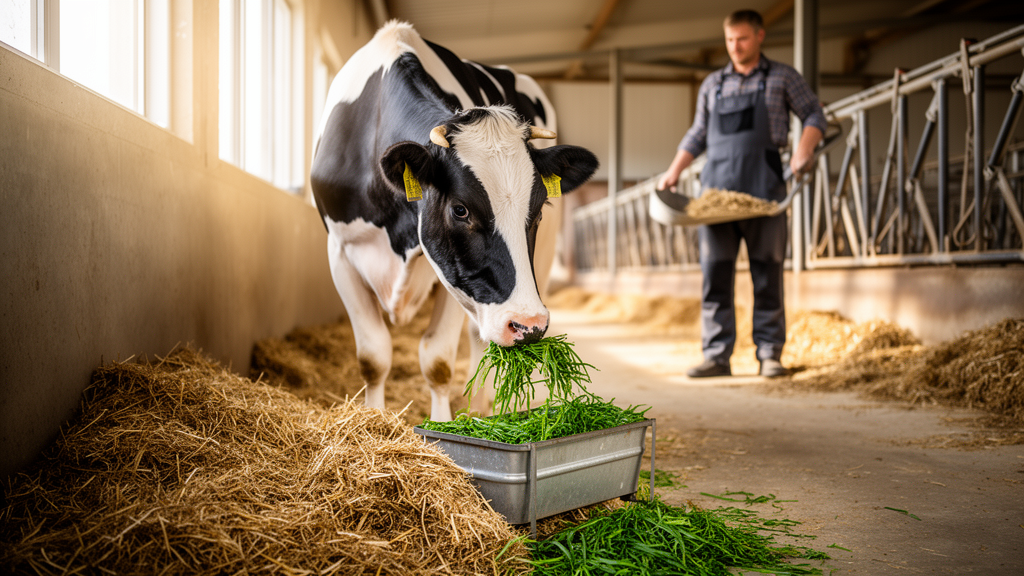
Plant essential oils have long been promoted as a natural way to curb the methane that dairy cows burp into the atmosphere, but a new systematic review and meta-analysis concludes that the evidence does not yet support a reliable effect. Pooling data from 31 eligible reports of essential oil supplementation in lactating dairy cows, researchers found no statistically significant pooled effect on milk yield, absolute methane emission, methane yield, or methane intensity. The findings, published in Frontiers in Animal Science, temper expectations that these aromatic plant compounds can be deployed as a straightforward climate solution for dairy farming.
Enteric methane is a serious problem on two fronts. It is one of the most potent greenhouse gases, with a global warming potential roughly 30 times that of carbon dioxide, and ruminant livestock production is the largest anthropogenic methane source. At the same time, methane production in the rumen wastes energy: dairy cows lose approximately 6 to 11 percent of their feed energy as methane during the conversion of plant biomass into milk and meat. A feed additive that suppressed methanogenesis without hurting production would therefore deliver both environmental and economic gains, which is precisely why essential oils have attracted so much attention.
The research team, based at Shandong Agricultural University in China, searched PubMed, Scopus, and Web of Science for studies published through July 2025, following the Population, Intervention, Comparison, Outcome framework. Eligible studies had to involve lactating dairy cows, dietary essential oil supplementation with a clearly described composition and dose, a concurrent unsupplemented control group, and at least one quantifiable outcome among milk yield, methane emission in grams per day, methane yield per kilogram of dry matter intake, or methane intensity per kilogram of milk. Studies relying solely on in vitro gas production or modeling without in vivo validation were excluded, and methane measurement techniques had to be specified, whether respiration chambers, GreenFeed systems, sulfur hexafluoride tracers, sniffer devices, or validated proxy methods.
From 942 records identified, the screening funnel narrowed to 283 full-text assessments and ultimately 31 included studies. The interventions ranged widely: single compounds and commercial blends containing constituents such as thymol, carvacrol, cinnamaldehyde, eugenol, linalool, and geranyl acetate, fed at doses from well under 2 grams to around 6 grams per cow per day, over durations from days to months. Most studies involved Holstein cows, and methane was measured by an assortment of techniques, including respiration chambers, GreenFeed units, the sulfur hexafluoride tracer method, and sniffer systems at milking parlors. Two reviewers independently screened studies, extracted data, and assessed risk of bias using the SYRCLE tool for animal studies.
The pooled results were consistently null. For milk yield, based on 24 comparisons, the standardized mean difference was 0.47 with a 95 percent confidence interval spanning −0.29 to 1.22 and a P value of 0.225. For methane emission, drawn from 10 comparisons, the point estimate of −0.87 suggested lower emissions with essential oils, but the confidence interval of −1.85 to 0.12 crossed the null, with P = 0.083. Methane yield showed a similarly non-significant estimate of −0.40 (95 percent CI, −1.55 to 0.75; P = 0.498), and methane intensity, based on 8 comparisons, yielded −0.79 (95 percent CI, −1.66 to 0.08; P = 0.075). In other words, the direction of the methane-related point estimates favored reduction, but the uncertainty around each estimate was too wide to rule out no effect.
Perhaps more striking than the null findings was the heterogeneity. The I² statistic, which measures the proportion of variation attributable to between-study differences rather than chance, ranged from 85.76 percent to 95.2 percent across the four outcomes, all with heterogeneity P values below 0.001. That means the studies differed so dramatically in their reported effects that a single pooled average may not describe what would happen in any particular herd, diet, or measurement setting. The authors emphasize that an average effect estimate under such conditions should be interpreted with great caution, and prediction intervals quantifying the likely spread of effects in new settings could not be calculated because the study-level dataset was unavailable.
The team also ran exploratory subgroup analyses and meta-regressions to probe whether formulation, dose, feeding duration, or methane measurement technique explained the variation. Some patterns emerged in the point estimates: blended products, doses of 2 to 6 grams per cow per day, and feeding periods of 20 to 60 days were associated with certain directions of effect. For milk yield, the high-dose subgroup showed a standardized mean difference of 1.07, though with P = 0.0545, and the difference between dose categories was not statistically significant (P = 0.142). Between-group tests for formulation, dose, and measurement technique were generally non-significant across the methane outcomes, and many subgroups contained only one or two comparisons, making the estimates imprecise and unstable. The authors are explicit that these patterns are hypothesis-generating and do not establish an optimal formulation, dose, or duration.
The null pooled result contrasts with some earlier findings for specific products. A previous analysis of the commercial blend Agolin Ruminant reported a 3.6 percent increase in milk yield and an 8.8 percent reduction in daily methane emissions in studies lasting longer than four weeks. The meta-analysis authors note an important distinction: that work focused on a single formulated product, whereas their synthesis combined studies of many different compounds and blends. Because essential oils are not a chemically uniform intervention, and their biological activity depends on the type and concentration of active constituents such as thymol, carvacrol, cinnamaldehyde, eugenol, and allicin, efficacy demonstrated for one product cannot be generalized to the entire class.
Several limitations constrain the conclusions. Only 8 to 10 studies contributed to each methane-related outcome, limiting statistical power, and funnel plot asymmetry tests had similarly low power, so publication bias cannot be excluded even though the plots appeared roughly symmetric. Risk of bias was uneven: while most studies were rated low risk for incomplete outcome data and baseline comparability, allocation concealment, personnel blinding, and assessor blinding were frequently unclear or high risk. The use of standardized mean differences, though necessary given non-uniform reporting units, reduces direct interpretability compared with mean differences in original units. Breed composition, with Holstein cows predominating, may also have contributed to unexplained heterogeneity in milk yield.
The authors’ bottom line is that essential oils should be regarded as candidate, formulation-specific interventions requiring confirmatory evaluation rather than proven methane mitigants. They call for large, preregistered, adequately powered trials with chemically characterized products, standardized methane measurement schedules, and transparent reporting of methane emission, methane yield, methane intensity, feed intake, and milk production together. Mechanistic work integrating rumen metagenomics, metatranscriptomics, and metabolomics, along with precision-feeding studies combining real-time sensors with adaptive dosing, could help identify which cows and which compounds respond. Until such evidence accumulates, the promise of essential oils as a climate tool for dairy farming remains exactly that: a promise awaiting rigorous proof.
Subject of Research: A systematic review and meta-analysis of essential oil supplementation effects on milk yield and methane emissions in dairy cows
Article Title: Effects of plant essential oils on milk yield and methane emissions in dairy cows: a meta-analysis
Article References: Xiang, H., Zhang, Q., Lin, X., Wang, Z., & Hou, Q. (2026). Effects of plant essential oils on milk yield and methane emissions in dairy cows: a meta-analysis. Frontiers in Animal Science, 7, Article 1923564. https://doi.org/10.3389/fanim.2026.1923564
Image Credits: AI Generated
DOI: 10.3389/fanim.2026.1923564
Keywords: dairy cows, essential oils, methane emissions, meta-analysis, enteric fermentation, greenhouse gases, milk yield, feed additives, animal nutrition, methane intensity, rumen fermentation, climate mitigation
News Source: William Thompson. (October 29, 2026). Essential Oils Show No Clear Methane-Cutting Effect in Dairy Cows, Meta-Analysis Finds. Scienmag.