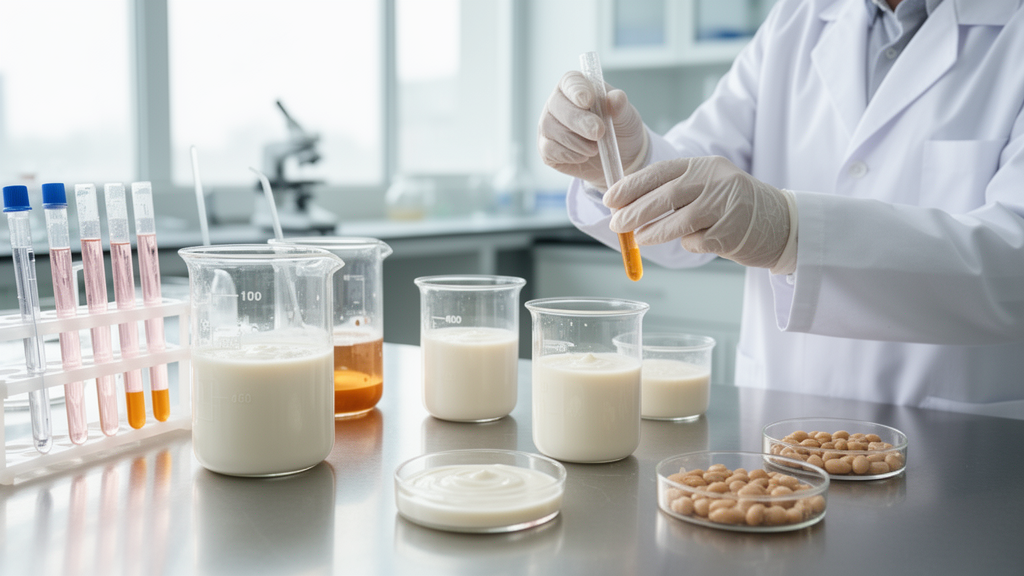
Plant-based yogurt alternatives made from common beans have moved a step closer to the functional food aisle, thanks to a laboratory study published in April 2026 in the journal Agricultural Products Processing and Storage. Their goal was to compare how fermentation with lactic acid bacteria shaped texture, color, mineral content, peptide release, and bioactivity in each variety, both before and after a simulated gastrointestinal digestion. The work addresses a gap in prior research, which had mostly examined single bean types or omitted a soy control.
The team cooked each type of dry bean under pressure, blended the cooked beans with sugar and coconut milk to form plant-based milks, and fermented the mixtures at 42 degrees Celsius for ten hours with a mixed starter culture containing Lactobacillus bulgaricus, Streptococcus thermophilus, and the probiotic adjunct Lactobacillus acidophilus. Fermentation continued until the pH fell to 4.5, the acidity level characteristic of conventional yogurt. All experiments were run in triplicate with three separate samples per run, and statistical differences were evaluated by one-way analysis of variance with Duncan’s post-hoc test at a significance level of 0.05.
The physicochemical results pointed to one clear standout. Fermentation significantly improved the textural properties of every bean yogurt, but great northern bean yogurt showed the strongest performance: the lowest syneresis, or whey separation, at 3.20 percent, along with the highest whiteness and lightness values in the CIELab color system. Firmness in great northern bean yogurt rose by 67.76 percent during fermentation, consistency by 64.01 percent, and cohesiveness by 208.77 percent. The authors attribute this robust gel formation to the acid-induced aggregation of great northern bean proteins, which apparently creates a fine, uniform gel network capable of trapping water. By contrast, pinto and red kidney bean yogurts, despite sharing a similar low-fat, high-protein profile, showed reduced hardness and consistency, suggesting that protein composition matters as much as gross macronutrient content.
Mineral analysis by inductively coupled plasma mass spectrometry revealed potassium as the most abundant element in all bean yogurts, followed by phosphorus, sulfur, magnesium, calcium, sodium, iron, boron, zinc, manganese, copper, molybdenum, and nickel. Pinto bean yogurt consistently contained the highest levels of several macro- and microelements, including potassium, phosphorus, magnesium, calcium, iron, and zinc. Fermentation generally reduced mineral content compared with the corresponding milks, an effect the authors note was cultivar dependent, with pinto and navy bean yogurts retaining comparatively more minerals. The researchers caution that mineral bioavailability was not directly assessed, so these compositional differences should be interpreted as nutritional relevance rather than demonstrated absorption advantages.
Bioactivity measurements told a more nuanced story. Among the unfermented and fermented products before digestion, pinto bean yogurt recorded the highest free radical scavenging activity against DPPH radicals, at 60.61 units expressed as an antiradical efficiency measure, and the highest total phenolic content at 2,736.92 milligrams of gallic acid equivalents per liter. Colored beans such as pinto beans have previously been reported to possess superior antioxidant properties compared with lighter varieties like navy and great northern beans, and this pattern held in the present study. Interestingly, total phenolic content of the yogurts slightly decreased relative to the bean milks after fermentation, even as antiradical efficiency rose modestly, a divergence the authors attribute to interactions among antioxidant components that can have antagonistic or synergistic effects.
Protein breakdown during fermentation was substantial. Sodium dodecyl sulfate polyacrylamide gel electrophoresis showed that large bean proteins in the 30 to 250 kilodalton range were hydrolyzed into polypeptides below 25 kilodaltons or individual amino acids, reflecting the proteolytic activity of the lactic acid bacteria. Total peptide content, measured with a fluorometric peptide assay, increased significantly in all fermented samples, ranging from 34.15 milligrams per 100 grams in soybean yogurt to 64.37 milligrams per 100 grams in red kidney bean yogurt. Relative to the unfermented matrices, peptide content rose by 18.25 to 25.32 percent in great northern and red kidney bean yogurts. The authors note that proteolysis by lactic acid bacteria can also degrade antinutritional proteins such as phytohemagglutinin and alpha-amylase inhibitors while improving protein digestibility.
The most striking results emerged after the researchers subjected the bean milks and yogurts to simulated gastrointestinal digestion following the INFOGEST protocol, a physiologically relevant in vitro model incorporating salivary, gastric, and intestinal phases. Digestion significantly increased both total phenolic content and antioxidant capacity in all samples. Within the yogurt digestates, pinto and red kidney bean yogurts showed the highest radical quenching ability, at 112.76 and 109.74 units respectively, and the highest phenolic levels, at 6,869.84 and 6,482.74 milligrams per liter. All digested bean milks exhibited ACE-inhibitory activity, which increased significantly after fermentation, with the fermented red kidney bean digestate reaching the highest inhibition of 29.75 percent. ACE, or angiotensin I-converting enzyme, regulates blood pressure by producing the vasoconstrictor angiotensin II, and its inhibition is the mechanism through which common antihypertensive drugs act.
Pearson correlation analysis added an important mechanistic layer. Antiradical efficiency correlated most strongly with total phenolic content both before and after digestion, confirming phenolic compounds as the primary contributors to antioxidant potential in these bean-based samples. Correlations involving peptides were very weak after digestion, suggesting that digested peptides contribute minimally to the measured antioxidant activity compared with phenolics. The authors propose that phenolics, with their multiple hydroxyl groups, radical-stabilizing resonance structures, and metal-chelating capacity, respond directly and dose-dependently in DPPH assays, whereas peptides often exert subtler effects that such single-assay measurements do not fully capture.
To explore antihypertensive relevance further, the team profiled small peptides in the digested samples using untargeted hydrophilic interaction chromatography coupled to tandem mass spectrometry. Several identified di- and tri-peptides contained residues frequently associated with ACE inhibition, including tyrosine, tryptophan, proline, methionine, leucine, isoleucine, phenylalanine, threonine, and histidine, with hydrophobic or aromatic residues at the C-terminus and positively charged or branched-chain residues at the N-terminus. The authors are careful to emphasize that this identification rests on sequence homology and structural similarity to known ACE-inhibitory peptides rather than direct inhibition assays of purified peptides, so the findings indicate potential functionality rather than conclusive biological activity. Isolation of individual peptides, in vitro inhibition testing, and in vivo validation will be needed to confirm efficacy.
Storage performance rounded out the evaluation. Over 28 days of refrigerated storage at 4 degrees Celsius, the yogurts showed no significant changes in moisture, soluble solids, color parameters, or texture, and viable lactic acid bacteria counts remained above the 1 × 10⁶ colony-forming units per gram threshold generally associated with probiotic efficacy at the time of consumption. Yeast and mold counts stayed below the detection limit of 10 colony-forming units per gram throughout. The authors acknowledge the study’s limitations: all bioactivity findings derive from in vitro assays and simulated digestion, without in vivo validation, animal or human testing, or comprehensive sensory evaluation. Within those constraints, the practical takeaway is that bean cultivar selection can be matched to intended function—red kidney beans for ACE-inhibitory potential, pinto beans for antioxidant capacity and mineral density, and great northern beans for texture and color—offering formulators a data-driven basis for developing targeted plant-based probiotic yogurts.
Subject of Research: Fermented plant-based yogurts made from common bean cultivars and their physicochemical and bioactive properties before and after simulated digestion
Article Title: Probiotic plant-based yogurts from common beans (Phaseolus vulgaris): physicochemical properties, bioactive peptides, and health-promoting activities before and after in vitro digestion
Article References: Karbasi, M., Xie, X., & Xu, C. (2026). Probiotic plant-based yogurts from common beans (Phaseolus vulgaris): physicochemical properties, bioactive peptides, and health-promoting activities before and after in vitro digestion. Agricultural Products Processing and Storage, 2(1), Article 38. https://doi.org/10.1007/s44462-026-00071-7
Image Credits: AI Generated
DOI: 10.1007/s44462-026-00071-7
Keywords: probiotic yogurt, common beans, Phaseolus vulgaris, lactic acid fermentation, bioactive peptides, ACE inhibition, antioxidant activity, in vitro digestion, plant-based dairy alternatives, great northern beans, pinto beans, red kidney beans
News Source: Alan Morgan. (October 29, 2026). Fermented Common Bean Yogurts Show Antioxidant and ACE-Inhibitory Potential in Lab Tests. Scienmag.