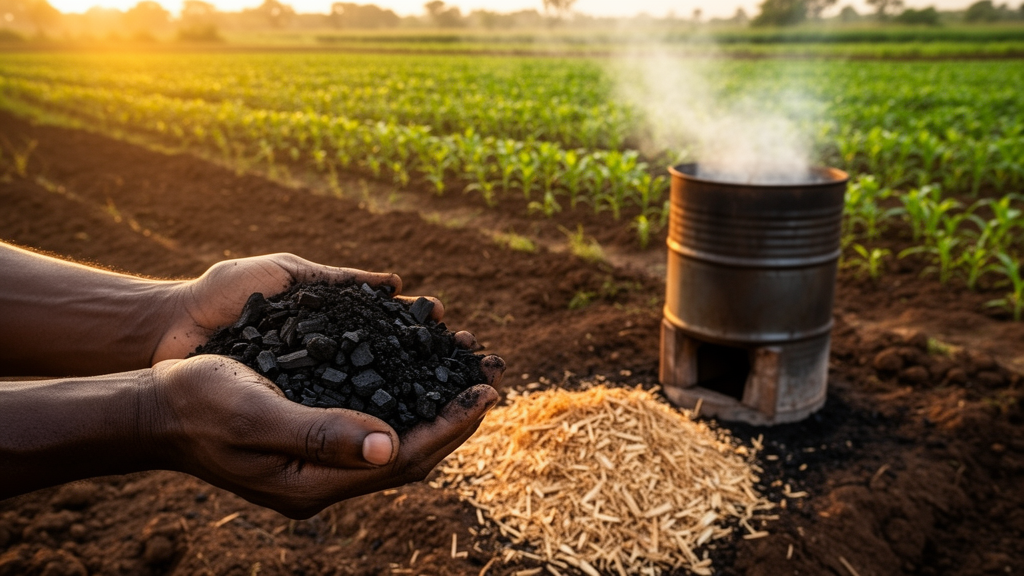
Researchers in Nigeria have compared compost, sawdust biochar and cow dung biochar as soil amendments and report that all three materials contain nutrients that maize plants can take up, with cow dung biochar showing the highest nutrient uptake and sawdust biochar producing the tallest plants. The study, published in BMC Chemistry, also found that heavy metal concentrations in the three products fell within World Health Organization and United States Environmental Protection Agency standards for soil health.
The team produced biochar through pyrolysis and prepared compost from cow dung and sawdust, then characterized the resulting products using Fourier Transform Infrared Spectroscopy, proximate analysis and physicochemical analysis. Heavy metal concentrations were measured with an Atomic Absorption Spectrophotometer, and the results were analyzed with descriptive statistics and one-way ANOVA.
The proximate analysis revealed distinct differences among the three materials. Volatile matter gave mean values of 24.00 to 55.00 percent across the compost, sawdust biochar and cow dung biochar. Moisture content was 10.94 plus or minus 1.00 percent for compost, 1.65 plus or minus 0.01 percent for sawdust biochar and 1.18 plus or minus 0.01 percent for cow dung biochar. Ash content measured 5.40 plus or minus 0.02 percent for compost, 7.80 plus or minus 0.02 percent for sawdust biochar and 9.20 plus or minus 0.01 percent for cow dung biochar, while fixed carbon content reached 39.60 plus or minus 0.02 percent for compost, 68.50 plus or minus 0.01 percent for sawdust biochar and 67.60 plus or minus 0.02 percent for cow dung biochar.
Heavy metal concentrations showed mean values ranging from 0.00 to 0.04 milligrams per kilogram for zinc, lead, cadmium and chromium across the compost, sawdust biochar and cow dung biochar. According to the authors, these values were within the WHO and USEPA standards for soil health, an important consideration because amendments made from waste biomass can sometimes carry contaminants into agricultural land.
The mineral analysis compared the biochars and compost against a sand control. Nitrogen content ranged from 0.02 to 0.17 percent across the compost, sawdust biochar, cow dung biochar and sand control, while phosphorus ranged from 8.26 to 12.54 milligrams per kilogram and potassium from 375.36 to 461.36 milligrams per kilogram. These measurements indicate that the biomass-derived materials contain plant-essential nutrients at measurable levels.
Biological tests using a pot experimental design assessed how the amendments affected maize growth. The researchers report that the uptake of nutrients from the compost, cow dung biochar and sawdust biochar by the maize plants indicated that nutrients were available in the samples, enriching both the plants and the soil. Nutrient uptake was highest in the cow dung biochar treatment, followed by the compost and then the sawdust biochar, while the greatest plant height was recorded in the sawdust biochar treatment. The values analyzed showed a statistically significant difference at P < 0.05.
The authors conclude that both the biochar and compost derived from cow dung and sawdust possess valuable properties that can positively influence soil health. They frame the work as highlighting the potential of using biomass waste to create sustainable soil amendments that could offer an alternative to synthetic fertilizers in agricultural practices.
As with any pot-based experiment, the findings reflect controlled growing conditions rather than results from full-scale field trials, and the published version is an early-access article that remains subject to further editorial edits before the final Version of Record. The measured nutrient levels, heavy metal compliance and maize growth responses reported here provide the evidence base for the authors’ proposal that agricultural and forestry waste streams in Nigeria could be converted into soil amendments, but broader conclusions about performance under real farming conditions would require further testing.
Subject of Research: Comparative evaluation of compost, sawdust biochar and cow dung biochar as soil amendments for nutrient availability and maize growth in Nigeria.
Article Title: Comparative study on the application of compost, sawdust and cow dung biomass for the sustainability and improvement of soil nutrients in Nigeria
Article References: Opara, I. J., Nicholas, E.-O. S., Abduljabar, J., Okudo, C. C., & Ukoha, P. O. (2026). Comparative study on the application of compost, sawdust and cow dung biomass for the sustainability and improvement of soil nutrients in Nigeria. BMC Chemistry. https://doi.org/10.1186/s13065-026-01942-7
Image Credits: AI Generated
DOI: 10.1186/s13065-026-01942-7
Keywords: biochar, compost, cow dung, sawdust, soil nutrients, maize, heavy metals, pyrolysis, Nigeria, soil amendment, proximate analysis, sustainable agriculture
News Source: Alan Morgan. (October 29, 2026). Cow Dung and Sawdust Biochars Show Promise for Enriching Nigerian Farm Soil. Scienmag.