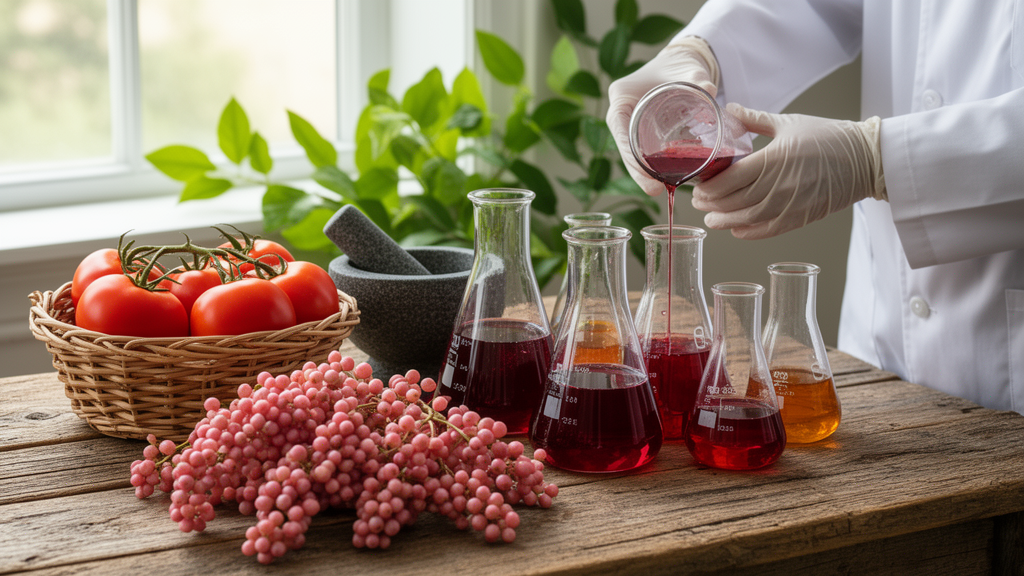
Food scientists have optimised a way to pull antioxidant phenolic compounds from a blend of two plants: the fruit of Schinus molle, the Peruvian peppertree, and the tomato. The study, published open access in Discover Food on 28 October 2026, reports that mixing the two plant materials in roughly equal parts boosted phenolic extraction by up to 14% compared with extracting either fruit on its own, an effect the authors attribute to complementary pH conditions and improved mass transfer within the mixture.
The research team, led by Eskedar Adane Fentie with colleagues including Reddy Prasad D.M. and Manjula Muthu Narayanan, set out to address a practical problem: synthetic antioxidants such as BHT and BHA face growing regulatory scrutiny over potential carcinogenic effects, creating demand for safer plant-derived alternatives. Although Schinus molle and tomato (Lycopersicon esculentum Mill.) had each been studied individually, no earlier work had examined their binary combination for synergistic phenolic extraction.
A face-centered central composite design explored three factors across 20 experimental runs: extraction temperature from 25 to 60 degrees Celsius, extraction time from 40 to 180 minutes, and the fruit-to-fruit ratio ranging from 0:100 to 100:0 by weight. The resulting model fit the data closely, with an R-squared value of 0.9896.
The model predicted a maximum yield of 50.07% at 55 degrees Celsius, an extraction time of 110 to 132 minutes, and a peppertree-to-tomato ratio of 47.6:52.4 by weight. When the team ran the experiment under those predicted optimum conditions, they measured an actual yield of 49.71% with a standard deviation of 0.10%, corresponding to a mean absolute percentage error of just 0.71%.
The optimised extract showed notable antioxidant and phytochemical content. Total phenolic content ranged from 2.4 to 154 milligrams of gallic acid equivalents per gram, and total flavonoid content ranged from 66 to 284 milligrams of quercetin equivalents per gram across the tested conditions.
The authors describe their work as a validated protocol for synergistic natural antioxidant extraction from the Schinus molle and tomato system. Because the study reports an optimised extraction procedure and in vitro antioxidant measurements rather than effects in humans or animals, the findings speak to process design and chemical characterisation, not clinical benefit. The article is being shared early as a citable, peer-reviewed accepted version carrying a permanent DOI, subject to further edits before the final Version of Record appears.
Subject of Research: Response surface optimisation of synergistic phenolic antioxidant extraction from a Schinus molle and tomato binary mixture
Article Title: Synergistic phenolic extraction from Schinus molle–tomato binary mixture with RSM optimisation and DPPH antioxidant activity
Article References: Fentie, E. A., D.M., R. P., Andualem, T. L., Yemata, T. A., & Narayanan, M. M. (2026). Synergistic phenolic extraction from Schinus molle–tomato binary mixture with RSM optimisation and DPPH antioxidant activity. Discover Food. https://doi.org/10.1007/s44187-026-01326-9
Image Credits: AI Generated
DOI: 10.1007/s44187-026-01326-9
Keywords: Schinus molle, tomato, phenolic extraction, response surface methodology, antioxidants, DPPH assay, total flavonoids, food science, natural preservatives, synergy, Synergistic, phenolic
News Source: Daisy Hatcher. (October 29, 2026). Peppertree and tomato team up for stronger antioxidant extraction. Scienmag.