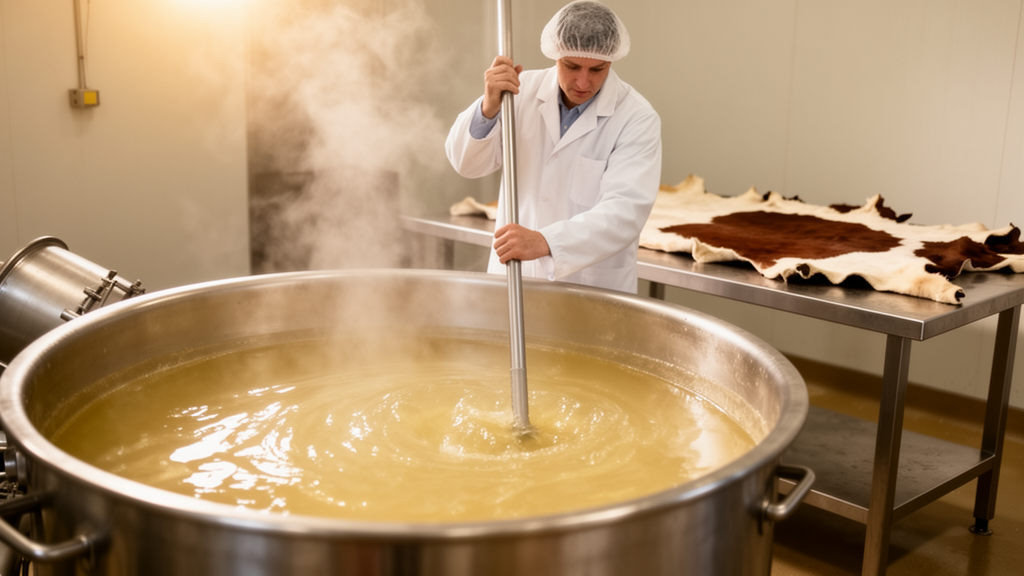
A research team in China now reports a redesigned enzymatic process that appears to break a long-standing trade-off in gelatin manufacturing: the tendency for higher extraction yields to come at the cost of weaker gels. In a study published in the journal Collagen and Leather, the researchers describe a “one-pot” biocatalytic method for producing gelatin from bovine hide that reached a gelatin yield of 92.7 percent while maintaining a gel strength of 210.0 Bloom grams, levels that satisfy the requirements of the Chinese industrial gelatin standard QB/T 1995–2024.
The work, led by Buqing Ye, Ziyu Wei, Chunxiao Zhang, Biyu Peng, and Lili Yan, was motivated by a persistent bottleneck in the field. Global gelatin consumption has consistently exceeded 400,000 tons annually and continues to grow, and the authors argue that improving the conversion efficiency of hides is important for sustainable livestock production and for meeting that demand. Conventional extraction routes, whether based on hot water, acid, or alkali, often require long processing times, multiple extraction cycles, high water consumption, and generate excessive salt, making them increasingly difficult to reconcile with modern manufacturing and environmental goals.
Enzymatic extraction has long been viewed as a gentler alternative. Proteases such as pepsin, alkaline protease, papain, bromelain, and actinidin can partially hydrolyze collagen under mild conditions with low water consumption and minimal environmental impact. But in practice, enzymatic gelatin has struggled with two linked problems: low yields and insufficient gel strength. The authors note that the highest gelatin yield previously reported for enzymatic methods was 23.5 percent, and that multiple extraction cycles were still needed to make good use of the hide. The root cause lies in collagen itself. The protein in hides has a highly organized, densely packed, multilayered structure that resists enzymatic attack, so proteases mostly act on the surface and on the non-helical terminal regions of collagen fibers, producing oligopeptides and amino acids rather than the high-molecular-weight chains that give gelatin its strength.
The team’s strategy attacked both sides of the problem at once. First, they used heat to deliberately denature the collagen before enzymatic hydrolysis. Collagen is relatively heat sensitive: under acidic conditions, once the temperature reaches roughly 40 degrees Celsius, its triple-helix structure begins to deteriorate. Heating disrupts the hydrogen bonds, hydrophobic interactions, and van der Waals forces that stabilize the protein’s three-dimensional conformation, loosening the molecular structure and exposing additional cleavage sites. This promotes what the authors call “endolytic” hydrolysis, in which enzymes can cut within the collagen chains rather than only at their ends. Second, they screened proteases for the right degree of bond specificity, aiming to avoid the excessive hydrolysis that shreds gelatin into weak, low-molecular-weight fragments.
That screening proved decisive. In tests on thermally denatured hide powder, neutral and alkaline proteases from various sources raised gelatin yields by more than 52.5 percent, but the resulting hydrolysates could not form a gel at the standard test concentration of 12.5 percent, and their viscosities were only 2.3 to 4.9 millipascal-seconds. At the other extreme, pepsin showed strong specificity, cleaving peptide bonds linked to hydrophobic residues such as phenylalanine and tyrosine, and produced gelatin with a high gel strength of about 278.7 Bloom grams but a yield of only about 9.7 percent. Several other acidic proteases with weak specificity drove yields as high as 96.4 percent yet destroyed the gel-forming capacity entirely. The sweet spot belonged to two acidic proteases, P-acid-2 and P-acid-3, which lifted yields to 51.9 to 59.6 percent while raising gel strength to 215.4 to 324.6 Bloom grams and viscosities to 6.5 to 6.6 millipascal-seconds. Because P-acid-2 gave the stronger gel, it was selected for further optimization.
Through single-factor experiments, the team then mapped how pH, temperature, reaction time, and enzyme dosage shaped both yield and quality. Dissolution of the denatured hide powder peaked at roughly 56.8 to 58.4 percent when the pH was held between 3.5 and 4.0, consistent with the acidic protease’s optimum near pH 3.5; above pH 4.0 the enzyme’s catalytic activity declined sharply and solubility fell rapidly. Temperature told a similar story of balance. Solubility stabilized at 94.0 to 95.7 percent once the temperature reached 45 degrees Celsius, but total soluble protein peaked near 40 degrees and then dropped as continued degradation produced low-molecular-weight peptides and amino acids. Holding the reaction at 35 to 40 degrees Celsius kept gel strength at or above 200.0 Bloom grams with viscosities of about 6.0 to 6.5 millipascal-seconds. Time mattered as well: hydrolysis beyond 8 hours accelerated the decline in gel strength and viscosity, because once much of the powder had dissolved, the enzyme began attacking the soluble gelatin itself. Enzyme dosage showed the same pattern, with gel strength collapsing to about 168.6 Bloom grams at 500 units per gram, so the team capped the dosage below 450 units per gram.
The optimized recipe, 40 degrees Celsius, pH 4.0, an acidic protease dosage of 350 units per gram, and constant-temperature stirring for 6 hours, was then validated at scale. In experiments simulating actual production conditions, 200 grams of delimed hide powder was rehydrated, thermally denatured at the boiling point, cooled to 40 degrees Celsius, and hydrolyzed in a 20-liter glass reactor. Across five consecutive batches, the average gelatin yield reached approximately 92.7 percent, significantly higher than in the earlier exploratory experiments, an improvement the authors attribute to mechanical stirring, which kept the hide powder suspended and improved contact between enzyme and collagen fibers. SDS-PAGE band profiles of the gelatin from the five batches were remarkably similar, indicating uniform molecular weight distribution and subunit composition from run to run.
Quality metrics were equally consistent. Across the five batches, gel strength measured 210.0 plus or minus 6.1 Bloom grams, viscosity 6.9 plus or minus 0.3 millipascal-seconds, ash content 2.1 plus or minus 0.3 percent, water-insoluble matter 0.15 plus or minus 0.03 percent, moisture 12.3 plus or minus 0.8 percent, and pH 6.4 plus or minus 0.2, all meeting the industrial gelatin standard. Functional properties were also in line with previously reported gelatins: an emulsification activity index of 8.9 square meters per gram, an emulsion stability index of 30.5 minutes, a foaming capacity of 53.1 percent, and foam stability of 79.6 percent. According to the authors, this demonstrates that the one-pot approach resolves the technical challenge of simultaneously increasing yield and gel strength in gelatin processing from bovine hide.
The environmental accounting may prove as consequential as the yield figures. By integrating acid washing, deacidification, gelatin extraction, and desalting into a single operation, the process eliminated repeated extraction, filtration, recombining of hydrolysates, and desalination steps. Compared with a conventional acidic process, the one-pot technology reduced total water consumption by approximately 78.9 percent, wastewater discharge by 100.0 percent, acid usage by 90.0 percent, and energy consumption during gelatin extraction by 28.6 percent, while cutting energy use in the gelatin drying stage by 63.5 percent. The production cycle shortened by 3 to 6 days, improving daily production efficiency. The authors position the method as technical support for the efficient utilization and green development of animal hide and skin resources, though the reported reductions come from the study’s own process comparisons, and broader adoption would depend on performance under full industrial conditions.
For a material as ubiquitous as gelatin, a process that delivers high yield, strong gels, and dramatically lower water, acid, and energy demands in a single vessel is a notable advance. Whether the chemistry survives the leap from a 20-liter reactor to factory scale remains the next test, but the study offers a concrete demonstration that careful enzyme selection, combined with deliberate thermal denaturation of collagen, can convert a stubborn raw material into high-quality gelatin with far less environmental cost than the traditional route.
Subject of Research: An enzymatic one-pot process for extracting high-yield, high-strength gelatin from acid-thermally denatured bovine hide collagen.
Article Title: Efficient and eco-friendly method of gelatin production from bovine hide by acid-thermal treatment and protease-aided process: one-pot biocatalysis approaches
Article References: Ye, B., Wei, Z., Zhang, C., Peng, B., & Yan, L. (2026). Efficient and eco-friendly method of gelatin production from bovine hide by acid-thermal treatment and protease-aided process: one-pot biocatalysis approaches. Collagen and Leather, 8(1), Article 36. https://doi.org/10.1186/s42825-026-00252-x
Image Credits: AI Generated
DOI: 10.1186/s42825-026-00252-x
Keywords: gelatin, bovine hide, collagen, enzymatic hydrolysis, acid protease, thermal denaturation, one-pot process, gel strength, Bloom strength, industrial gelatin, wastewater reduction, green manufacturing
News Source: Denise Maddox. (October 29, 2026). One-Pot Enzymatic Process Lifts Bovine Hide Gelatin Yield and Strength. Scienmag.