


The compound dissolves poorly in water, circulates badly, and at systemic doses can suppress the immune system. Their findings, published in the journal Collagen and Leather, describe a composite delivery system that preserved cartilage structure in the animals while showing no detectable toxicity in major organs.
The system, named RAPA@Lipo/rhCol III, was built in two stages. First, rapamycin was encapsulated in cationic liposomes made from hydrogenated soybean phosphatidylcholine, cholesterol, and stearylamine using a thin-film dispersion method. Transmission electron microscopy showed spherical vesicles with well-defined boundaries, and dynamic light scattering measured an average hydrodynamic diameter of 150.9 ± 3.1 nanometers with a polydispersity index of 0.128 ± 0.03. The zeta potential was strongly positive at +37.5 ± 0.6 millivolts, a property the researchers consider useful because the cartilage extracellular matrix carries negative charge, allowing electrostatic interactions that may help the particles stay in the joint.
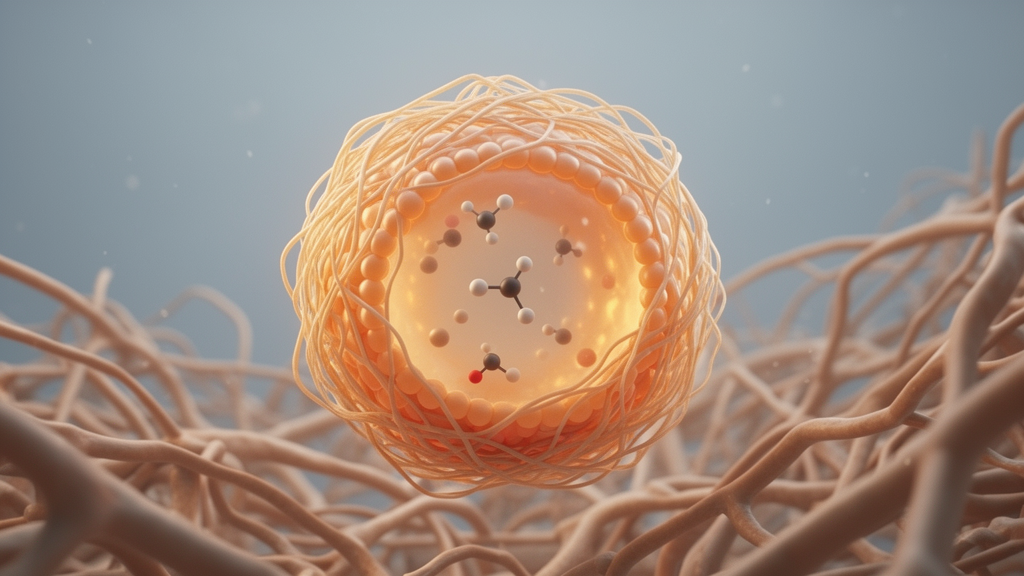
The second stage involved electrostatic self-assembly. Recombinant humanized type III collagen, produced by genetic engineering with a fully human sequence, is negatively charged and spontaneously adsorbed onto the positively charged liposome surface, forming core-shell structured hybrid nanoparticles. Confocal microscopy confirmed the coating: FITC-labeled collagen in green and Nile red-labeled liposomes in red produced coinciding fluorescence signals. Zeta potential measurements tracked the change, falling from roughly +38 millivolts for the unmodified liposomes to about +4 millivolts for the most heavily collagen-coated formulation, consistent with progressive surface coverage.
The collagen coating changed drug release behavior in a concentration-dependent way. Among three formulations tested at different mass ratios, the intermediate coating, designated RAPA@Lipo/rhCol III-5, showed the most pronounced sustained release, with cumulative rapamycin release significantly slower than the unmodified liposomes over a ten-day observation period in a phosphate buffer and ethanol mixture at 37 degrees Celsius. The highest collagen concentration did not further improve release and behaved similarly to the unmodified control. Encapsulation efficiency declined progressively as collagen concentration rose, from 82.77 percent down to 72.60 percent, which the authors attribute to transient disruption of the phospholipid bilayer during collagen adsorption. Both formulations remained physically stable over seven days of storage at 37 degrees Celsius, with no visible aggregation, although particle size increased gradually in proportion to collagen content, likely reflecting hydration and molecular rearrangement of the collagen layer.
In cell experiments, the team isolated primary chondrocytes from neonatal Sprague-Dawley rats and exposed them to hydrogen peroxide to simulate the oxidative stress characteristic of osteoarthritic tissue. Under these conditions, all treatment groups reduced chondrocyte death compared with untreated controls, but the composite system showed the strongest protective effect, with significantly fewer propidium iodide-positive cells in live/dead staining. CCK-8 assays over five days showed that the composite supported enhanced chondrocyte proliferation under both normal and oxidative stress conditions. Using the DCFH-DA fluorescent probe, the researchers found that both rapamycin liposomes and collagen alone reduced intracellular reactive oxygen species, but the composite achieved a significantly greater reduction than either single component, which the authors interpret as a synergistic antioxidant effect arising from complementary mechanisms: rapamycin-induced autophagy clearing oxidatively damaged components, and collagen stabilizing membranes and bolstering intrinsic cellular defenses.
Matrix synthesis followed a similar pattern. Toluidine blue staining and quantitative sulfated glycosaminoglycan normalized to DNA content showed that the composite group maintained the highest matrix synthesis per cell under oxidative stress, outperforming both single-component treatments. Gene expression analysis by reverse transcription quantitative PCR revealed that the composite and collagen groups upregulated type II collagen, the hallmark cartilage matrix protein, while the rapamycin liposomes and composite upregulated the autophagy-related genes LC3B and ATG5. The matrix-degrading enzyme MMP13 was most strongly downregulated in the composite group. Immunofluorescence staining corroborated these findings at the protein level, with the composite group showing the most intense LC3B puncta formation, an indicator of autophagic activity, alongside markedly reduced MMP13 signal.
The in vivo experiments used a chemically induced osteoarthritis model. Male Sprague-Dawley rats received an intra-articular injection of 2 milligrams of sodium monoiodoacetate into the right knee, a method that triggers progressive joint degeneration. After one week, the animals were divided into five groups and treated weekly for four weeks: an untreated control, a PBS vehicle group, and three treatment groups receiving rapamycin liposomes, collagen alone, or the composite. The animal protocol was approved by the Medical Ethics Committee of Sichuan University.
After four weeks of treatment, macroscopic examination and micro-computed tomography of the harvested knee joints showed clear differences between groups. The vehicle-treated animals developed the expected osteoarthritic pathology, including surface erosion, cartilage thinning, and substantial osteophyte formation with subchondral bone remodeling. Both monotherapy groups showed moderate reduction in these pathological bone changes, but the composite treatment achieved the most pronounced preservation of normal joint architecture, minimizing osteophyte development and maintaining subchondral bone structure close to healthy controls. Quantitative analysis confirmed that composite treatment reduced pathological osteophyte volume and attenuated the increase in subchondral bone volume fraction, consistent with mitigated subchondral bone sclerosis.
Histology reinforced the structural findings. Sections stained with hematoxylin and eosin, toluidine blue, and safranin O-fast green showed that vehicle-treated joints exhibited surface fibrillation, chondrocyte cluster formation, and markedly diminished matrix staining, while composite-treated joints retained smooth cartilage surfaces, organized cellular arrangement, and matrix staining intensity approaching normal levels. Immunohistochemistry revealed the characteristic osteoarthritic shift in the vehicle, liposome, and collagen groups, with reduced type II collagen and elevated type I collagen and MMP13, indicating cartilage dedifferentiation and matrix degradation. The composite group maintained type II collagen expression comparable to healthy controls while suppressing the pathological overexpression of type I collagen and MMP13. Safety assessment through histological examination of heart, liver, spleen, lungs, and kidneys showed normal tissue architecture across all treatment groups, with no inflammatory infiltration, necrosis, or fibrosis.
The authors frame the work as an integrated disease-modulation and tissue-repair strategy, in which pharmacological intervention through sustained mTOR inhibition is combined with biomaterial-mediated signaling from the collagen coating. Rapamycin, a specific inhibitor of the mTOR pathway, is thought to act in osteoarthritis by restoring autophagic flux, suppressing inflammation, and delaying chondrocyte senescence, while recombinant humanized type III collagen provides bioactive cues that support cell adhesion, proliferation, and matrix synthesis. It is important to note the scope of these results: they come from rat chondrocytes in culture and a small animal model of chemically induced osteoarthritis, with three rats per group in the in vivo experiment, and the humanized collagen was tested in rats rather than patients. Osteoarthritis affects hundreds of millions of people worldwide and current treatment remains largely limited to symptomatic relief or end-stage joint replacement, so the demand for disease-modifying approaches is substantial.
Subject of Research: A rapamycin-loaded, collagen-coated liposomal drug delivery system for osteoarthritis treatment tested in rat chondrocytes and a rat osteoarthritis model.
Article Title: Recombinant humanized collagen type Ⅲ-modified rapamycin liposomes for promoting osteoarthritis repair
Article References: Liu, C., Dai, W., Zhao, X., Mao, S., Guo, L., Fan, Y., & Zhang, X. (2026). Recombinant humanized collagen type Ⅲ-modified rapamycin liposomes for promoting osteoarthritis repair. Collagen and Leather, 8(1), Article 32. https://doi.org/10.1186/s42825-026-00257-6
Image Credits: AI Generated
DOI: 10.1186/s42825-026-00257-6
Keywords: osteoarthritis, rapamycin, liposomes, recombinant humanized collagen type III, mTOR inhibition, autophagy, chondrocytes, cartilage repair, drug delivery, nanoparticles, rat model, micro-CT
News Source: Denise Maddox. (October 29, 2026). Collagen-Coated Rapamycin Liposomes Show Cartilage Repair Promise in Rats. Scienmag.



