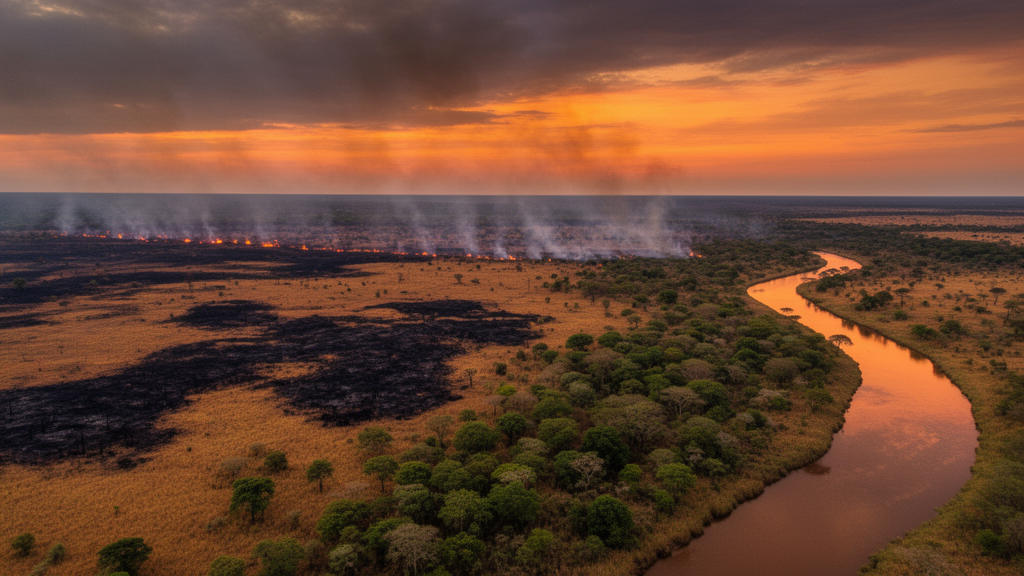
Fire comes back to most of Mozambique’s Niassa Special Reserve so quickly that the interval between blazes is often just a single year, according to a new survival analysis of twelve years of satellite observations. The study, published in Fire Ecology, reconstructed annual fire histories from 2013 to 2024 using Landsat-derived burned-area maps and found that recurrent burning dominates the landscape: 69.6 percent of the reserve burned more than six times during the twelve-year window. Only 2.6 percent of the reserve escaped fire entirely, and areas burned just once or twice covered a mere 4.1 percent of the terrain.
The Niassa Special Reserve covers roughly 42,200 square kilometres across Niassa and Cabo Delgado provinces in northern Mozambique, forming part of the transboundary Selous–Niassa ecosystem with Tanzania. It is one of the largest protected areas in Africa and contains an extensive mosaic of dry and moist miombo woodlands, the vast tropical dry forest formation dominated by trees of the genera Brachystegia, Julbernardia and Isoberlinia. The climate is tropical dry sub-humid, with rains from November to April and a dry season from May to October, and annual rainfall ranging from about 800 millimetres in the east to 1,200 millimetres in the west.
To track fire recurrence, the researchers generated a regular grid of sampling points spaced one kilometre apart across the reserve, yielding 38,107 locations. For each point and each year, they recorded whether the underlying 30-metre pixel was classified as burned or unburned, producing a binary fire history for every location. Fire-return intervals were then reconstructed as the number of years between consecutive fire detections. Because the observation window is finite, not all intervals could be fully observed: the dataset comprised 263,994 exact intervals between two observed fires, 8,199 left-censored intervals that began before the record started, and 16,323 right-censored intervals extending beyond its end.
In this context, a location is considered to have survived while it remains unburned after a previous fire, and a subsequent fire terminates that fire-free period. The hazard function describes the conditional probability that a still-unburned location will burn in the next year, given how long it has already gone without fire. The researchers compared discrete exponential, discrete gamma and discrete Weibull models using the Akaike Information Criterion, and the discrete Weibull model provided the best fit for every vegetation type retained in the analysis.
The results reveal a landscape where reburning is concentrated almost immediately after previous fires. Hazard functions peaked at one-year intervals and declined thereafter, meaning the probability of a new fire was highest in the first year after a burn and fell as time elapsed. Median fire-return intervals were approximately one year across most major vegetation types, and the modal interval was one year in nearly all of them. Probabilities for intervals longer than five years were consistently low, indicating that long fire-free periods are rare throughout the reserve.
Vegetation type emerged as the strongest source of variation. Dry lowland miombo had the shortest intervals, the highest annual burned area and the lowest fire-free persistence, while moist escarpment miombo showed longer intervals, less annual burning and higher probabilities of remaining unburned. The two dominant vegetation types, Lugenda Lowland Dry Miombo and Matondavela Moist Miombo, together covered about 90.7 percent of the study area and showed fire rotation periods of 1.34 and 1.73 years respectively, with 74.4 percent and 58.0 percent of their area burning each year. Lichinga Escarpment Moist Miombo, by contrast, representing 4.2 percent of the study area, had a fire rotation period of 3.87 years and an annual burned area of just 25.8 percent, with a median fire-return interval of two years.
Statistical comparisons using Kaplan–Meier fire-free-persistence curves and weighted log-rank tests confirmed that these differences were significant after correction for multiple comparisons. Lichinga Escarpment Moist Miombo formed a clearly distinct group with consistently higher survival probabilities across all time steps, while Lugenda Lowland Dry Miombo represented the opposite extreme with the lowest persistence and a rapid decline in the first years after fire. Mueda Mixed Dry Miombo and Makonde Bamboo Thicket grouped together with low persistence and frequent burning, and Manda Moist Miombo and Matondavela Moist Miombo occupied an intermediate position. Most of the separation among groups occurred within the first years after fire, after which persistence converged towards low values everywhere.
The declining hazard pattern, while seemingly counterintuitive given that fuels accumulate over time, has a plausible statistical explanation. Hazard functions estimated from population-level data reflect not only fuel build-up within individual sites but also heterogeneity among sites, a phenomenon known as frailty. Highly flammable locations tend to burn soon after a previous fire and are progressively removed from the pool of unburned sites, so as time passes the remaining population becomes dominated by locations that are intrinsically less flammable because of local vegetation structure, fuel continuity, moisture, topography or ignition exposure. The authors suggest that in Niassa, ignition exposure may also relate to human burning practices, since areas repeatedly used for burning burn early and often, while wetter, rockier or less accessible landscapes persist longer without fire.
The study’s authors note that fires are deliberately set across many African savannas for grazing management, hunting, gathering of savanna products and preventing damaging late-season fires, and that West African studies have shown such practices can generate highly regular seasonal and spatial fire mosaics. Given the regularity and spatial extent of burning in Niassa, the pattern likely reflects a strongly human-shaped fire regime maintained by the interaction between rapidly recovering grassy fuels, frequent ignitions and heterogeneous landscape conditions. The researchers also caution that their annual-resolution analysis does not distinguish between early and late dry-season fires, which can have different ecological effects even when they contribute similarly to fire-frequency metrics.
The findings carry weight for conservation because many characteristic miombo tree species, although capable of resprouting after fire, may need fire-free intervals longer than those commonly observed to recruit into larger size classes. The authors suggest that the longer intervals found in moist and escarpment formations may be disproportionately important, potentially providing opportunities for tree recruitment and the persistence of less fire-tolerant species, and that maintaining a mosaic of fire frequencies across the landscape may be more beneficial than uniformly suppressing or promoting burning. Persistent short intervals, they warn, may lead to structural simplification and long-term shifts in species composition, reinforcing fire-trap dynamics in which juvenile trees are repeatedly top-killed before escaping the flame zone. The results support fire management strategies that reduce the dominance of recurrent short intervals while preserving the spatial heterogeneity needed for regeneration and long-term resilience in this miombo landscape.
Subject of Research: Fire-return intervals and fire recurrence patterns across vegetation types in Mozambique's Niassa Special Reserve
Article Title: Fire return intervals are very short at Niassa Special Reserve, Mozambique, especially in dry miombo woodlands—a survival analysis
Article References: Dias, C. R. G., Silva, J. M. N., Ribeiro, N. S., & Pereira, J. M. C. (2026). Fire return intervals are very short at Niassa Special Reserve, Mozambique, especially in dry miombo woodlands—a survival analysis. Fire Ecology, 22(1), Article 157. https://doi.org/10.1186/s42408-026-00598-x
Image Credits: AI Generated
DOI: 10.1186/s42408-026-00598-x
Keywords: fire ecology, miombo woodlands, Niassa Special Reserve, Mozambique, fire-return intervals, survival analysis, Landsat, burned area, savanna, hazard function, fire management, conservation
News Source: Gavin Prescott. (October 29, 2026). Fires Return Every Year in Mozambique’s Niassa Reserve, Satellite Record Shows. Scienmag.