

• HOME
  • NEWS
  • EXPLORE
    • CAREER
      • Companies
      • Jobs
    • EVENTS
    • iGEM
      • News
      • Team
    • PHOTOS
    • VIDEO
    • WIKI
  • BLOG
  • COMMUNITY
    • FACEBOOK
    • INSTAGRAM
    • TWITTER
Saturday, October 31, 2026
BIOENGINEER.ORG
No Result
View All Result
  • Login
  • HOME
  • NEWS
  • EXPLORE
    • CAREER
      • Companies
      • Jobs
        • Lecturer
        • PhD Studentship
        • Postdoc
        • Research Assistant
    • EVENTS
    • iGEM
      • News
      • Team
    • PHOTOS
    • VIDEO
    • WIKI
  • BLOG
  • COMMUNITY
    • FACEBOOK
    • INSTAGRAM
    • TWITTER
No Result
View All Result
Bioengineer.org
No Result
View All Result
Home NEWS Science News Biology

CRISPR centromere editing reshapes wheat chromosomes

by
October 28, 2026
in Biology
Reading Time: 2 mins read
0
CRISPR centromere editing reshapes wheat chromosomes

CRISPR centromere editing reshapes wheat chromosomes

Share on FacebookShare on TwitterShare on LinkedinShare on RedditShare on Telegram

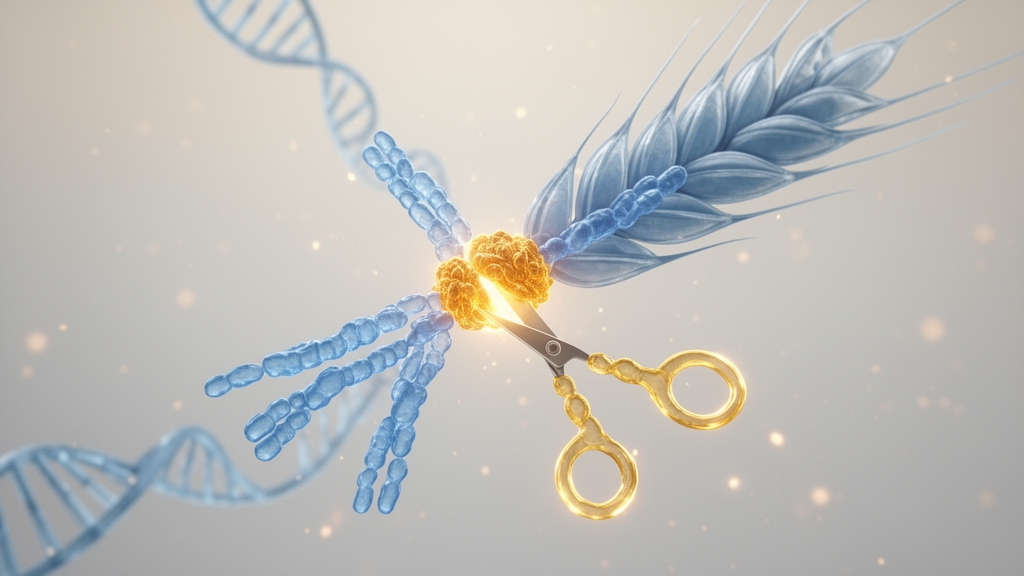
Researchers have developed a CRISPR–Cas9 strategy that restructures the karyotype of hexaploid wheat by targeting its centromeres, the regions that anchor chromosomes during cell division. The approach, called centromere editing-mediated chromosomal variation, directs the gene-editing machinery at abundant centromeric retrotransposons, repetitive sequences that populate the centromeres of wheat’s large polyploid genome. Because these repeats occur across many chromosomes at once, a single editing step can cleave several chromosomes simultaneously, something that has been difficult to achieve in genomes spanning gigabases of DNA.

The consequences of this genome-wide cleavage were extensive. In a single generation, the method generated diverse karyotypic variants and reconfigured up to 11 chromosomes at once. Among the rearrangements were widespread reciprocal translocations, exchanges of chromosome segments between different chromosomes. One line carried six such events involving seven chromosomes, an unusually extensive reshuffling for a single engineered plant.

A key question for any chromosome-engineering scheme is whether the new arrangements can survive meiosis and be passed on. The newly formed translocation chromosomes underwent centromere remodelling, a process that appears to underpin their relatively stable maintenance and heritable transmission through generations. This suggests that centromeres are not merely targets for breakage but active sites where redesigned chromosomes can be consolidated into inheritable new karyotypes.

The team also examined the functional consequences of balanced translocations, in which no genetic material is lost overall. These rearrangements imposed minimal transcriptional perturbation, and plants carrying them maintained normal growth. That combination, extensive chromosomal restructuring with minimal transcriptional perturbation and normal growth, is what makes the strategy attractive for breeding, where engineering karyotypes could expand the genetic and breeding potential of crops.

The authors position centromeres as effective sites for chromosome engineering breeding and describe the work as a scalable framework for karyotype redesign in polyploid crops.

Subject of Research: Centromere-targeted CRISPR engineering of wheat karyotypes

Article Title: Rewriting wheat karyotypes through centromere-targeted chromosome engineering

Article References: Zhou, X., Chen, Y., Li, C., Teng, W., Cui, Y., Tan, X., Hu, M., Zhou, Y., Xie, X., Guo, W., Yan, W., Sun, Q., Ni, Z., Wang, Y., Su, H., & Zong, Y. (2026). Rewriting wheat karyotypes through centromere-targeted chromosome engineering. Nature Plants. https://doi.org/10.1038/s41477-026-02441-2

Image Credits: AI Generated

DOI: 10.1038/s41477-026-02441-2

Keywords: wheat, centromere, CRISPR-Cas9, chromosome engineering, karyotype, reciprocal translocation, polyploid crops, retrotransposons, chromosome remodelling, plant breeding, Rewriting, karyotypes

News Source: Alan Morgan. (October 28, 2026). CRISPR centromere editing reshapes wheat chromosomes. Scienmag.


Tags: centromerechromosome engineeringchromosome remodellingCRISPR-Cas9karyotypekaryotypesplant breedingpolyploid cropsreciprocal translocationretrotransposonsRewritingwheat
Share12Tweet7Share2ShareShareShare1

Related Posts

Microbial Sources and Stress Shape the Hidden Endophytes of an Invasive Plant

Microbial Sources and Stress Shape the Hidden Endophytes of an Invasive Plant

October 30, 2026
Firebreaks Leave Lasting Scars in Grasslands While Wildfire Heals Fast

Firebreaks Leave Lasting Scars in Grasslands While Wildfire Heals Fast

October 30, 2026

Hidden Peptides in Non-Coding RNAs Reshape Cardiovascular Biology

October 30, 2026

Phage K Holin’s C-Terminal Region Shapes Antibacterial Activity, Study Finds

October 30, 2026

POPULAR NEWS

  • Microbial Sources and Stress Shape the Hidden Endophytes of an Invasive Plant

    Microbial Sources and Stress Shape the Hidden Endophytes of an Invasive Plant

    29 shares
    Share 12 Tweet 7
  • Firebreaks Leave Lasting Scars in Grasslands While Wildfire Heals Fast

    29 shares
    Share 12 Tweet 7
  • ZNF207 shields glutamine transporter ASCT2 from degradation to fuel liver cancer growth

    29 shares
    Share 12 Tweet 7
  • Systematic review maps sustainability tensions in offshore wind development

    29 shares
    Share 12 Tweet 7

About

We bring you the latest biotechnology news from best research centers and universities around the world. Check our website.

Follow us

Recent News

Microbial Sources and Stress Shape the Hidden Endophytes of an Invasive Plant

Firebreaks Leave Lasting Scars in Grasslands While Wildfire Heals Fast

ZNF207 shields glutamine transporter ASCT2 from degradation to fuel liver cancer growth

Subscribe to Blog via Email

Enter your email address to subscribe to this blog and receive notifications of new posts by email.

Join 86 other subscribers
  • Contact Us

Bioengineer.org © Copyright 2023 All Rights Reserved.

Welcome Back!

Login to your account below

Forgotten Password?

Retrieve your password

Please enter your username or email address to reset your password.

Log In
No Result
View All Result
  • Homepages
    • Home Page 1
    • Home Page 2
  • News
  • National
  • Business
  • Health
  • Lifestyle
  • Science

Bioengineer.org © Copyright 2023 All Rights Reserved.
