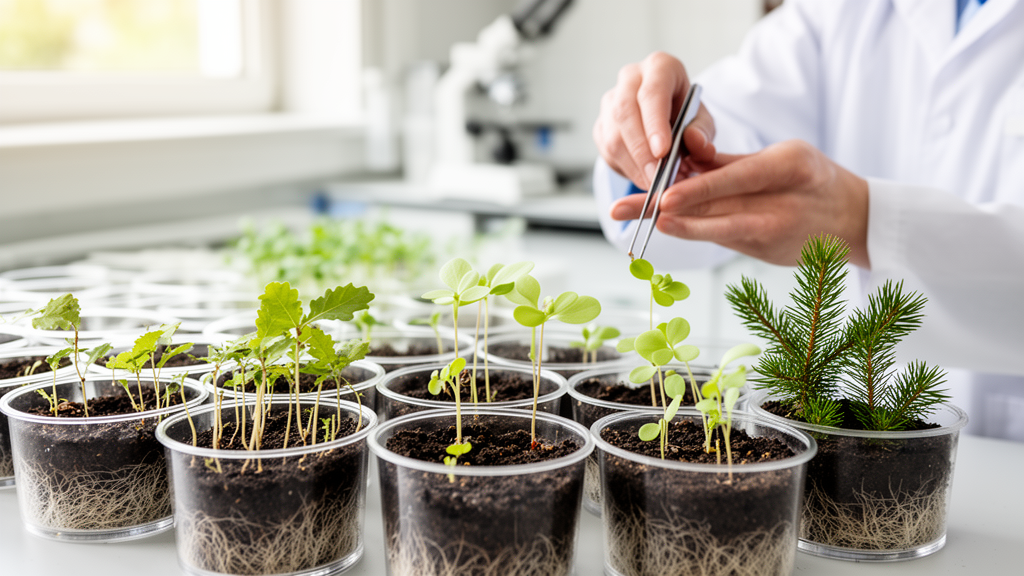
A team of European researchers has released OptGERM, an open-access database documenting 15,774 individual phenotypic trait records from controlled translocation experiments on seeds of six widespread European tree species. The dataset, described in the journal Annals of Forest Science, covers silver fir (Abies alba), sycamore maple (Acer pseudoplatanus), European beech (Fagus sylvatica), sessile oak (Quercus petraea), downy oak (Quercus pubescens) and cork oak (Quercus suber). Seeds were collected between 2021 and 2024 from 43 populations spanning the distribution ranges of the species, with each population sampled from 8 to 20 mother trees. The authors present the resource as a way to inform ecological and evolutionary research on the earliest, and often most climate-sensitive, stages of a tree’s life.
The motivation behind the database lies in a persistent gap in forest science. Tree populations are known to show local adaptation and phenotypic plasticity across their ranges, and sensitivity to warming can change across a tree’s life stages. Yet the earliest life stages, germination and seedling establishment, remain poorly characterized even though they represent critical bottlenecks for forest regeneration and are considered particularly vulnerable to climate change. Germination is the first interaction between a plant and its environment, and it can cascade into later fitness-related traits such as seedling growth and survival, mediated in part by seed reserves and phenology. By capturing these stages experimentally, the creators of OptGERM aim to give researchers a standardized window into processes that are difficult to observe in the wild.
The experimental design is unusually detailed. Seeds were collected across each species’ range, with deliberate effort to represent all phylogenetic groups within species as well as marginal and core populations. Collection years spanned 2021 to 2024 depending on seed availability. Mother tree identity was recorded for 21 of the 43 populations, while in the remaining cases individual collections were bulked per population. Storage protocols differed by seed type: experiments on recalcitrant Quercus seeds began immediately after collection, pseudo-recalcitrant seeds of beech and sycamore maple were stored for at most three months at 4 °C, and orthodox silver fir seeds were kept at −5 °C for four months, so that populations within a species received similar pre-experiment treatment.
All germination experiments took place at INRAE Bordeaux under identical laboratory conditions. Seed mass and water content were measured before any treatment. For the three species with dormant seeds, silver fir, sycamore maple and beech, each population seedlot was randomly split in two: one group received cold, moist stratification at 4 °C for three to six weeks depending on species, while the other was sown directly as a non-stratified control. Seeds were germinated in growing chambers in nursery trays with substrates tailored to each species, from a peat-and-sand mix for fir to a universal substrate blended with perlite for downy oak.
The climatic chambers were set at 15 °C, 20 °C and 25 °C, designed to simulate at least a 5 °C increase relative to each seed origin. Relative humidity was held at 75 percent, photosynthetic photon flux density at 100 µmol/m²/s, and a 13:11 hour light/dark photoperiod was applied to mimic springtime germination conditions, with silver fir given a longer 16:8 photoperiod because it germinates later in spring. During dark phases, chamber temperatures were reduced by 8 °C for fir and 5 °C for the other species. Seeds were randomly positioned within each chamber, watered three days per week, and monitored for germination and first leaf emergence three days per week for five months. Post-germination traits were measured once, between one and four months after first leaf emergence, depending on the species.
The trait list is broad. Seed traits include mass and water content, measured per mother tree where available or per population where seeds were bulked, with water content determined after drying seeds at 70 °C until weight stabilized for two days. For cork oak, the circumference or diameter at breast height of mother trees was also recorded. Germination traits cover germination status, timing and stratification status, monitored three days per week. First phenology traits include stem height at first leaf emergence, a trait the authors highlight as important for seedling competition and establishment. Post-germination measurements include stem height and diameter, root collar diameter, leaf counts and leaf area, aboveground and belowground biomass dried at 60 °C, specific leaf area, the root-shoot ratio, and survival at the end of the experiment.
Some measurements went further. Within the chambers, the team used a multi-pigment meter to record chlorophyll, flavonol, anthocyanin and NFI contents on a single fully developed, light-exposed leaf. For cork oak and silver fir, roots were scanned before drying and root length was processed with RhizoVision Explorer software. When seedlings produced more than one stem or main root, each was measured and ranked by length, with the longest designated as the primary measurement. The result is a dataset that links individual seeds, through unique identifiers, to their germination behavior and subsequent seedling development.
Quality control was a central concern. Four researchers checked the database for consistency at multiple stages, with all records initially taken on paper and digitized within the same week, and transcription errors systematically verified independently. Once data collection for a species was complete, the dataset was inspected for outliers using visual checks in R, with impossible or biologically unrealistic values identified against published ranges and expert knowledge. Suspected errors were corrected by consulting original records where possible, for example measurements recorded in centimeters instead of millimeters, and unresolvable anomalies were excluded. Outliers were not automatically removed; each was checked to determine whether it reflected a recording error or a biologically plausible observation. Trait distributions were also examined by population, site, species and temperature treatment using histograms, boxplots and summary statistics.
The database is already yielding findings. Cork oak shows a thermal germination cline, with populations from drier and warmer environments germinating at higher rates, and seedlings from those populations display a more acquisitive strategy, with higher water and carbon uptake capacities that appear essential for surviving their first summer. For the dormant-seeded species, comparative germination data under stratified and non-stratified conditions allow identification of populations at risk of reduced germination when dormancy-breaking requirements are not met, and recent analyses suggest stratification enhances seedling fitness in silver fir, sycamore maple and beech depending on population origin. The authors also note that germination timing appears to be advancing in response to warming, which could expose seedlings to early-season drought even as late germination helps them avoid late frosts.
The team is candid about limits. Traits in OptGERM reflect population responses under experimental warming only, and results may differ under natural conditions. The design ensured optimal water availability, which reduced the expected root investment of warm sessile oak populations, and irradiance levels were relatively low for light-demanding species such as the oaks. Post-germination traits were also measured at different months across species, a caveat for multi-species comparisons. The database is available on Zenodo as two csv files with accompanying metadata, linked by a provenance identifier connecting each population’s environmental and geographic characteristics to its trait measurements. As part of the Horizon Europe OptFORESTS project, the nursery-monitored seedlots have now been planted in common gardens across Europe, offering a way to track how these early-life trait patterns carry through a tree’s life cycle.
Subject of Research: A database of germination and early seedling development traits from translocation experiments on six European tree species
Article Title: OptGERM: a comprehensive database of within and among species germination and early seedling development for six European tree species
Article References: Benito Garzón, M., Agro, M., Vicente, E., Carme, M., Dencausse, B., Kohler, A., Alexandru, A.-M., Avanzi, C., Bagnoli, F., Belovarska, M., Dovč, N., Fady, B., González-Martínez, S. C., Hansen, J. K., Kravanja, M., Kroon, J., Lario, F., Marchi, M., Mihai, G., … Westergren, M. (2026). OptGERM: a comprehensive database of within and among species germination and early seedling development for six European tree species. Annals of Forest Science, 83(1), Article 47. https://doi.org/10.1186/s13595-026-01368-0
Image Credits: AI Generated
DOI: 10.1186/s13595-026-01368-0
Keywords: OptGERM, germination, seedlings, forest regeneration, climate warming, tree populations, seed dormancy, stratification, phenotypic traits, European trees, open-access database, seedling fitness
News Source: Alan Morgan. (October 28, 2026). New database tracks germination and early seedling traits of six European trees. Scienmag.