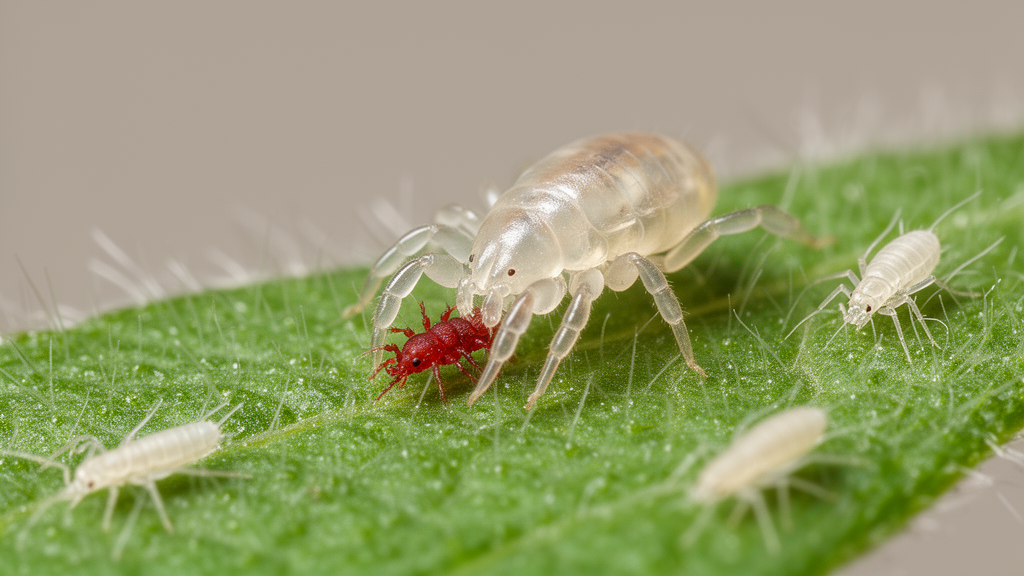
The predatory mite Neoseiulus californicus, a workhorse of augmentative biological control programs worldwide, is markedly better at hunting two-spotted spider mites than western flower thrips, according to a new laboratory study published in the Egyptian Journal of Biological Pest Control. The research, conducted at the Institute of Plant Protection, Chinese Academy of Agricultural Sciences in Beijing, systematically quantified how efficiently this generalist predator consumes and reproduces in response to two of the world’s most damaging agricultural pests, and the results point to a clear trophic mismatch between the mite and thrips prey.
The study, led by Atef Mahmoud Mohamed Sayed with Xuenong Xu and Mohammad Ali Abdelhady, exposed mated adult female N. californicus to eggs and first-instar larvae of both pest species across nine prey densities, from 3 to 50 individuals per arena, in small escape-proof chambers containing kidney bean leaf discs. The predators were starved for 24 hours before testing to standardize hunger, and each density treatment was replicated twenty times, with predator-free control arenas used to account for natural mortality. Consumption was recorded after 24 hours, and ambiguous cases such as partially consumed or vanished prey accounted for less than 2 percent of observations.
Across every prey type and stage tested, the predator displayed a Type II functional response, the hyperbolic pattern in which consumption rises with prey density but decelerates as handling time becomes the limiting factor. The fitted Holling disc equation models explained the data exceptionally well, with coefficients of determination ranging from 0.955 to 0.994. This response type suggests the mite can suppress low to moderate pest populations effectively, but its per-capita impact weakens as prey become abundant.
The starkest difference between the two prey species lay in handling time, the interval a predator spends subduing and consuming a single prey item. Spider mite prey required only 3.7 to 3.9 minutes each, while thrips took 29.5 to 34.7 minutes, a 7.6 to 9.3-fold difference that was highly significant statistically. This disparity translated directly into theoretical maximum predation rates: at saturation, a single female could theoretically consume 370 to 385 spider mites per day, but only 41 to 49 thrips. Attack rates, by contrast, were only modestly higher for spider mites, 0.72 to 0.76 per day versus 0.45 to 0.59 per day for thrips, and this difference did not reach statistical significance, indicating that encounter rates were broadly comparable and that handling efficiency was the decisive factor.
Notably, prey life stage mattered little. Eggs and first-instar larvae of each species showed no statistically significant differences in attack rate, handling time, or maximum predation rate, suggesting the predator employs foraging tactics that work equally well against sessile and mobile stages within each prey species. At the highest density tested, 50 prey per arena, the consumption gap widened to 63.4 percent in favor of spider mites, and the advantage grew progressively with density, consistent with a significant species-by-density interaction in the statistical analysis.
Predation efficiency, the percentage of available prey actually consumed, declined with increasing density for all prey types, as expected under a Type II response, but the decline was steeper and overall levels lower for thrips. At moderate densities of 15 to 30 prey per arena, which the authors describe as typical of biological control interventions, efficiency averaged 72.4 percent for spider mites versus 53.5 percent for thrips, a difference the authors estimate translates to roughly 18 spider mites consumed per day versus about 12 thrips at moderate infestations.
The numerical response, measured as egg production over a ten-day observation period with prey replenished daily, told a consistent story. Oviposition rose with prey density for both species, but females laying eggs on a diet of spider mites produced 1.39 times more eggs overall, averaging 2.50 eggs per female per day compared with 1.80 on thrips. On spider mites, the relationship followed a decelerating polynomial that peaked at a predicted 3.55 eggs per day at a density of about 41 prey, while on thrips the response was logarithmic, rising continuously but without reaching a clear plateau within the tested range. A minimum threshold of one egg per female per day, considered necessary for positive population growth, was met at all tested spider mite densities but only at five or more thrips per arena, hinting that predator populations might decline when thrips are very scarce.
Experiments on mutual interference added a cautionary note for release planning. When multiple females shared an arena with 50 spider mite larvae, per-capita consumption fell from 25.6 prey for a lone female to 9.9 prey when nine females were crowded together, a 61 percent drop in individual efficiency even as total consumption rose 3.5-fold. This inverse density dependence, likely driven by physical encounters between foraging females, means that piling on more predators yields diminishing returns and that moderate, possibly sequential, releases may be more economical than single high-density applications.
Synthesizing consumption and reproduction into an integrated performance index, the authors found the metric was 2.89 times higher for spider mites than for thrips. Polynomial fits to the index identified optimal deployment densities of 18.7 prey per arena for spider mites and 22.3 for thrips, with peak performance occurring at intermediate densities of 15 to 25 prey per sampling unit for both species. From these parameters, the authors propose predator-to-prey ratios of roughly 1:6 to 1:10 as a theoretical baseline for spider mite management, while stressing that these figures are a starting point for hypothesis generation and that field validation is required before any operational application.
The authors are candid about the study’s limitations. The 25-millimeter leaf-disc arenas lack the spatial complexity, trichome barriers, and prey refugia of real crops, likely inflating predation estimates. The no-choice design excluded prey switching and interactions with other natural enemies, only eggs and first instars were tested, and the linearized model fitting, while standard in older work, introduces statistical bias compared with modern nonlinear approaches. The mechanistic explanation for the handling-time gap, thinner cuticles and richer nutritional content in spider mites versus heavily sclerotized, actively defending thrips larvae, remains speculative without biochemical profiling. Still, the laboratory-derived parameters offer a quantitative foundation for designing greenhouse and field studies, and the authors conclude that for thrips management, N. californicus should be integrated with complementary approaches such as specialist predators or entomopathogenic fungi rather than deployed alone.
Subject of Research: Laboratory comparison of the functional and numerical responses of the predatory mite Neoseiulus californicus to two-spotted spider mites and western flower thrips.
Article Title: Functional and numerical response comparison of Neoseiulus californicus (McGregor) (Acari: Phytoseiidae) to Frankliniella occidentalis (Pergande) and Tetranychus urticae Koch
Article References: Sayed, A. M. M., Xu, X., & Abdelhady, M. A. (2026). Functional and numerical response comparison of Neoseiulus californicus (McGregor) (Acari: Phytoseiidae) to Frankliniella occidentalis (Pergande) and Tetranychus urticae Koch. Egyptian Journal of Biological Pest Control, 36(1), Article 22. https://doi.org/10.1186/s41938-026-00899-y
Image Credits: AI Generated
DOI: 10.1186/s41938-026-00899-y
Keywords: Neoseiulus californicus, Tetranychus urticae, Frankliniella occidentalis, functional response, numerical response, biological control, predatory mites, handling time, oviposition, integrated pest management, Type II response, laboratory study
News Source: Alan Morgan. (October 29, 2026). Predatory Mite Excels Against Spider Mites but Struggles with Thrips in Lab Tests. Scienmag.