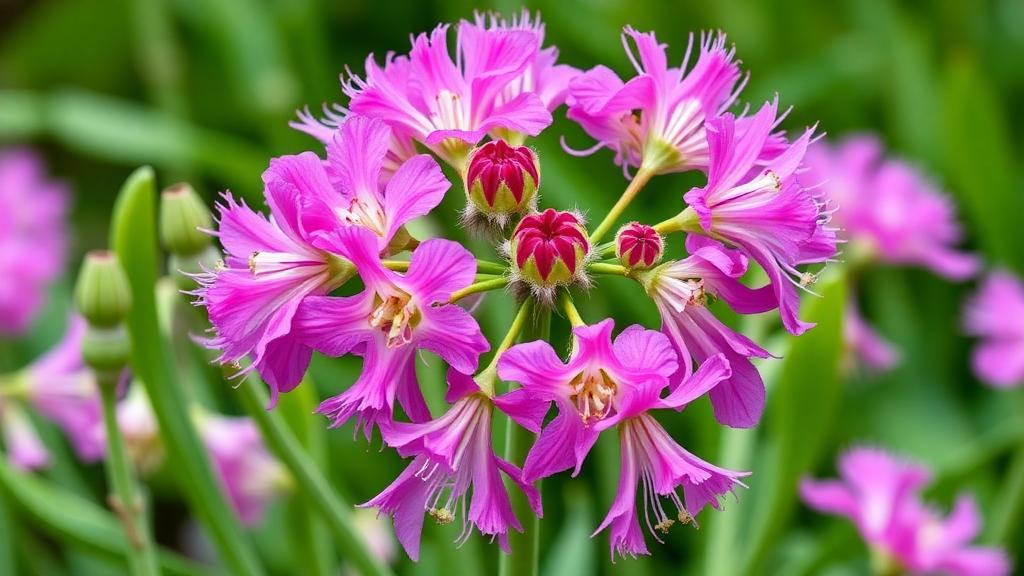
Carnations are among the world’s most important cut flowers, but in Taiwan their commercial cultivation runs into a stubborn obstacle: summer heat. High temperatures during the hottest months significantly reduce both the yield and the quality of commercial carnation cultivars, and some varieties show poor growth altogether under the conditions of a Taiwanese summer. A new open-access study published in Botanical Studies on 3 December 2025 tackles this problem not in the field but at the level of DNA, using two complementary molecular marker systems to map the genetic relationships among native Dianthus species, commercial cultivars, and laboratory-made hybrids.
The logic behind the study rests on a well-established principle in ornamental plant breeding: the success of interspecific or intergeneric hybridization depends heavily on genetic distance between the parents. Cross two species that are too distantly related, and the cross may fail; cross close relatives, and compatibility improves. Traditionally, Dianthus species were classified by visible traits such as plant size, leaf shape, and calyx shape, but the authors note that this morphological approach leads to uncertain identification, particularly because leaf dimensions in Dianthus can shift with environmental conditions. Molecular markers, by contrast, are relatively stable and can reduce or avoid classification confusion caused by environmental and phenotypic changes, making them valuable for verifying species origins and genetic traits.
Taiwan is home to several native Dianthus species that could serve as donors of valuable traits. According to the study, Dianthus pygmaeus and D. seisuimontanus grow at altitudes above 2000 meters, while D. palinensis, an unknown Dianthus species from Mt. Da-du, and another unknown species from Miaoli County are found in low-altitude areas. Dianthus superbus (Taiwan) L. var. longicalycinus was found on Matsu Island, a relatively isolated and closed ecosystem. Among these, D. palinensis stands out for breeding purposes: it can adapt to hot and humid climates, exhibits disease resistance traits, grows in northern Taiwan, and can flower year-round on flat ground. By hybridizing such Taiwan endemic species with commercial cultivars, breeders hope to introduce traits such as the ability to over-summer, long vase life, and disease resistance into commercial varieties.
To build the genetic picture, the team assembled 14 species or cultivars of Dianthus along with two outgroup plants, Lychnis fulgens and Saponaria officinalis, both members of the same family, Caryophyllaceae. The collection included six native Taiwanese species (two of them unnamed), one native Japanese species, three commercial cultivars grown in Taiwan, and four interspecific hybrids. All plant materials were maintained at the Horticultural Experiment Station of National Chung Hsing University in Taichung. The researchers extracted DNA from leaves using a CTAB-based protocol and applied two marker systems in parallel: the internal transcribed spacer (ITS) region of nuclear ribosomal DNA, situated between the 18S and 26S subunits and widely used for phylogenetic studies and species identification, and random amplified polymorphic DNA (RAPD), a PCR-based fingerprinting technique applied here with 25 primer sets.
The two marker systems told complementary stories. In the RAPD analysis, phylogenetic clustering clearly separated the two outgroups from all Dianthus samples and divided the 16 Dianthus accessions into three groups: the seven native Taiwanese species formed one group; commercial varieties or hybrids carrying the lineage of D. japonicus ‘Red Plum’ or D. barbatus ‘Lord Breanthus’ formed another; and those carrying the D. caryophyllus ‘Festival’ lineage constituted a third. RAPD thus effectively differentiated among native Taiwanese species, commercial varieties, interspecific hybrids, and outgroup taxa. Notably, RAPD analysis grouped all hybrid offspring with their maternal parents, suggesting that RAPD may be particularly effective for identifying the parental origins of hybrid Dianthus, especially the maternal parent.
The ITS analysis produced a different, and in some ways more revealing, picture. Sequencing of the ITS region showed that the two outgroups differ substantially from the Dianthus samples, and that the hybrid D. barbatus × D. japonicus carries a noticeable deletion at the front end of the sequence plus an additional 19-base-pair fragment at the rear end, while most Dianthus species differ by only single base pairs at various sites. In the resulting phylogenetic tree, the two commercial varieties D. japonicus ‘Red Plum’ and D. caryophyllus ‘Festival’ formed their own distinct group, while all seven native Taiwanese species, the commercial variety D. barbatus ‘Lord Breanthus’, and the three hybrid varieties grouped together. The authors conclude that ITS markers were more informative for identifying parent-offspring relationships than RAPD was.
One of the study’s most striking findings concerns a case of mistaken botanical identity. Dianthus superbus (Taiwan) L. var. longicalycinus and D. superbus (Japan) L. var. longicalycinus share the same scientific name, yet they differ visibly: the Taiwanese plant has short lanceolate leaves measuring only 4 to 5 centimeters, while the Japanese plant has linear-lanceolate leaves about 9 centimeters long. The molecular data backed up the morphological divergence. RAPD analysis indicated that the Taiwanese variety’s closest relative is Dianthus pygmaeus, whereas the Japanese variety’s closest relative is the unknown Dianthus species from Mt. Da-du. ITS analysis placed the two identically named varieties in two different groups. Taken together, the authors argue that despite sharing a common scientific name, the Taiwanese and Japanese native plants should be considered distinct species, a conclusion that highlights the need to reassess taxonomic classifications among morphologically similar varieties.
The markers also shed light on how hybrid offspring relate to their parents, with practical implications for breeding. ITS results showed that the hybrids D. japonicus × D. palinensis and D. japonicus × D. caryophyllus are genetically distant from their maternal parent, D. japonicus ‘Red Plum’, and a similar pattern held for hybrids of the maternal parent D. barbatus ‘Lord Breanthus’. Among hybrids with D. palinensis as the paternal parent, D. japonicus × D. palinensis showed a close genetic relationship, while D. caryophyllus × D. palinensis was more distantly related. Morphology added its own layer of information: the hybrid D. japonicus × D. palinensis displayed petal margin indentation intermediate between its two parents, and crosses involving the double-petaled commercial variety D. caryophyllus ‘Festival’ produced offspring with single petals when ‘Festival’ was the mother and double petals when it was the father.
Perhaps the most breeding-relevant observation came from linking the ITS grouping to heat performance. The authors report that two native species, D. palinensis and D. superbus (Taiwan) L. var. longicalycinus, along with the commercial variety D. barbatus ‘Lord Breanthus’, showed better heat tolerance under high-temperature cultivation in Taiwan, although the underlying data were not shown in the publication. Intriguingly, these three heat-tolerant entries were classified together in a separate group by ITS analysis, while the remaining native species clustered elsewhere. On this basis, the authors suggest that ITS might be more suitable than RAPD as a screening tool for breeding heat-tolerant Dianthus lines, a claim that rests on the observed grouping pattern and would benefit from the supporting tolerance data being published in full.
The study’s scope is modest but purposeful: 14 Dianthus entries and two outgroups, one marker of each type, and a single collection site. The authors frame the combined use of RAPD and ITS as providing complementary insights into genetic relationships within the genus, supporting the strategic use of molecular markers in breeding programs and supplying genetics, breeding tools, and germplasm information for future Dianthus work. For an industry in which carnation quality and yield are strongly influenced by the growing environment, the practical takeaway is that choosing the right molecular marker for the right question, RAPD for distinguishing broad groups and tracing maternal parentage, ITS for resolving parent-offspring relationships and flagging heat-tolerance-linked lineages, could streamline the effort to breed carnations that survive Taiwan’s summers. The findings also carry a taxonomic warning: names alone cannot be trusted to reflect true genetic identity, and molecular verification may be needed before any Dianthus accession is chosen as a breeding parent.
Subject of Research: Phylogenetic analysis of Dianthus species using ITS and RAPD molecular markers to inform carnation breeding
Article Title: Phylogenetic analysis of Dianthus using ITS and RAPD markers reveals insights for carnation breeding
Article References: Cabillo, C. M., Tuan, Y.-H., Chen, Y.-M., Huang, Y.-T., Li, C.-W., & Pan, I.-C. (2025). Phylogenetic analysis of Dianthus using ITS and RAPD markers reveals insights for carnation breeding. Botanical Studies, 66(1), Article 39. https://doi.org/10.1186/s40529-025-00475-x
Image Credits: AI Generated
DOI: 10.1186/s40529-025-00475-x
Keywords: Dianthus, carnation, ITS markers, RAPD, phylogenetics, plant breeding, Taiwan, heat tolerance, molecular markers, interspecific hybridization, taxonomy, horticulture
News Source: Juliet Wilcox. (October 29, 2026). Molecular Markers Untangle Dianthus Family Tree to Guide Heat-Tolerant Carnation Breeding. Scienmag.