• HOME
  • NEWS
  • EXPLORE
    • CAREER
      • Companies
      • Jobs
    • EVENTS
    • iGEM
      • News
      • Team
    • PHOTOS
    • VIDEO
    • WIKI
  • BLOG
  • COMMUNITY
    • FACEBOOK
    • INSTAGRAM
    • TWITTER
Thursday, October 29, 2026
BIOENGINEER.ORG
No Result
View All Result
  • Login
  • HOME
  • NEWS
  • EXPLORE
    • CAREER
      • Companies
      • Jobs
        • Lecturer
        • PhD Studentship
        • Postdoc
        • Research Assistant
    • EVENTS
    • iGEM
      • News
      • Team
    • PHOTOS
    • VIDEO
    • WIKI
  • BLOG
  • COMMUNITY
    • FACEBOOK
    • INSTAGRAM
    • TWITTER
No Result
View All Result
Bioengineer.org
No Result
View All Result
Home NEWS Science News Chemistry

Magnetic heating keeps carbon from clogging CO2 electroreduction catalysts

by
October 28, 2026
in Chemistry
Reading Time: 2 mins read
0
Magnetic heating keeps carbon from clogging CO2 electroreduction catalysts

Magnetic heating keeps carbon from clogging CO2 electroreduction catalysts

Share on FacebookShare on TwitterShare on LinkedinShare on RedditShare on Telegram

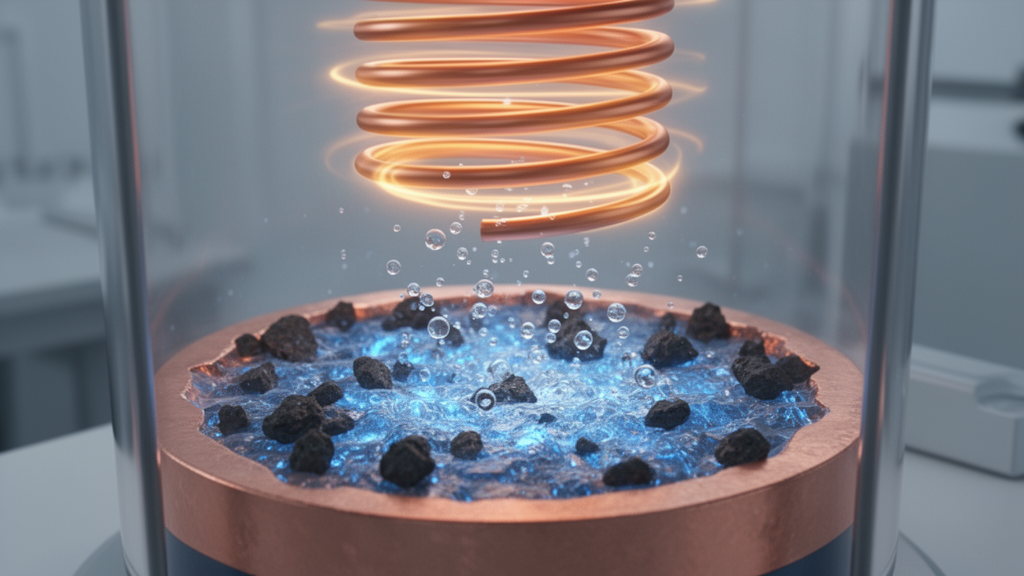
Carbonate build-up is one of the quiet killers of carbon dioxide electroreduction systems. As CO2 is converted at the cathode, local alkalinity drives the formation of carbonate and bicarbonate deposits that choke efficiency and shorten device lifetimes. A study published in Nature Catalysis on 22 October 2026 reports a way to fight back: applying an external alternating magnetic field that heats the catalyst surface locally, suppressing the precipitation before it starts.

The researchers, led by Wenda Zhou and Shouguo Wang, designed two ferromagnetic high-entropy alloys, CrMnNiZnPd and CrNiCuZnAg, synthesised through a nebulization-blast strategy. When placed under an alternating magnetic field, the confined alloys generate a localized heating field around the catalyst. According to the abstract, this heating reduces the build-up of hydroxide ions and increases the solubility of carbonate and bicarbonate species at the catalyst-electrolyte interface, thereby inhibiting precipitation.

The performance gains were substantial. In potassium bicarbonate electrolyte, the CrMnNiZnPd catalyst showed superior activity towards single-carbon products under the magnetic field, while CrNiCuZnAg favoured multicarbon products, both compared with operation without the field. Crucially, both systems ran stably for more than 200 hours, a durability benchmark that matters enormously for any prospective industrial deployment of CO2 electroreduction.

What makes the result potentially significant is its generality. The improved performance and durability persisted not only in alkaline potassium hydroxide but also in non-buffered potassium chloride electrolytes, suggesting the magnetic heating strategy works across different electrolyte chemistries rather than being an artefact of one particular system.

The authors frame alternating-magnetic-field-induced local heating as an effective tool for regulating the interfacial reaction microenvironment, with potential for mitigating carbonate-related limitations in CO2 electroreduction.

Subject of Research: Using alternating magnetic field-induced local heating in ferromagnetic high-entropy alloys to suppress carbonate formation in CO2 electroreduction

Article Title: Inducing local heating fields in ferromagnetic high-entropy alloys to inhibit (bi)carbonate formation for durable CO2 electroreduction

Article References: Zhou, W., Yuan, C., Luo, X., Chen, M., Zhang, J., Liu, S., Lei, W., & Wang, S. (2026). Inducing local heating fields in ferromagnetic high-entropy alloys to inhibit (bi)carbonate formation for durable CO2 electroreduction. Nature Catalysis, 9(10), 1158-1168. https://doi.org/10.1038/s41929-026-01619-3

Image Credits: AI Generated

DOI: 10.1038/s41929-026-01619-3

Keywords: CO2 electroreduction, carbonate precipitation, high-entropy alloys, alternating magnetic field, local heating, electrocatalysis, catalyst durability, interfacial microenvironment, Nature Catalysis, Inducing, local, heating

News Source: Bethany Barker. (October 28, 2026). Magnetic heating keeps carbon from clogging CO2 electroreduction catalysts. Scienmag.
Tags: alternating magnetic fieldcarbonate precipitationcatalyst durabilityCO2 electroreductionelectrocatalysisheatingHigh-entropy alloysinducinginterfacial microenvironmentlocallocal heatingNature Catalysis
Share12Tweet7Share2ShareShareShare1

Related Posts

Ruthenium Catalysis Emerges as a Versatile Route to Bioactive Heterocycles

Ruthenium Catalysis Emerges as a Versatile Route to Bioactive Heterocycles

October 29, 2026
Myo-Inositol Boosts Doxorubicin-Induced Apoptosis in Breast Cancer Cells in Vitro

Myo-Inositol Boosts Doxorubicin-Induced Apoptosis in Breast Cancer Cells in Vitro

October 29, 2026

Research report: Unsupervised learning-based analysis of degradation behavior in filler-containing amine-cured epoxy formulations

October 28, 2026

Tomato leaves discarded after harvest yield rutin-rich extract that lingers in skin layers

October 28, 2026

POPULAR NEWS

  • Nursing decision support tool linked to lower neonatal hypoglycemia rates in hospital study

    Nursing decision support tool linked to lower neonatal hypoglycemia rates in hospital study

    29 shares
    Share 12 Tweet 7
  • IVF Study Finds Progesterone-to-Oocyte Ratio Adds Little Beyond Its Parts

    29 shares
    Share 12 Tweet 7
  • Mitochondrial Cleanup and a DNA Sensor May Team Up to Drive Stroke Inflammation

    29 shares
    Share 12 Tweet 7
  • Smartphones, Glucose Sensors and Voice May Reveal Diabetic Minds, Review Finds

    29 shares
    Share 12 Tweet 7

About

We bring you the latest biotechnology news from best research centers and universities around the world. Check our website.

Follow us

Recent News

PET imaging reveals septic hearts switch to glucose when pumping fails

Systemic Right Ventricle Fails Differently Across Congenital Heart Disease Subtypes

Hybrid AI and physics model predicts tape deformation in robotic 3D printing

Subscribe to Blog via Email

Enter your email address to subscribe to this blog and receive notifications of new posts by email.

Join 85 other subscribers
  • Contact Us

Bioengineer.org © Copyright 2023 All Rights Reserved.

Welcome Back!

Login to your account below

Forgotten Password?

Retrieve your password

Please enter your username or email address to reset your password.

Log In
No Result
View All Result
  • Homepages
    • Home Page 1
    • Home Page 2
  • News
  • National
  • Business
  • Health
  • Lifestyle
  • Science

Bioengineer.org © Copyright 2023 All Rights Reserved.