


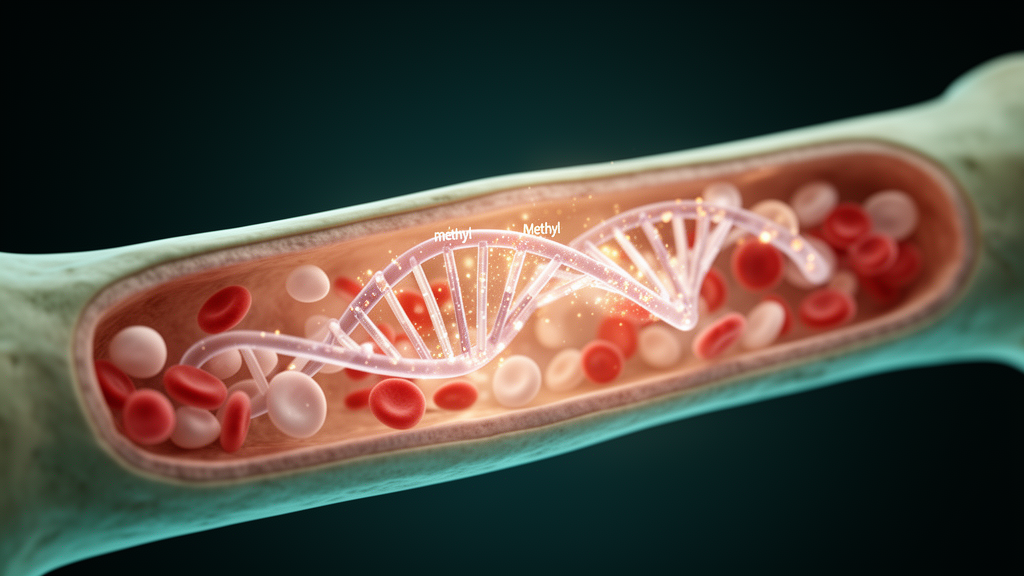
Researchers have developed a DNA methylation-based risk score that appears to predict how quickly patients with myelodysplastic neoplasms (MDS) may progress to acute myeloid leukemia, adding a molecular layer of prognostic information beyond the clinical and genetic parameters doctors currently use. The study, published in Clinical Epigenetics, describes a compact signature of 55 CpG sites that stratifies patients into distinct risk groups for AML transformation-free survival.
MDS are clonal disorders of the blood-forming system characterized by ineffective hematopoiesis, cytopenias, and a variable risk of progression to acute myeloid leukemia. Risk assessment has traditionally relied on clinical, cytogenetic, and mutational features, and the most recent models, such as IPSS-M, already incorporate gene mutations. Yet clinical heterogeneity continues to complicate treatment decisions, and the authors argue that aberrant DNA methylation—an epigenetic alteration considered an important contributor to malignant transformation in MDS—may capture additional prognostic information that mutations alone do not.
To build the model, the team used genome-wide methylation data from 68 bone marrow samples, training it to predict AML transformation-free survival. The resulting signature was then tested in an independent validation cohort of 172 patients. According to the study, the 55-CpG score stratified MDS patients into distinct risk groups and predicted transformation in a manner that appears largely independent of established clinical, cytogenetic, and mutational parameters.
A single CpG site emerged as the most important contributor to the score: a position in the promoter of the gene SPAG6. Hypomethylation at this site was associated with inferior AML transformation-free survival. The researchers report that higher-risk methylation profiles, such as that involving SPAG6, were associated with the coordinated upregulation of other cancer–testis antigens and developmentally restricted genes, suggesting possible reactivation of early developmental and stemness-related transcriptional programs in the higher-risk patients.
Beyond its prognostic performance, the signature showed a hint of practical versatility. In a limited set of paired peripheral blood and bone marrow samples, the methylation signature showed preliminary concordance, raising the possibility that a simple blood draw could eventually substitute for bone marrow sampling in some settings. The authors are careful to frame this as preliminary: the finding requires confirmation in larger sample sets before any minimally invasive application could be considered.
The study’s conclusion is deliberately measured. The authors summarize that the compact DNA methylation signature shows promising results as an independent predictor of AML transformation-free survival in MDS and warrants prospective validation in larger patient cohorts. The development cohort comprised 68 bone marrow samples and the validation cohort 172 patients, so the findings, while internally consistent, rest on moderate sample sizes and have not yet been tested prospectively.
If validated, the approach could address a persistent gap in MDS care. The methylation score is not presented as a replacement for existing tools but as an addition that appears to carry independent information.
The work also points to biology, not just statistics. The link between SPAG6 promoter hypomethylation, cancer–testis antigen upregulation, and apparent reactivation of developmental and stemness programs suggests that the methylation changes marking high-risk disease may be functionally connected to the processes driving transformation, rather than serving merely as passive biomarkers. Whether that connection holds up under further scrutiny, and whether the signature performs across the full spectrum of MDS subtypes and treatments, remains to be established by the prospective studies the authors call for.
Subject of Research: A DNA methylation-based risk score for predicting AML transformation in myelodysplastic neoplasms
Article Title: A DNA methylation–based risk score improves prognostic stratification in myelodysplastic neoplasms
Article References: Eichner, F., Vogi, V., Petzer, V., Schwendinger, S., Löffler, F., Tymoszuk, P., El Halim, H. A., Herms, S., Hoffmann, P., Fontenay, M., Rombaut, D., Jansen, J. H., Stauder, R., Zschocke, J., Wolf, D., & Jukic, E. (2026). A DNA methylation–based risk score improves prognostic stratification in myelodysplastic neoplasms. Clinical Epigenetics. https://doi.org/10.1186/s13148-026-02247-1
Image Credits: AI Generated
DOI: 10.1186/s13148-026-02247-1
Keywords: DNA methylation, myelodysplastic neoplasms, acute myeloid leukemia, prognostic risk score, SPAG6, cancer-testis antigens, epigenetics, IPSS-M, AML transformation-free survival, biomarker, hematology, bone marrow
News Source: Nathaniel Bowman. (October 28, 2026). DNA Methylation Score Sharpens Leukemia Risk Prediction in MDS. Scienmag.



