


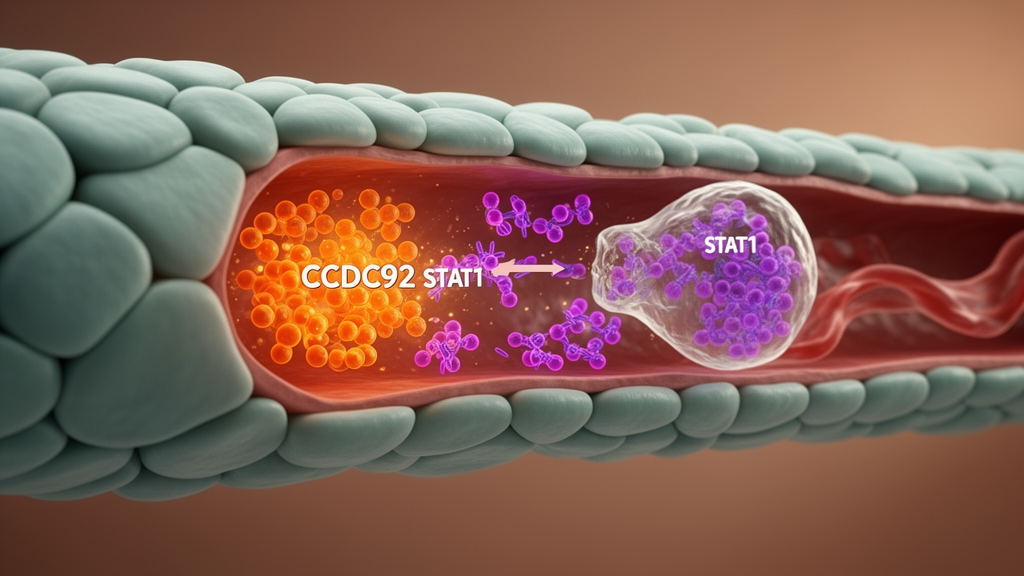
A protein called CCDC92 appears to protect blood vessels from the earliest stages of atherosclerosis by marking a key inflammatory signaling molecule for destruction, according to a new study published in Cellular and Molecular Life Sciences. The work, led by Dayin Lyu, Pengcheng Shi and colleagues with senior author Qing K. Wang, links a genetic risk variant for coronary artery disease to a previously unrecognized pathway that operates in the endothelial cells lining the arteries.
Coronary artery disease affects an estimated 315 million people worldwide. A recent genome-wide association study had connected rs9863, a single-letter DNA variant in the 3′ untranslated region of the CCDC92 gene, to coronary risk, but the causal relationship remained unclear. In the new study, the researchers report that CCDC92 expression is significantly reduced in vascular endothelium from human coronary artery disease patients and from atherosclerotic ApoE-deficient mice. Analysis of GTEx data showed that the risk allele T of rs9863 is associated with both reduced CCDC92 expression and alternative splicing of the gene, an effect mediated through the microRNA miR-377-3p.
Experiments in coronary artery endothelial cells showed what loss of the protein does. When the team knocked down CCDC92, the cells proliferated, migrated and formed capillary tubes less effectively, while more monocytes adhered to and crossed the endothelial monolayer — processes involved in the initiation of atherosclerosis. Knockdown also raised the levels of the endothelial activation markers ICAM1 and VCAM1 by activating NFκB, and increased the amount of total and phosphorylated STAT1 in the cells. Notably, this increase occurred independently of the JAK or SRC kinases that normally drive STAT1 activation, indicating a non-canonical route of STAT1 regulation.
The mechanism the authors describe is a proteolytic one. CCDC92 physically interacts with STAT1 and anchors it to the 19S proteasome through the adaptor proteins ADRM1 and UCHL5, promoting STAT1 degradation. When CCDC92 is reduced, the complex between STAT1 and ADRM1/UCHL5 forms less efficiently, STAT1 escapes degradation, and its abundance rises, allowing STAT1-target genes to be activated. Consistent with this model, overexpressing CCDC92 did not alter endothelial cell function, and in mice, endothelial knockdown of Ccdc92 using a lentiviral shRNA in atherosclerotic ApoE-deficient mice aggravated lesion formation, accompanied by endothelial activation, STAT1 activation and upregulation of STAT1-target genes.
Together, the findings define what the authors call a novel non-canonical STAT1 inhibitory pathway in endothelial cells, in which CCDC92 acts as an adaptor that delivers STAT1 to the 19S proteasome via ADRM1/UCHL5, and they connect this CCDC92–STAT1 pathway to atherosclerosis. The study was published as an open-access original article on 28 October 2026, and the version shared ahead of final publication remains subject to further editorial edits. As with all preclinical and human-association work, the results establish mechanisms in cells and in a mouse model of atherosclerosis and identify a genetic association in human data; they do not by themselves establish a therapy, and translating the CCDC92–STAT1 axis into clinical benefit will require further study.
Subject of Research: A CCDC92-mediated non-canonical STAT1 degradation pathway in endothelial cells and its role in the initiation of atherosclerosis
Article Title: Identification of a CCDC92-mediated non-canonical STAT1 signaling cascade in endothelial cells inhibiting initiation of atherosclerosis
Article References: Lyu, D., Shi, P., Zhang, Y., Qiao, Z., Ke, T., Xu, C., Yao, Y., & Wang, Q. K. (2026). Identification of a CCDC92-mediated non-canonical STAT1 signaling cascade in endothelial cells inhibiting initiation of atherosclerosis. Cellular and Molecular Life Sciences. https://doi.org/10.1007/s00018-026-06501-w
Image Credits: AI Generated
DOI: 10.1007/s00018-026-06501-w
Keywords: CCDC92, STAT1, endothelial cells, atherosclerosis, coronary artery disease, rs9863, proteasome, ADRM1, UCHL5, NFκB, GTEx, ApoE-deficient mice
News Source: Juliet Wilcox. (October 28, 2026). Endothelial protein CCDC92 found to restrain early atherosclerosis through STAT1 degradation. Scienmag.



