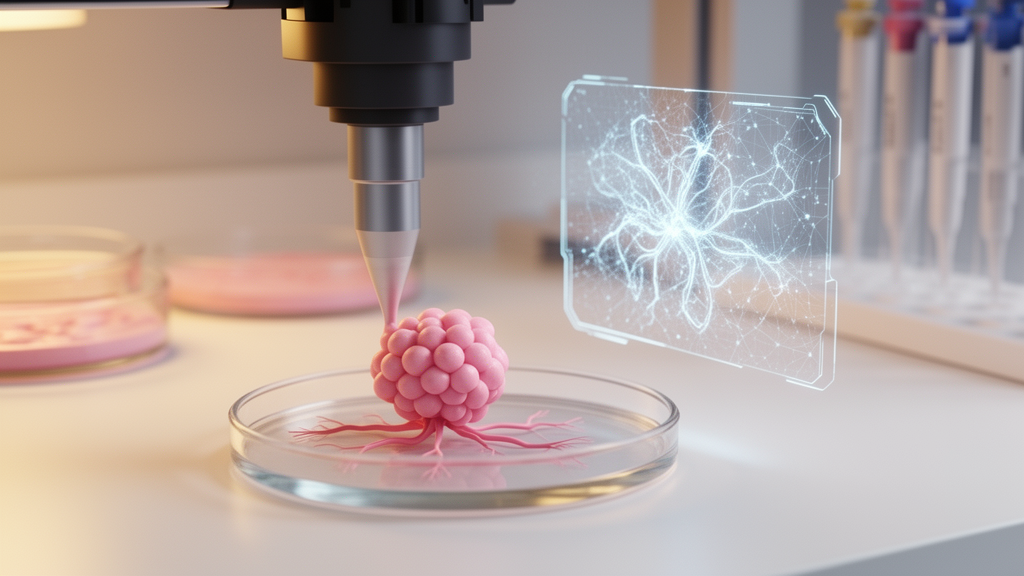
A new review in the Journal of Translational Medicine maps how artificial intelligence and three-dimensional bioprinting are being combined to create in vitro tumor models that better reproduce the native tumor microenvironment. The article, published as an open-access review on 24 October 2026, examines AI’s role across the entire bioprinting workflow, from image-based model design and real-time printing control to post-printing functional assessment and high-throughput drug evaluation.
The authors, including Tian Zhong, Chaoyong Zhang and Xingliang Dai, describe how machine learning and deep learning algorithms can optimize bioink formulation, predict the mechanical behavior of printed constructs, and enable error correction during fabrication.
A central focus of the review is the reconstruction of key components of the tumor microenvironment. The authors discuss extracellular matrices with tunable mechanical properties, perfusable vascular networks, and spatially organized multi-cellular architectures that incorporate cancer cells, stromal cells, and immune populations.
The review also covers applications of AI-enhanced bioprinted tumor models in automated drug screening, resistance mechanism studies, and personalized medicine. Particular attention is given to the integration of patient-derived cells and multi-omics data. Such models, the authors argue, could help identify which therapies are most likely to work for a given patient and shed light on how tumors develop resistance to treatment.
However, the review is explicit about the field’s current limitations. The authors identify a trade-off between biomimetic fidelity and throughput: the more faithfully a model reproduces the complexity of a real tumor, the harder and slower it becomes to produce at the scale needed for large drug screens. They also point to the lack of standardized protocols and shared data repositories, which makes it difficult to compare results between laboratories, and they stress the need for improved validation of these models against clinical outcomes. Without such validation, it remains unclear how well bioprinted models predict how patients will actually respond to therapy.
Looking forward, the authors highlight emerging directions including closed-loop optimization systems, in which AI continuously adjusts printing parameters based on measured outcomes; intelligent bioinks that respond to printing conditions; and the integration of bioprinting with organ-on-a-chip platforms to add dynamic fluid flow and physiological cues to printed tissue models.
As a review rather than a primary research study, the article synthesizes existing literature rather than presenting new experimental data, and its assessments of capabilities and challenges reflect the current state of a rapidly evolving field. The authors state that the review aims to inform researchers and clinicians about the current capabilities and future potential of AI-assisted bioprinted tumor models for oncology research and therapeutic development. The full article is open access and citable under a permanent DOI, with the published version subject to further editorial updates.
Subject of Research: The use of artificial intelligence in 3D bioprinting to create biomimetic in vitro tumor models for drug screening and personalized medicine
Article Title: Artificial intelligence-enabled bioprinting for tumor modeling: from biomimetic microenvironment reconstruction to drug screening
Article References: Zhong, T., Zhang, C., Zhang, X., Yang, Y., Wang, Y., Hua, X., & Dai, X. (2026). Artificial intelligence-enabled bioprinting for tumor modeling: from biomimetic microenvironment reconstruction to drug screening. Journal of Translational Medicine. https://doi.org/10.1186/s12967-026-09134-6
Image Credits: AI Generated
DOI: 10.1186/s12967-026-09134-6
Keywords: artificial intelligence, 3D bioprinting, tumor models, tumor microenvironment, bioinks, drug screening, personalized medicine, machine learning, organ-on-a-chip, patient-derived cells, multi-omics, vascular networks
News Source: Nathaniel Bowman. (October 28, 2026). AI Meets Bioprinting to Build Tumor Models for Drug Screening. Scienmag.