• HOME
  • NEWS
  • EXPLORE
    • CAREER
      • Companies
      • Jobs
    • EVENTS
    • iGEM
      • News
      • Team
    • PHOTOS
    • VIDEO
    • WIKI
  • BLOG
  • COMMUNITY
    • FACEBOOK
    • INSTAGRAM
    • TWITTER
Thursday, October 29, 2026
BIOENGINEER.ORG
No Result
View All Result
  • Login
  • HOME
  • NEWS
  • EXPLORE
    • CAREER
      • Companies
      • Jobs
        • Lecturer
        • PhD Studentship
        • Postdoc
        • Research Assistant
    • EVENTS
    • iGEM
      • News
      • Team
    • PHOTOS
    • VIDEO
    • WIKI
  • BLOG
  • COMMUNITY
    • FACEBOOK
    • INSTAGRAM
    • TWITTER
No Result
View All Result
Bioengineer.org
No Result
View All Result
Home NEWS Science News Biology

Circular RNA aptamers recruit natural ADAR1 to edit RNA with near-perfect efficiency

by
October 28, 2026
in Biology
Reading Time: 2 mins read
0
Circular RNA aptamers recruit natural ADAR1 to edit RNA with near-perfect efficiency

Circular RNA aptamers recruit natural ADAR1 to edit RNA with near-perfect efficiency

Share on FacebookShare on TwitterShare on LinkedinShare on RedditShare on Telegram

Researchers have unveiled a new RNA editing platform that coaxes a cell’s own editing enzyme into correcting RNA transcripts with efficiencies approaching 100 percent in cultured cells and 84 percent in living mice. The system, called MARRS, short for multivalent ADAR1-recruiting RNA editing system, is described in a study published in Nature Methods on 28 October 2026.

Adenosine-to-inosine RNA editing has long been viewed as a promising therapeutic strategy because it can correct mutations at the transcript level without inducing permanent changes to the genome. Yet existing systems have struggled with limited editing efficiency, a constraint that has hindered practical applications.

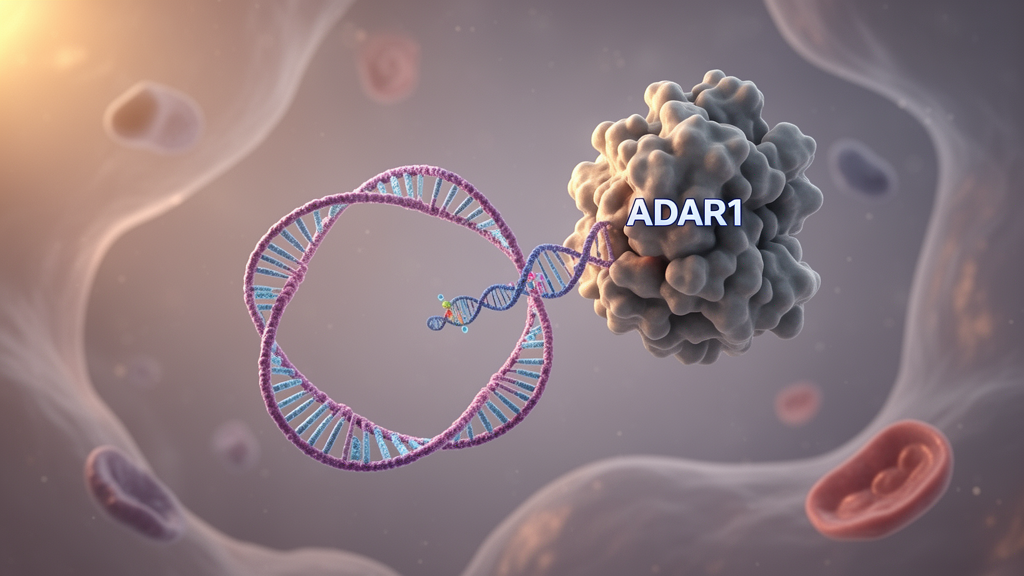
MARRS tackles this bottleneck by exploiting engineered multivalent RNA aptamers to recruit endogenous ADAR1 enzymes. The team designed aptamers that target the Zα domain of ADAR1 p150.

Two design choices proved decisive. First, the researchers optimized the aptamers themselves for stronger and more reliable engagement of ADAR1 p150.

Multivalency added a further boost. The researchers engineered tandem arrays of aptamers and embedded them in a circular RNA scaffold, presenting multiple recruitment modules for the enzyme. According to the study, this engineering strategy enabled near-complete adenosine-to-inosine editing of RNA targets, with efficiencies reaching up to 100 percent in vitro and 84 percent in vivo in mouse models.

The platform also demonstrated remarkable versatility, functioning across a range of transcript targets. Equally important, the authors report that MARRS maintains high specificity, with minimal off-target effects, a critical requirement for any editing technology intended for research or therapeutic use.

Because MARRS operates without the need for exogenous enzymes, the researchers describe it as a safe, efficient and programmable platform.

The work, with Han Zhu as first author and Shu-Lin Liu among the authors, appears in Nature Methods. The published figures include evaluations of aptamer reprogramming, guide RNA truncation and circularization, tandem aptamer engineering, and in vivo editing efficiency, laying out the stepwise development of the system from design to animal testing.

If the reported efficiencies and specificity hold up in broader testing, MARRS could expand the toolkit for transcript-level correction of disease-associated mutations, offering a programmable alternative that leverages the cell’s own editing machinery rather than replacing it.

Subject of Research: Development of an RNA editing platform that recruits endogenous ADAR1 using multivalent circular RNA aptamers

Article Title: Aptamer-mediated multivalent endogenous ADAR1 recruitment for highly efficient RNA editing

Article References: Zhu, H., Zhou, Y., Huang, R., Wang, Y.-F., Hu, Y., Wang, L., Jin, J.-H., Ye, Q., Liu, X., Wang, Z.-G., Xie, H.-Y., Li, J. B., Pang, D.-W., & Liu, S.-L. (2026). Aptamer-mediated multivalent endogenous ADAR1 recruitment for highly efficient RNA editing. Nature Methods. https://doi.org/10.1038/s41592-026-03284-7

Image Credits: AI Generated

DOI: 10.1038/s41592-026-03284-7

Keywords: RNA editing, ADAR1, MARRS, circular RNA, aptamers, adenosine-to-inosine, Nature Methods, gene therapy, transcript editing, off-target effects, Aptamer-mediated, multivalent

News Source: Gregory Coleman. (October 28, 2026). Circular RNA aptamers recruit natural ADAR1 to edit RNA with near-perfect efficiency. Scienmag.


Tags: ADAR1adenosine-to-inosineAptamer-mediatedAptamerscircular RNAGene TherapyMARRSmultivalentNature Methodsoff-target effectsRNA editingtranscript editing
Share12Tweet7Share2ShareShareShare1

Related Posts

HPTLC Method with Chemometric Fingerprinting Speeds Up Soyasaponin Analysis

HPTLC Method with Chemometric Fingerprinting Speeds Up Soyasaponin Analysis

October 29, 2026
Long-Read RNA Sequencing Reveals Full-Length HERV Transcripts and Novel ERVE-4 Isoforms in Clear Cell Renal Cell Carcinoma

Long-Read RNA Sequencing Reveals Full-Length HERV Transcripts and Novel ERVE-4 Isoforms in Clear Cell Renal Cell Carcinoma

October 29, 2026

Stray cats and dogs in Malaysia carry uncharacterised Bartonella lineages in fleas

October 29, 2026

HIV-1 Spread Between Macrophages Sidesteps the BST-2 Tetherin Restriction Factor

October 29, 2026

POPULAR NEWS

  • One Transformer Reads Three Brain-Signal Types at Once, Hitting 71% Accuracy

    One Transformer Reads Three Brain-Signal Types at Once, Hitting 71% Accuracy

    29 shares
    Share 12 Tweet 7
  • Research report: Case Report: Probable paroxysmal sympathetic hyperactivity during vascular and postoperative critical illness with bilateral white matter abnormalities

    29 shares
    Share 12 Tweet 7
  • Propionate, Not Extra Protein, Drives Reproductive Gains in Young Range Cows

    29 shares
    Share 12 Tweet 7
  • Deep Learning Model Predicts Adhesive Hydrogel Strength Under Distribution Shift

    29 shares
    Share 12 Tweet 7

About

We bring you the latest biotechnology news from best research centers and universities around the world. Check our website.

Follow us

Recent News

Dolphin-Inspired Optimizer Charts Shorter Paths for Robot Teams in Dynamic Simulations

HPTLC Method with Chemometric Fingerprinting Speeds Up Soyasaponin Analysis

Long-Read RNA Sequencing Reveals Full-Length HERV Transcripts and Novel ERVE-4 Isoforms in Clear Cell Renal Cell Carcinoma

Subscribe to Blog via Email

Enter your email address to subscribe to this blog and receive notifications of new posts by email.

Join 85 other subscribers
  • Contact Us

Bioengineer.org © Copyright 2023 All Rights Reserved.

Welcome Back!

Login to your account below

Forgotten Password?

Retrieve your password

Please enter your username or email address to reset your password.

Log In
No Result
View All Result
  • Homepages
    • Home Page 1
    • Home Page 2
  • News
  • National
  • Business
  • Health
  • Lifestyle
  • Science

Bioengineer.org © Copyright 2023 All Rights Reserved.