A carefully controlled crossover trial in 32 healthy beagle dogs has found that the preservative in a multi-dose maropitant injectable, not the temperature at which it is stored, determines how much pain the subcutaneous injection causes. A benzyl alcohol–preserved formulation produced significantly lower acute injection-site pain scores than an otherwise nearly identical formulation preserved with m-cresol, the preservative used in the widely used antiemetic Cerenia, and the advantage held whether the vial came straight from the refrigerator or had been warmed to room temperature.
Maropitant is a selective neurokinin-1 receptor antagonist used as an injectable antiemetic in veterinary medicine. Although clinically effective against vomiting, commercially available maropitant injections are well known to cause immediate pain and irritation when given under the skin, making the drug a sensitive benchmark for studying what drives injection discomfort. In current practice, refrigeration is routinely recommended to soften the sting, but it had remained unresolved whether cooling genuinely relieves pain or whether the preservative chemistry itself is the dominant factor.
The new study, conducted under Good Laboratory Practice standards by researchers at Zydus Lifesciences in Ahmedabad, India, and published in Frontiers in Veterinary Science, was designed to decouple those two variables. The test formulation, supplied by ZyVet Animal Health, was engineered to be qualitatively and quantitatively identical to Cerenia in its primary physicochemical components, containing 10 mg/mL maropitant as maropitant citrate monohydrate and 63 mg/mL sulphobutylether-β-cyclodextrin. The only difference was the preservative: 11.8 mg/mL benzyl alcohol in the test product versus 3.3 mg/mL meta-cresol in the reference product, with closely matched pH and osmolality ranges.
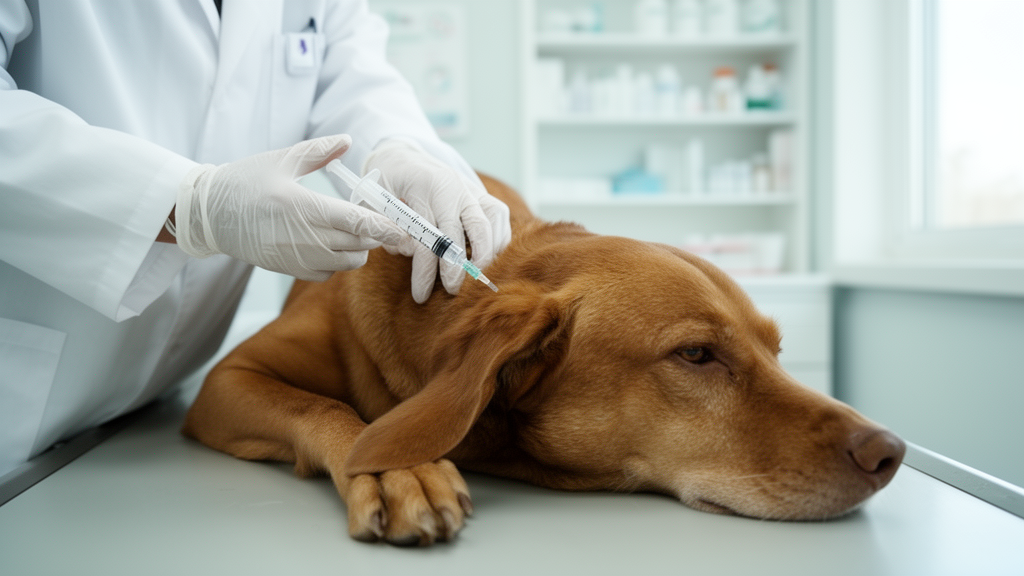
Sixteen male and 16 female beagle dogs, all more than one year old and weighing between 8 and 12 kg, were enrolled after passing a complete physical examination including blood count and serum biochemistry. Each animal received all four treatment combinations—benzyl alcohol or m-cresol formulation, each at 4 °C and at 25 °C—in a double-blinded, randomized, four-period, four-sequence, four-treatment Latin square crossover, with at least three days of washout between injections. Vials were equilibrated for 1.5 to 2 hours in an ice bath or water bath, temperatures were continuously monitored with a calibrated digital thermometer, and injections of 0.1 mL/kg at 1 mg/kg maropitant were delivered with a fresh 26½-gauge needle within 30 seconds of withdrawal, at systematically rotated sites on the clipped dorsolateral flank.
Pain was scored immediately after each injection for two minutes by two independent, blinded observers using three complementary measures: a 10-centimeter visual analog scale (VAS) anchored at no pain and maximal pain, a simple descriptive scale (SDS) grading behavioral responses from 0 for no reaction to 3 for severe reactions such as prolonged yelping, hiding, or aggression, and a checklist of clinical signs including restlessness, head shaking, and local reactions. Injection sites were re-examined at 24 hours for delayed swelling or tenderness. Before the trial, both evaluators underwent standardized training and calibration to strengthen inter-observer reliability.
The results were unambiguous. Log-transformed VAS least-square means were 1.94 ± 0.14 for the benzyl alcohol formulation at 25 °C and 2.33 ± 0.14 at 4 °C, compared with 3.43 ± 0.11 for the m-cresol formulation at 25 °C and 3.38 ± 0.11 at 4 °C, with the benzyl alcohol values significantly lower in both pairwise comparisons (P < 0.0001). Within each formulation, the two temperatures did not differ significantly, indicating that cooling did not materially change pain perception as measured by the VAS. Agreement between observers on the VAS was excellent, with Lin’s concordance correlation coefficient of 0.99.
The ordinal SDS analysis told the same story. Receiving the m-cresol formulation at 25 °C was associated with a 10.32-fold increase in the odds of higher pain scores relative to the benzyl alcohol formulation at 25 °C (95% CI 3.75–28.4), and a 6.51-fold increase relative to the benzyl alcohol formulation at 4 °C (95% CI 2.42–17.56). The m-cresol formulation at 4 °C yielded odds ratios of 7.61 and 4.80 against the benzyl alcohol formulation at 25 °C and 4 °C, respectively. The only within-formulation temperature contrast, a slight elevation for the benzyl alcohol product at 4 °C versus 25 °C (odds ratio 1.58, 95% CI 0.60–4.18), was not statistically significant (P = 0.35). Cohen’s kappa for SDS scoring was 0.89, classified as almost perfect agreement. Mean SDS scores ranged from 0.6 for the benzyl alcohol formulation at 25 °C to 1.5 for the m-cresol formulation at 25 °C.
Observable behavior matched the scale scores. Although the clinical-sign counts were descriptive and not formally tested, 68 events were recorded after m-cresol injections versus 18 after benzyl alcohol injections. Restlessness appeared in 25 of 32 dogs after the m-cresol formulation (11 at 4 °C, 14 at 25 °C) but in only 6 dogs after the benzyl alcohol formulation (3 at each temperature). Head shaking occurred in 15 dogs after m-cresol dosing and in a single dog after the chilled benzyl alcohol product. Squeaking or squealing was recorded nine times after the m-cresol formulation at 25 °C and only twice after the benzyl alcohol formulation at the same temperature. At the 24-hour check, no swelling, erythema, or pain on palpation was found at any injection site in any group.
The authors also verified that the crossover design itself did not distort the comparison. Analysis of variance on the log-transformed VAS scores found no significant sequence, period, or subject-within-sequence effects, and cumulative logit models for the SDS scores confirmed the same independence, in contrast to an earlier published maropitant pain study that had reported a period effect attributed to shifting injection sites and restraint techniques. The authors attribute the clean result to uniform injection-site selection and consistent, trained personnel handling restraint throughout the trial.
Mechanistically, the authors point to benzyl alcohol’s intrinsic local anesthetic properties, noting literature describing its ability to transiently block voltage-gated sodium channels and stabilize neuronal membranes along nociceptive afferent fibers. They also contrast the physicochemistry of the two preservatives: benzyl alcohol is structurally neutral at physiological pH, whereas meta-cresol is more lipophilic and has a more reactive, acidic phenolic structure that may promote membrane partitioning and nociceptor activation without any compensatory anesthetic effect. The authors caution that the study population consisted of healthy, purpose-bred laboratory beagles, which may behave more stoically than a diverse clinical population of client-owned pets; the VAS and SDS remain inherently subjective; and local tissue evaluation stopped at 24 hours, so longer-term or subclinical tissue reactions were not assessed. They call for studies in real-world clinical patient data to substantiate the finding, which, if it holds, suggests that choosing the preservative—not chilling the vial—is what spares dogs the sting of maropitant injections.
Subject of Research: A randomized crossover trial comparing injection-site pain from benzyl alcohol– versus m-cresol–preserved maropitant formulations in beagle dogs at two storage temperatures.
Article Title: Comparative assessment of benzyl alcohol and m-cresol as preservatives in maropitant injectable formulation: implications for pain & tolerability
Article References: Pawar, V., Trivedi, J., Muchhara, J., Dharvadiya, N., Patel, S., Patel, R., Shah, M., Sundar, R., Kannan, M. E., Ukawala, M., Laddha, R., & Jain, M. (2026). Comparative assessment of benzyl alcohol and m-cresol as preservatives in maropitant injectable formulation: implications for pain & tolerability. Frontiers in Veterinary Science, 13, Article 1943767. https://doi.org/10.3389/fvets.2026.1943767
Image Credits: AI Generated
DOI: 10.3389/fvets.2026.1943767
Keywords: maropitant, benzyl alcohol, m-cresol, injection-site pain, beagle dogs, preservatives, veterinary pharmacology, subcutaneous injection, crossover trial, Cerenia, local tolerability, visual analog scale
News Source: Drew Townsend. (October 28, 2026). Benzyl Alcohol Beats m-Cresol for Painful Maropitant Injections in Dogs. Scienmag.