A virtual reality program that pairs immersive 360-degree nature scenes with guided mindfulness narration is about to face its first structured test in children. Operation Calm, developed by researchers at McGill University in Montreal, is designed to help young people practise self-regulation skills that could one day ease the anxiety surrounding medical and dental procedures. Before the intervention can be evaluated for clinical benefit, however, its developers must answer a more basic set of questions: can children access it, understand it, complete it, and tolerate wearing a headset for roughly ten minutes without uncomfortable side effects?
A study protocol published in Frontiers in Health Services describes exactly that early-stage evaluation. The project, registered at ClinicalTrials.gov as NCT07694934, is a community-based, single-arm, mixed-methods feasibility study with pre–post measurements. It will recruit approximately 50 children and adolescents aged 6 to 17 years, up to 50 parents or legal guardians, and 50 pediatric clinicians or supervised trainees across Canada. Because the study is a protocol, no results exist yet; every finding discussed below is a planned outcome rather than a reported one.
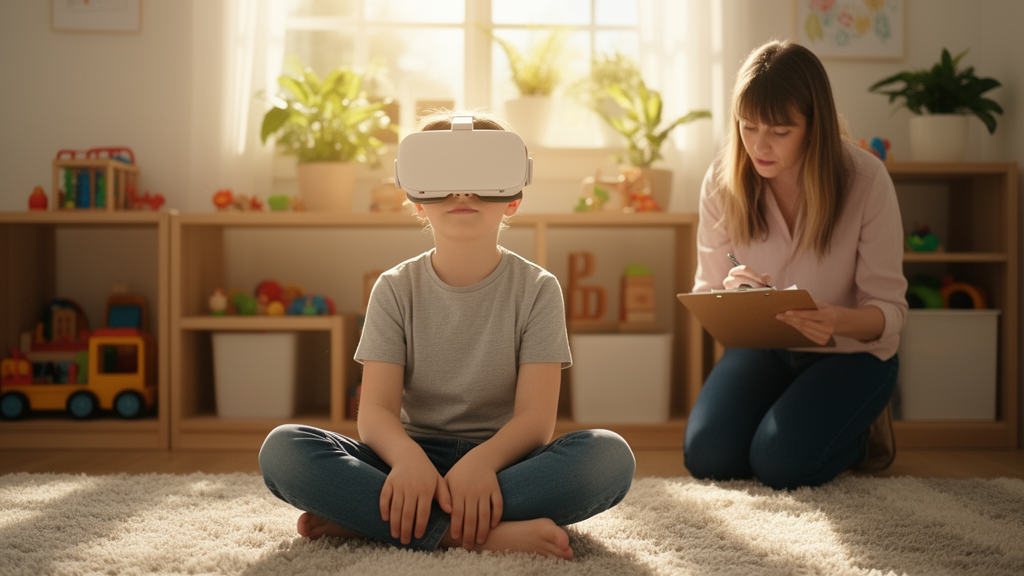
The intervention itself is deliberately simple in structure. A child uses a smartphone-compatible VR headset supplied by the research team and views one of five prerecorded 360-degree nature environments, including forest, beach, underwater, and wildlife settings, while listening to standardized, age-appropriate mindfulness narration. Guided elements include slow diaphragmatic breathing, sensory grounding, present-moment awareness, gentle redirection after distraction, and a brief reflection on calm, safety, and relaxation. The narration and approximate ten-minute duration remain constant across scenes; only the visual environment changes. Scenes are assigned through a predetermined rotating schedule intended to balance representation, a procedure the researchers explicitly note is not randomization and creates no treatment arms.
The theoretical rationale draws on three strands of prior evidence. Systematic reviews of immersive VR in pediatric procedures report promising effects on procedural pain and anxiety, though with substantial heterogeneity across procedures, formats, and outcomes, and an umbrella review found consistent reductions in needle-related pain in children alongside considerable overlap among meta-analyses. Mindfulness-based interventions have shown reductions in psychological distress in young people, with effects that vary across outcomes and populations, and a review of 44 meta-analyses found mindfulness generally outperformed passive controls but showed smaller and less consistent advantages over active interventions. Virtual nature exposure, meanwhile, has been associated with positive affect, mood improvement, and restoration, though it is not assumed to reproduce all benefits of direct contact with natural environments.
Importantly, the protocol’s authors acknowledge that an earlier pediatric perioperative VR study demonstrated the feasibility of delivering VR from the preoperative waiting area through anesthesia induction, but that study tested an interactive distraction game rather than mindfulness-based virtual nature. Its findings therefore do not establish the feasibility or effectiveness of Operation Calm’s specific components. The new study was also redesigned after the loss of its original clinical site: it no longer tests clinical efficacy, randomizes surgical patients, compares the intervention with standard care, or includes perioperative follow-up. Instead, it asks whether intended users can complete the session, whether it is understandable and acceptable, which features need refinement, and whether parents and clinicians consider it developmentally and clinically appropriate.
Measurement follows a structured plan. Children complete the Children’s Anxiety Meter–State and a current calmness rating immediately before and immediately after the VR session, the Pediatric Simulator Sickness Questionnaire afterward to capture symptoms such as nausea, dizziness, headache, eye strain, and fatigue, and a child-specific evaluation. Parents and clinicians review their assigned scene through an approved web-based format rather than the headset, then complete group-specific evaluations covering developmental appropriateness, perceived usefulness, family practicality, clinical relevance, safety, barriers, and implementation feasibility. Open-ended responses will undergo qualitative content analysis, with quantitative and qualitative findings integrated through a convergent mixed-methods approach.
The analysis plan keeps claims carefully bounded. Feasibility and evaluation outcomes will be summarized descriptively with transparent denominators and confidence intervals where informative. Exploratory paired pre–post changes in anxiety and calmness will be analyzed with paired-samples t tests or Wilcoxon signed-rank tests, reporting effect sizes and confidence intervals, but the protocol states plainly that any immediate change will be treated as hypothesis-generating and will not be interpreted as evidence of clinical efficacy. Planning benchmarks are explicit: child completion of at least 80 percent supports feasibility, 60 to 79 percent suggests modification, and below 60 percent suggests major redesign, while questionnaire completeness of at least 85 percent is desirable.
Safety provisions reflect the known risks of brief VR exposure in children. Exclusion criteria screen out uncontrolled epilepsy, photosensitive seizures, other VR contraindications, severe motion sickness or significant vestibular symptoms, and unaccommodated sensory, motor, physical, or comprehension limitations that would prevent safe headset use. Sessions stop if a child requests it or if moderate or severe nausea, dizziness, headache, visual disturbance, loss of balance, panic, or marked distress occurs. Risk mitigation includes seated use in a clear area, adult availability during remote sessions, explicit stopping instructions, slow reorientation after headset removal, and systematic adverse-event documentation. The study is considered minimal risk, and no independent data safety monitoring board is planned because exposure is brief.
The design carries limitations the authors themselves enumerate. There is no control group, randomization, allocation concealment, or blinding, so any immediate pre–post change could reflect expectancy, novelty, regression to the mean, demand characteristics, or measurement reactivity. The community sample is not recruited during an actual medical or dental procedure and may have low baseline anxiety, limiting the magnitude and clinical meaning of any change. Most outcomes are self-reported, remote recruitment may underrepresent children without compatible smartphones, and parent and clinician web-based review is less immersive than the child’s headset experience. Scene comparisons are underpowered and confounded by the non-random rotating allocation.
If feasibility, acceptability, and tolerability prove adequate, the researchers outline a clear next stage: evaluating Operation Calm in children facing a defined medical or dental procedure using a multicentre design, an appropriate comparator, concealed randomization where feasible, standardized co-interventions, independent outcome collection, and longer follow-up, potentially incorporating objective indicators such as heart rate variability, electrodermal activity, salivary cortisol, behavioural distress, and analgesic use. For now, the contribution of this study is not an estimate of treatment benefit but a multi-perspective assessment of whether a portable VR mindfulness program can be delivered safely and consistently outside hospital care, and what must change before it can be tested properly in a clinical trial.
Subject of Research: A feasibility study protocol evaluating a virtual reality mindfulness intervention with nature scenes for children in Canada
Article Title: Feasibility, acceptability, and tolerability of operation calm: a mixed-methods evaluation with children, parents, and clinicians
Article References: Benchimol-Elkaim, B., Khoury, B., & Tsimicalis, A. (2026). Feasibility, acceptability, and tolerability of operation calm: a mixed-methods evaluation with children, parents, and clinicians. Frontiers in Health Services, 6, 1912318. https://doi.org/10.3389/frhs.2026.1912318
Image Credits: AI Generated
DOI: 10.3389/frhs.2026.1912318
Keywords: virtual reality, mindfulness, pediatric anxiety, feasibility study, nature exposure, digital health, children's mental health, procedural anxiety, mixed methods, clinical trial protocol, simulator sickness, Canada
News Source: Glenn Wilkins. (October 28, 2026). Virtual Reality Mindfulness Study Tests Whether Children Can Use Operation Calm. Scienmag.