


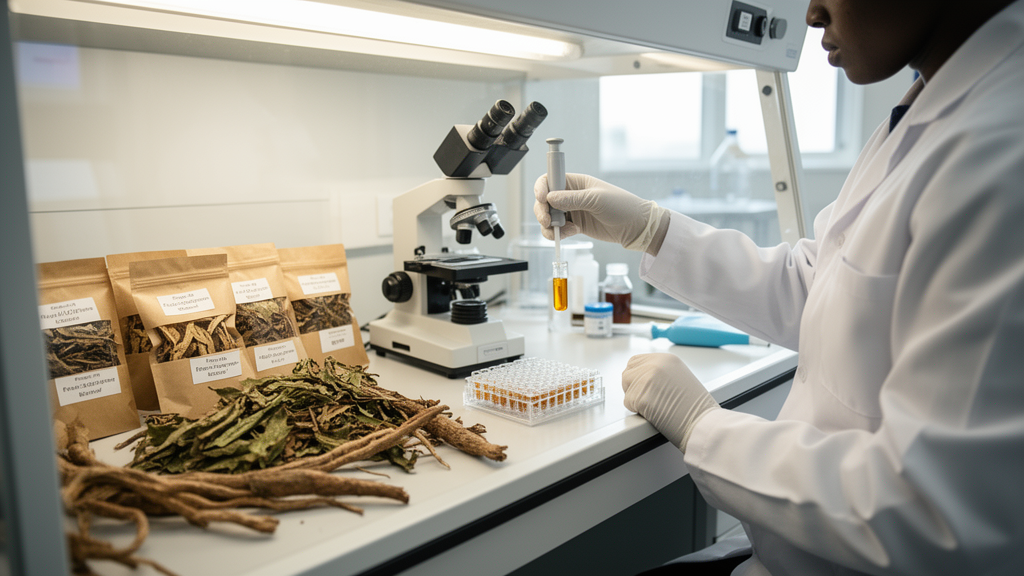
Crude extracts from Croton kinondoensis, a plant species recently described from coastal Kenya, inhibited herpes simplex virus type 1 replication in Vero E6 cells, according to a new study from Kenyan research institutes. The work, published in Frontiers in Natural Products, combined laboratory antiviral testing with chemical profiling and computational modelling to identify candidate compounds within the extracts.
HSV-1 infects an estimated 67 percent of the global population under 50 years of age, and pooled adult seroprevalence in Sub-Saharan Africa has been reported at 96.2 percent. Existing first-line therapy relies on nucleoside analogues such as acyclovir, but resistance to these drugs, together with cost and access barriers in low-resource settings, motivates continued searches for new anti-HSV-1 leads. Medicinal plants remain one source of such candidates, and C. kinondoensis, a member of the Euphorbiaceae family, had not previously been evaluated for antiviral activity.
The researchers prepared crude dichloromethane:methanol (1:1, v/v) extracts from the roots, stems, and leaves and twigs of the plant. Each extract was tested for cytotoxicity using the MTT assay and for anti-HSV-1 activity using time-of-addition and plaque reduction assays in Vero E6 cells infected with HSV-1 strain 7401H. All three extracts inhibited viral plaque formation in a concentration-dependent manner.
The leaf-and-twig extract, designated CKA, showed the most favourable balance between antiviral activity and cellular toxicity. Its 50 percent cytotoxic concentration was 324.8 ± 18.08 µg/mL, its plaque reduction IC50 was 20.00 ± 3.52 µg/mL, and the resulting selectivity index was 16.24. The extract also maintained selectivity across different treatment timing conditions: a selectivity index of 13.48 when added before infection, 7.95 when added simultaneously with the virus, and 8.42 when added after infection.
To characterise the active extract, the team used gas chromatography–mass spectrometry (GC–MS), which putatively identified thirteen constituents. The profile was dominated by methyl eugenol at 45.81 percent and methyl isoeugenol at 14.04 percent. The authors emphasise that these identifications are putative, based on the GC–MS profiling approach.
The thirteen constituents were then evaluated by molecular docking and MM-GBSA binding free-energy estimation against three HSV-1 targets: thymidine kinase, DNA polymerase, and the helicase–primase complex. This computational screening prioritised 1,2-dimethoxy-4-(1,2-dimethoxyethyl)benzene as the top predicted binder to thymidine kinase, with an MM-GBSA score of −42.8 kcal/mol, comparable to the approved drug acyclovir. Stigmasterol emerged as the top predicted binder to the helicase–primase complex, with a score of −46.2 kcal/mol.
The authors are careful to stress that these are computationally predicted binding interactions, not demonstrated mechanisms of action. Docking and free-energy estimates suggest which constituents might interact with which viral proteins, but they do not establish that any compound in the extract actually inhibits the virus through these targets in infected cells. Biochemical assays and bioassay-guided fractionation studies are required before any mechanistic or translational conclusion can be drawn.
The study’s scope also carries inherent limitations typical of early natural product screening. All antiviral results come from a single cell line, Vero E6, and a single laboratory strain of HSV-1, so activity against clinical isolates or in other cell types remains untested. The crude extract nature of the material means the observed plaque reduction cannot yet be attributed to any individual constituent, and the selectivity index, while acceptable by the authors’ assessment, reflects in vitro cytotoxicity rather than safety in any organism.
Nevertheless, the findings add C. kinondoensis to the list of Croton species investigated for antiviral properties and provide a defined starting point for follow-up work. The combination of a reproducible in vitro effect, a quantified selectivity margin, a chemical profile dominated by methyl eugenol and methyl isoeugenol, and a shortlist of computationally prioritised candidate binders gives future fractionation and mechanism studies a concrete direction. Whether any of the thirteen putative constituents, alone or in combination, accounts for the extract’s activity against HSV-1 remains an open question that only experimental validation can answer.
Subject of Research: In vitro anti-HSV-1 activity and computational phytochemical characterisation of Croton kinondoensis extracts
Article Title: In vitro anti-HSV-1 activity of crude Croton kinondoensis root, stem, leaf and twig extracts in vero E6 cells: GC–MS profiling and computational characterisation of candidate phytochemicals
Article References: Buoga, E. W., Terefe, E. M., Odari, E. O., Oketch, R., Martim, P., Barmasai, S., Auko, S., Getahun, M. N., & Muriuki, J. (2026). In vitro anti-HSV-1 activity of crude Croton kinondoensis root, stem, leaf and twig extracts in vero E6 cells: GC–MS profiling and computational characterisation of candidate phytochemicals. Frontiers in Natural Products, 5, Article 1968395. https://doi.org/10.3389/fntpr.2026.1968395
Image Credits: AI Generated
DOI: 10.3389/fntpr.2026.1968395
Keywords: HSV-1, Croton kinondoensis, antiviral activity, Vero E6 cells, GC-MS, molecular docking, MM-GBSA, thymidine kinase, helicase-primase complex, methyl eugenol, stigmasterol, selectivity index
News Source: Kristina Jarvis. (October 28, 2026). Kenyan plant extracts show anti-HSV-1 activity in lab cells. Scienmag.



