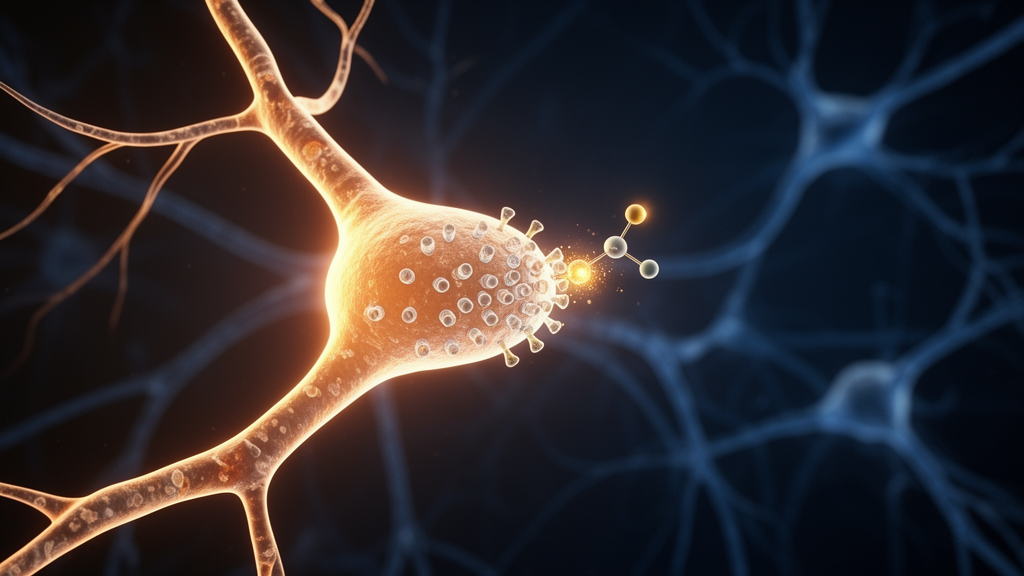
Synapses vary enormously in how many NMDA-type glutamate receptors they carry, and those differences shape how neurons compute. A new study published in Nature Neuroscience on 21 October 2026 reports that a single chemical modification, added by the kinase SIK3 to one site on the obligatory NMDA receptor subunit GluN1, acts as a key signal for recruiting these receptors to synapses. The work, from Rui Lu, Wade Morishita, Xiao Han, Paul Temkin, Robert C. Malenka and Thomas C. Südhof, identifies what the authors describe as a central mechanism controlling synaptic NMDA receptor localization.
NMDA receptors are central components of neural computation, yet how synapses set their levels has remained unclear. Using conditional GluN1 knock-in mice that allow monitoring of endogenous NMDA receptors, the researchers identified synaptic complexes containing SIK3 and GluN1. SIK3, a serine–threonine protein kinase, localizes to synapses, where it phosphorylates GluN1 at a single site. That one phosphorylation event, the study finds, controls the recruitment of NMDA receptors to synapses.
The evidence for selectivity is striking. Genetic deletion of SIK3 severely and selectively decreased synaptic GluN1 levels by roughly 60 percent, without altering levels of AMPA-type glutamate receptors and without inducing major transcriptional changes. In other words, the effect was not a general collapse of synaptic machinery or a downstream consequence of altered gene expression, but a specific loss of NMDA receptors from synapses.
Timing experiments reinforced the conclusion. Pharmacological inhibition of SIK3 impaired synaptic NMDA receptor responses within 45 minutes, indicating that the kinase continuously maintains receptor localization rather than only building it during development. Consistently, mutating the SIK3 phosphorylation site on GluN1 inhibited the synaptic recruitment of the receptor, while phosphomimetic and phosphorylation-blocking GluN1 mutations constitutively enhanced or suppressed NMDA receptor levels, respectively, as summarized in the study’s figure descriptions.
The study also connects the mechanism to sleep biology. ‘Sleepy’, a known gain-of-function mutation in SIK3 that increases sleep, selectively enhanced synaptic NMDA receptor levels by increasing GluN1 phosphorylation. In cultured neurons, the Sleepy mutation selectively increased GluN1 phosphorylation, and in vivo it enhanced synaptic NMDA receptor responses, according to the reported figures. The authors conclude that SIK3 phosphorylation of GluN1 provides a key signal for recruiting NMDA receptors to synapses.
Because the findings are reported in an abstract and figure summaries of a subscription article, they should be read as the authors’ own characterization of their experiments in mice and cultured neurons rather than as independently replicated results. Even so, the work offers a concrete molecular handle on a long-standing question: how individual synapses decide how many NMDA receptors to hold, a decision with broad implications for excitatory signaling in the brain.
Subject of Research: Molecular control of synaptic NMDA receptor localization by SIK3-mediated phosphorylation of GluN1
Article Title: SIK3 controls synaptic localization of NMDA receptors by phosphorylating GluN1
Article References: Lu, R., Morishita, W., Han, X., Temkin, P., Malenka, R. C., & Südhof, T. C. (2026). SIK3 controls synaptic localization of NMDA receptors by phosphorylating GluN1. Nature Neuroscience. https://doi.org/10.1038/s41593-026-02469-9
Image Credits: AI Generated
DOI: 10.1038/s41593-026-02469-9
Keywords: SIK3, GluN1, NMDA receptors, synapse, phosphorylation, glutamate receptors, neuroscience, Sleepy mutation, AMPAR, synaptic localization, controls, synaptic
News Source: Cassandra Pierce. (October 28, 2026). Single phosphorylation event controls where NMDA receptors sit in the brain. Scienmag.