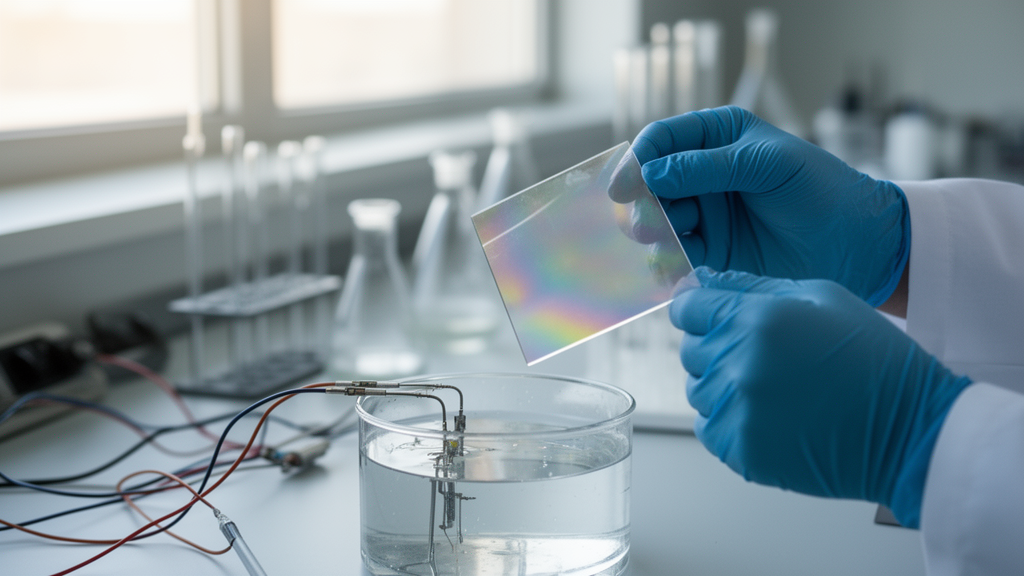
A team of researchers in India has reported the first electrodeposition of aluminium-modified bismuth oxide (Al-Bi2O3) thin films, grown directly onto fluorine-doped tin oxide (FTO) substrates at room temperature and then annealed at 400 degrees Celsius to form transparent, polycrystalline films with promising optical and electrical characteristics. The work, published as an open-access research article in the Springer journal Discover Surfaces, was carried out by Karthik Vinayagam and Anandhakumar Sundaramurthy of one institution together with Nishakavya Saravanan, and it sets out a relatively simple, low-temperature route to a material class that the authors argue could serve as a next-generation transparent conductive oxide for optoelectronic applications.
Transparent conductive oxides sit at the heart of many modern technologies, from solar cells and supercapacitors to electronic devices, nano-thermite systems and sensors. The research background cited in the article notes that such oxides are well suited to constructing energy-efficient optoelectronics, with the potential to consume 90 percent less power by eliminating backlighting. Metal oxides are considered promising alternatives to amorphous silicon and organic semiconductors for ultra-high resolution, ultra-large size, low cost and environmentally friendly devices. Yet developing an efficient p-type transparent conductive oxide remains an enormous challenge, because the localised nature of the O-2p valence band makes it difficult to introduce shallow acceptors and produces large effective hole masses. Most organic p-type candidates exhibit poor stability and low mobility, while fabrication processes for inorganic candidates based on copper oxide, tin oxide and nickel oxide have been complex, tedious and expensive.
Bismuth oxide occupies a special place in this landscape. The authors describe it as the best oxygen ion conductor, a property attributed to its fluorite-type crystal structure and a high percentage of oxygen vacancies, up to 25 percent. Bismuth oxide has five polycrystalline polymorphs, alpha (monoclinic), beta (tetragonal), gamma (body-centred cubic), delta (face-centred cubic) and epsilon (hexagonal), each with different electrical behaviour. The face-centred-cubic polymorph used in transparent conductive oxide films is only stable at high temperatures, between 729 and 825 degrees Celsius, owing to the nanocrystalline size of the particles in the film, around 70 nanometres. The possibility of obtaining bismuth oxide films at low temperatures is therefore of great interest, and previous methods including sol-gel chemistry, chemical bath deposition, pulsed laser deposition and chemical vapour deposition have been used to synthesise bismuth oxide nanostructures with varying size and morphology.
According to the article, doped bismuth oxide films have been reported using chemical bath, sol-gel and vapour deposition techniques, but these methods typically involve multi-step processing and stringent control over synthesis conditions. Electrochemical electrodeposition, by contrast, offers simplicity, cost-effectiveness and precise control over film thickness and composition. The authors state that, despite these benefits, no prior study had demonstrated the successful incorporation of aluminium into bismuth oxide films using this technique, and they describe their work as the first electrochemical route toward aluminium-modified bismuth oxide thin films. Earlier work showed that nanocrystalline thin films of delta-bismuth oxide can be electrodeposited at low temperature directly from alkaline solutions, but those films presented defective holes and thermal instability at high temperatures.
The experimental recipe is described in detail in the paper. The electrolyte was prepared by mixing bismuth (III) nitrate pentahydrate and aluminium sulphate hydrate in a 3:1 ratio in milli-Q water, giving final concentrations of 0.1 M and 0.033 M respectively, with tartaric acid at 0.25 M and potassium hydroxide at 2.5 M added to produce a highly alkaline solution with a pH of approximately 14. The working electrode was an FTO-coated glass substrate with a transmittance of 90 percent, decontaminated by an aqua regia bath followed by ultrasonic cleaning in isopropyl alcohol, acetone and deionized water. A platinum wire served as the counter electrode and a saturated Ag/AgCl electrode as the reference. After pretreating the substrate by cyclic voltammetry in dilute sulfuric acid, the films were deposited at room temperature in potentiostatic mode with potential limits of -1.5 to +1.8 V for six cycles at a scan rate of 100 mV/s, then annealed in a tubular furnace at 400 degrees Celsius for 30 minutes in normal atmospheric conditions.
The deposition mechanism, which had not previously been reported in the literature, was reconstructed from an earlier hypothesis that Bi(III) exists as [BiO]2- under strong alkaline conditions and can be oxidised to Bi(V) species. In the proposed sequence, bismuth species are oxidised to form a thin film of Bi2O5, which then undergoes reduction to Bi2O3 with the release of oxygen. Aluminium sulphate hydrolysis is proposed to yield aluminium hydroxide and aluminium oxide with the evolution of hydrogen, and the authors suggest that hydrogen evolution during the reduction process facilitates the conversion of Bi2O5 to Bi2O3. Cyclic voltammetry showed peaks corresponding to hydrogen ion reduction and to Bi2O3/Al-Bi2O3 deposition at -0.44 V and -0.7 V respectively. When the scan rate was varied from 10 to 100 mV/s, the redox peak currents increased linearly with the square root of the scan rate, a diffusion-controlled behaviour described by the Randles-Sevcik relationship that the authors interpret as supporting the co-deposition of both aluminium and bismuth species into a homogeneous mixed oxide layer.
Optimisation of the deposition window and annealing duration proved decisive for film quality. Deposition within a window of -1.65 V to +1.65 V produced discrete particles whose size grew with the number of cycles, while a window of -1.8 V to +1.5 V yielded larger, chunk-like structures. Without annealing, the deposited material formed large agglomerated chunks. The 400 degrees Celsius annealing temperature was selected through systematic optimisation considering crystallinity, phase stability and optical properties; preliminary experiments at lower temperatures resulted in incomplete crystallisation, while temperatures above 450 degrees Celsius posed a risk of structural transformation and damage to the underlying FTO substrate. Films deposited over six cycles in the chosen window showed a reduced surface roughness of 0.116 micrometres, though with visible cracks, and after 30 minutes of annealing the film underwent a dramatic transformation attributed to recrystallisation, producing thin prisms with multiple sharp edges and a measured thickness of approximately 114 micrometres. The authors acknowledge that this thickness exceeds conventional transparent conductive oxide benchmarks, which are typically below 1 micrometre, and note that it could be reduced by fewer deposition cycles, shorter deposition times and careful control of the applied potential window.
Structural analysis by X-ray diffraction revealed peaks corresponding to planes of both bismuth oxide and aluminium oxide, confirming the formation of the cubic phase of Bi2O3 alongside the tetragonal phase of Al2O3. The sharp diffraction peaks, without any discernible amorphous halo, indicated a well-defined crystalline structure, and increased peak intensity after annealing pointed to enhanced crystallinity and grain growth. The authors interpret the material as an aluminium-modified bismuth oxide structure in which limited substitutional incorporation of Al3+ into the Bi2O3 lattice may induce lattice distortion, while a fraction of the aluminium exists as a separate Al2O3 phase or as amorphous aluminium-containing species. Fourier transform infrared spectroscopy showed peaks associated with Al2O3 and Al-O stretching, Bi-O bonds, Bi-O-Bi stretching and Al-O-Al bonds, together with bands attributed to water, hydroxyl groups, carbonyl stretching and nitrogen-hydrogen and carbon-hydrogen vibrations.
Optical measurements, performed with bare FTO as the baseline to isolate the film properties, showed that the transmittance of annealed Al-Bi2O3 films reached up to 76 percent, compared with 68 percent for as-deposited Al-Bi2O3 and 59 percent for Bi2O3 films. Tauc plot analysis of the directly allowed transition gave optical band gap values of 2.3, 2.25 and 2.2 electronvolts for Bi2O3, as-deposited Al-Bi2O3 and annealed Al-Bi2O3 films respectively; the authors attribute the slight reduction to defect-induced band tailing, microstrain effects and microstructural evolution rather than significant intrinsic band structure modification. The refractive index decreased systematically with increasing wavelength, and its stability improved from Bi2O3 films through as-deposited to annealed Al-Bi2O3 films, which the authors read as evidence that aluminium incorporation and annealing positively influence the optical properties. The extinction coefficient of the annealed Al-Bi2O3 films decreased steadily with wavelength, whereas the unannealed films showed random values.
On the electrical side, the films exhibited a bulk resistivity of 1.04 x 10⁻⁴ ohm centimetres and a figure of merit, calculated from sheet resistance and transmittance at 700 nanometres, of 3 x 10⁻³ (ohm per square) to the power of minus one. Although bismuth oxide is known for high oxygen-ion conductivity at elevated temperatures, the authors report that the measured room-temperature resistivity and linear current-voltage characteristics indicate that electronic conduction dominates under the present measurement conditions, suggesting mixed ionic-electronic conduction behaviour. The choice of FTO over indium-doped tin oxide as the substrate was deliberate: FTO is believed to have higher chemical stability at high temperatures, with its film resistance staying constant until about 450 degrees Celsius and even decreasing at 600 degrees Celsius, whereas the resistance of ITO films begins to rise above 250 degrees Celsius. The authors conclude that the study demonstrates a simple methodology to fabricate Al-Bi2O3 thin films for next-generation transparent conductive oxides, warranting further exploration and potential integration into advanced electronic and energy applications.
Subject of Research: Electrodeposition of aluminium-modified bismuth oxide thin films as transparent conductive oxides for optoelectronics
Article Title: Fabrication of aluminium modified Bi2O3 thin film as a transparent conductive oxide for optoelectronic applications
Article References: Vinayagam, K., Saravanan, N., & Sundaramurthy, A. (2026). Fabrication of aluminium modified Bi2O3 thin film as a transparent conductive oxide for optoelectronic applications. Discover Surfaces, 1(1), Article 4. https://doi.org/10.1007/s44507-026-00003-9
Image Credits: AI Generated
DOI: 10.1007/s44507-026-00003-9
Keywords: transparent conductive oxide, bismuth oxide, aluminium doping, electrodeposition, thin films, FTO substrate, optoelectronics, annealing, optical band gap, X-ray diffraction, transmittance, electrical resistivity
News Source: Denise Maddox. (October 28, 2026). Room-Temperature Electrodeposition Yields Aluminium-Modified Bismuth Oxide Films for Transparent Electronics. Scienmag.