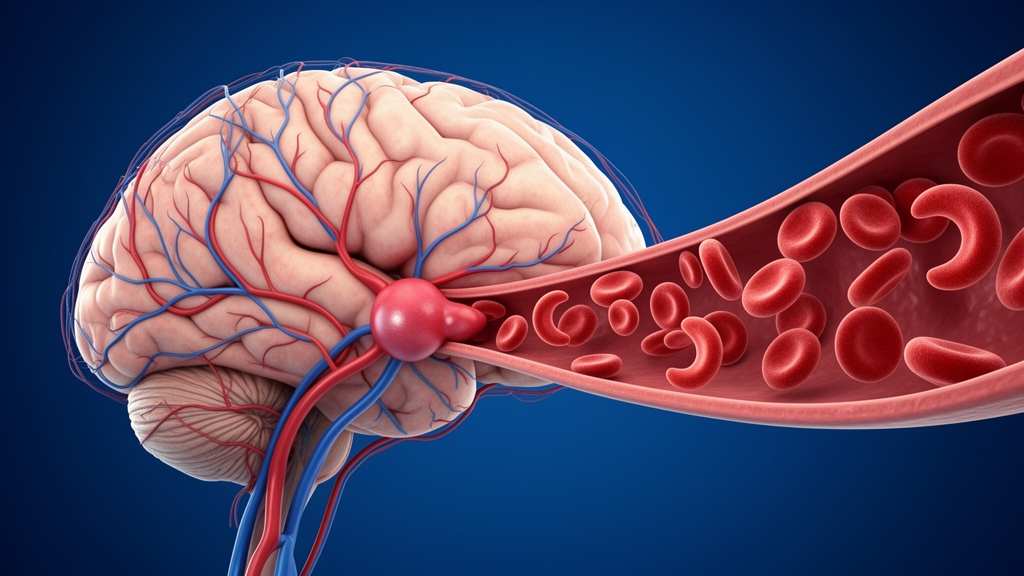
Children and young adults with sickle cell disease who developed cerebral aneurysms were markedly older than those without them, and most of the aneurysms in the study occurred in males, according to a single-center observational study published in BMC Neurology.
The research team, led by Alejandro R. Gonzalez-Barreto and senior author Lori C. Jordan, set out to identify which factors are associated with a higher frequency of cerebral aneurysms in sickle cell disease, a question that had not previously been explored in detail. Their hypothesis was that increased cerebral blood flow, low hemoglobin levels, and established aneurysm risk factors from the general population would be linked to aneurysms in people with sickle cell disease.
Between 2014 and 2022, the investigators recruited children and young adults with the HbSS and HbSβ0 thalassemia forms of sickle cell disease from an academic medical center clinic and a nearby community health clinic, along with age- and race-matched controls. Participants were between 6 and 45 years old and underwent brain MRI and magnetic resonance angiography, with risk factor data collected alongside the imaging.
Aneurysms were found in 13 of 183 participants with sickle cell disease, a prevalence of 7.1 percent, compared with 3 of 77 controls, or 3.9 percent. All aneurysms detected in control participants were found in women. Within the sickle cell disease group, the pattern looked very different: 10 of the 13 aneurysms, or 76.9 percent, occurred in males, while males made up only 44.7 percent of participants without aneurysms, a difference the authors report as statistically significant.
Age showed the strongest association. Participants with aneurysms had a mean age of 30.9 years, compared with 17.2 years for those without aneurysms, a difference the study reports as highly significant. Smoking also stood out: 23.1 percent of participants with aneurysms were current smokers, versus 4.7 percent of those without aneurysms, a comparison the authors report as significant.
Two of the hypothesized mechanisms did not hold up in the data. Hemoglobin levels were not different between sickle cell disease participants with and without aneurysms. Cerebral blood flow was numerically higher in the aneurysm group, 86.7 versus 80.8 milliliters per 100 grams per minute, but the difference was not statistically significant, so the study did not find evidence linking increased blood flow to aneurysm presence.
In multivariable analysis using penalized logistic regression, the researchers fitted models that adjusted for several factors simultaneously. In a model including age, sex, systolic blood pressure and current smoking, only age remained significant, with an odds ratio of 1.14 per year, meaning each additional year of age was associated with a 14 percent increase in the odds of having an aneurysm. Male sex showed a large but not quite significant effect in that model, with an odds ratio of 3.85.
A second model that included age, sex and the presence of silent cerebral infarcts or ischemic stroke told a similar story. Age was again significant, with an odds ratio of 1.14, and male sex reached significance with an odds ratio of 4.45. The authors conclude that age, smoking and male sex were identified as risk factors for aneurysm development in sickle cell disease, while increased cerebral blood flow and low hemoglobin levels were not linked to aneurysms in this cohort.
The team notes that the findings could be clinically important for identifying subgroups of people with sickle cell disease at higher risk of cerebral aneurysms. As an observational, single-center cross-sectional study, it establishes associations rather than proving causation, and the relatively small number of aneurysm cases means the estimates carry wide uncertainty, as reflected in the confidence intervals reported for the regression models. The article was published as an open-access paper on 28 October 2026.
Subject of Research: Risk factors for cerebral aneurysms in children and young adults with sickle cell disease
Article Title: Risk factors for cerebral aneurysms in sickle cell disease
Article References: Gonzalez-Barreto, A. R., Donahue, M. J., Aumann, M., Rodeghier, M., Davis, S., DeBaun, M. R., Kassim, A. A., Martin, D., Pruthi, S., Davis, L. T., & Jordan, L. C. (2026). Risk factors for cerebral aneurysms in sickle cell disease. BMC Neurology. https://doi.org/10.1186/s12883-026-05541-w
Image Credits: AI Generated
DOI: 10.1186/s12883-026-05541-w
Keywords: sickle cell disease, cerebral aneurysm, cerebral blood flow, hemoglobin, smoking, male sex, MRI, arterial spin labeling, silent cerebral infarcts, BMC Neurology, observational study, risk factors
News Source: Cassandra Pierce. (October 28, 2026). Age, male sex and smoking linked to brain aneurysms in sickle cell disease. Scienmag.