


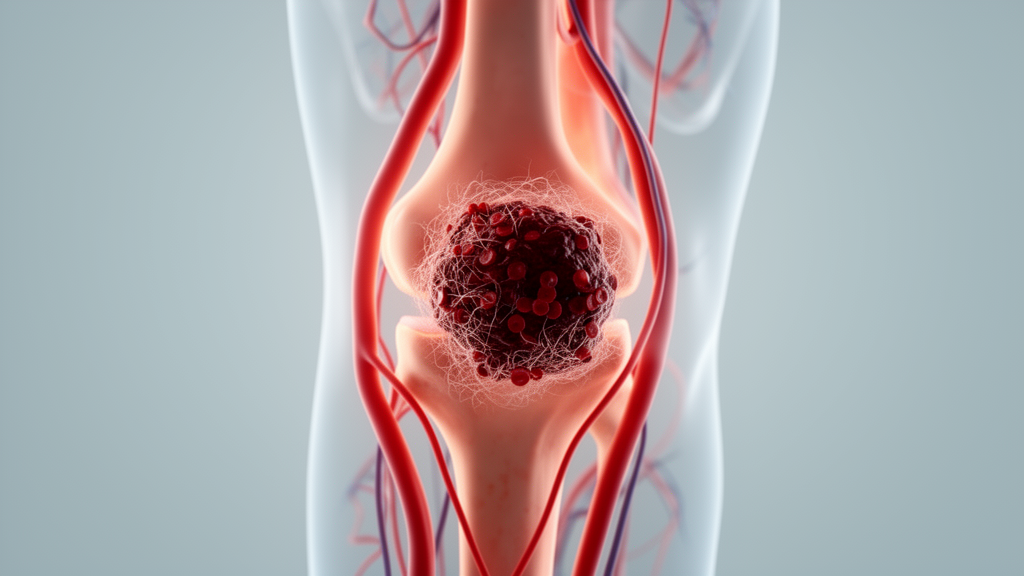
A combined blood-test model built from routine coagulation and fibrinolysis markers can identify many cases of deep vein thrombosis after knee arthroplasty with moderate accuracy, according to a study published in BMC Surgery. The research, led by Xiao Ze, Hongyi Zhu, Haibin Zhou and Ye Xie, enrolled 376 patients undergoing knee arthroplasty and used ultrasound findings as the reference standard for diagnosing postoperative clots. Of those patients, 268 showed no thrombosis while 108 did, giving the team a substantial group of both outcomes to work with when testing which laboratory signals tracked most closely with the condition.
Deep vein thrombosis is a recognized concern after knee replacement surgery, and ultrasound is the standard method for detecting it in the days following the operation. The study’s objective was to develop and internally validate a model based on thrombosis biomarkers for the early identification of ultrasound-detected DVT after knee arthroplasty, and to evaluate how well the model discriminated between patients with and without clots and whether it might hold clinical utility. The researchers emphasized that the work was an internal validation exercise, meaning the model was tested within the same patient cohort rather than in an entirely separate population.
The team measured four markers tied to clot formation and breakdown: D-dimer, thrombin–antithrombin complex, plasmin–α2-plasmin inhibitor complex, and tissue-type plasminogen activator–plasminogen activator inhibitor-1 complex. Each reflects a different stage of the hemostatic process. TAT rises when thrombin is generated and immediately neutralized by antithrombin, a signature of active clot formation. PIC appears when plasmin degrades fibrin, marking fibrinolytic activity. t-PAIC forms when the body’s natural clot-dissolving activator is bound and neutralized by its inhibitor, indicating a shift in the balance of the fibrinolytic system. D-dimer, the most widely used of the four, is a degradation product of cross-linked fibrin and a general indicator that clot formation and breakdown have occurred somewhere in the circulation.
When the researchers compared the 108 patients who developed DVT with the 268 who did not, several differences emerged. The DVT group had a higher average age and a lower platelet count, differences that reached statistical significance at the p < 0.05 level. More strikingly, the levels of D-dimer, TAT, PIC and t-PAIC were all significantly elevated in the thrombosis group, with p values below 0.001. This pattern is biologically coherent: patients forming clots would be expected to show both greater thrombin activity and greater fibrin turnover, and the measurements captured exactly that signature in the postoperative blood samples.
To determine which markers carried independent information, the investigators ran univariable and multivariable logistic regression analyses. In the multivariable model, TAT and t-PAIC remained independently associated with postoperative DVT, while D-dimer showed a borderline association. PIC, despite being significantly elevated on its own, did not retain independent significance once the other markers were accounted for, suggesting that its information overlapped with that of the retained variables. This kind of statistical pruning is standard practice in biomarker modeling, because correlated markers of the same underlying process often carry redundant information.
The combined model built from D-dimer, TAT and t-PAIC achieved an area under the receiver operating characteristic curve of approximately 0.75. An AUC of 0.75 corresponds to moderate discriminative ability, meaning the model ranked patients with DVT above those without it noticeably better than chance, but well short of the near-perfect separation that a stand-alone diagnostic test would require. The researchers also reported a Brier score of 0.18, a measure that combines discrimination and calibration into a single number where lower values indicate better predictive accuracy. They characterized this as indicating acceptable overall performance.
Calibration, the agreement between predicted probabilities and observed outcomes, was assessed with calibration curves and described as generally acceptable. The team also performed a decision curve analysis, which evaluates the net benefit of using a model at different risk thresholds. The model provided a positive net benefit across threshold probabilities of 0.10 to 0.40, a range that in a postoperative surveillance context would correspond to deciding which patients warrant closer monitoring or further imaging. Bootstrap methods were used for internal validation, a resampling technique that estimates how stable the model’s performance estimates are within the original dataset.
The authors concluded that the combined biomarker model demonstrated moderate discriminatory ability and acceptable overall performance for the early identification of ultrasound-detected DVT after knee arthroplasty. They suggested that such a model may support early postoperative risk stratification and help identify patients who require closer surveillance or further imaging evaluation. The framing is deliberately cautious: the model is positioned as a potential adjunct to existing clinical assessment and ultrasound, not as a replacement for either.
Several limitations temper the findings. The study relied on internal validation only, and the authors explicitly state that external validation is required to confirm the model’s generalizability and clinical utility before any implementation. A model that performs at an AUC of 0.75 in one cohort may perform differently in another, particularly across centers with different patient populations, surgical protocols or assay methods. The moderate discrimination also means that a meaningful proportion of patients would still be misclassified if the model were used alone, which is why the authors frame it as a tool for stratifying surveillance intensity rather than as a definitive diagnostic test. The study was published as open access research in BMC Surgery on 23 October 2026, and the article notes that this early-shared version is citable and carries a permanent DOI while remaining subject to further edits before the final Version of Record.
Subject of Research: A biomarker-based model for early identification of deep vein thrombosis after knee arthroplasty
Article Title: Early identification of deep vein thrombosis after knee arthroplasty based on novel thrombosis biomarkers
Article References: Ze, X., Zhu, H., Zhou, H., & Xie, Y. (2026). Early identification of deep vein thrombosis after knee arthroplasty based on novel thrombosis biomarkers. BMC Surgery. https://doi.org/10.1186/s12893-026-04300-5
Image Credits: AI Generated
DOI: 10.1186/s12893-026-04300-5
Keywords: deep vein thrombosis, knee arthroplasty, D-dimer, thrombin-antithrombin complex, t-PAIC, biomarkers, logistic regression, ROC curve, internal validation, risk stratification, BMC Surgery, postoperative surveillance
News Source: Ophelia Keating. (October 28, 2026). Blood Clot Markers Show Promise for Spotting DVT After Knee Surgery. Scienmag.



