

• HOME
  • NEWS
  • EXPLORE
    • CAREER
      • Companies
      • Jobs
    • EVENTS
    • iGEM
      • News
      • Team
    • PHOTOS
    • VIDEO
    • WIKI
  • BLOG
  • COMMUNITY
    • FACEBOOK
    • INSTAGRAM
    • TWITTER
Wednesday, October 28, 2026
BIOENGINEER.ORG
No Result
View All Result
  • Login
  • HOME
  • NEWS
  • EXPLORE
    • CAREER
      • Companies
      • Jobs
        • Lecturer
        • PhD Studentship
        • Postdoc
        • Research Assistant
    • EVENTS
    • iGEM
      • News
      • Team
    • PHOTOS
    • VIDEO
    • WIKI
  • BLOG
  • COMMUNITY
    • FACEBOOK
    • INSTAGRAM
    • TWITTER
No Result
View All Result
Bioengineer.org
No Result
View All Result
Home NEWS Science News Biology

Eye-tracking reveals where students look wrong when reading phylogenetic trees

by
October 28, 2026
in Biology
Reading Time: 2 mins read
0
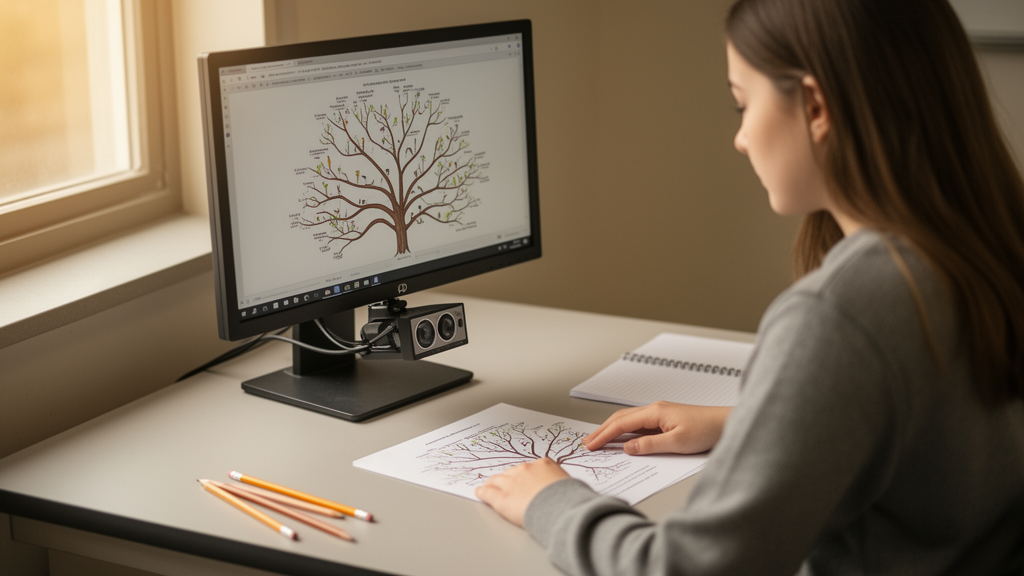
Eye-tracking reveals where students look wrong when reading phylogenetic trees

Eye-tracking reveals where students look wrong when reading phylogenetic trees

Share on FacebookShare on TwitterShare on LinkedinShare on RedditShare on Telegram

Students who struggle to interpret phylogenetic trees may be looking in the wrong places, according to a new eye-tracking study of introductory biology students. The research, published in Developmental Biology Advances, documented how learners visually process evolutionary trees, the branching diagrams scientists use to represent hypotheses about relationships among species.

The study team, led by Mallika Saha with Daniel Ferguson, Tina Marcroft and Kristy L. Daniel, asked introductory biology students to complete tree-reading tasks while an eye tracker recorded their gaze patterns. The researchers defined tree-reading as the ability to understand, use and accurately communicate the hypotheses represented within phylogenetic trees, a skill students are known to find difficult.

By analyzing where participants looked and for how long, the researchers identified specific areas of interest that students visually assess when solving tree-reading questions. They compared the eye movements of students who answered the tasks accurately with those who answered incorrectly.

The comparison revealed significant differences in both dwell time and fixation event counts between the two groups. Participants who gave incorrect responses spent longer dwell times on the task prompt itself and directed less visual attention to the phylogenetic tree than participants who answered correctly.

Inaccurate performers also spent more time visually processing less informative features of the trees than their more accurate peers on each task. In other words, struggling students were not simply looking away from the problem; they were allocating their attention to elements of the diagram that carried less information relevant to the question.

The authors argue that while tree-reading instruction has been expanded in introductory biology courses, more explicit tree-thinking instruction is needed to enhance students’ comprehension of phylogenetic trees. They suggest that identifying which visual elements of these models cause longer dwell times, or which are being ignored by learners, can help educators adapt instruction to emphasize the most informative areas of interest and promote more accurate tree-thinking.

Because the study examined introductory biology students during interpretation tasks using an eye-tracking approach, its findings describe visual processing patterns in that setting rather than establishing which teaching interventions would improve performance. The authors note the work is intended as a starting point for educators seeking to understand how students visually engage with evolutionary diagrams before designing better instruction.

Subject of Research: Eye-tracking study of how introductory biology students visually process phylogenetic trees during interpretation tasks

Article Title: Viewing trees: an investigation into how students visually interact with phylogenetic trees

Article References: Saha, M., Ferguson, D., Marcroft, T., & Daniel, K. L. (2026). Viewing trees: an investigation into how students visually interact with phylogenetic trees. Developmental Biology Advances. https://doi.org/10.1186/s13227-026-00276-8

Image Credits: AI Generated

DOI: 10.1186/s13227-026-00276-8

Keywords: phylogenetic trees, eye tracking, tree-reading, biology education, introductory biology, dwell time, fixations, tree-thinking, student misconceptions, visual attention, Viewing, trees

News Source: Drew Townsend. (October 28, 2026). Eye-tracking reveals where students look wrong when reading phylogenetic trees. Scienmag.

Tags: biology educationdwell timeeye trackingfixationsintroductory biologyphylogenetic treesstudent misconceptionstree-readingtree-thinkingtreesViewingvisual attention
Share12Tweet7Share2ShareShareShare1

Related Posts

Field Guide Aims to Make Vertebrate Sampling More Useful for Pathogen Research

Field Guide Aims to Make Vertebrate Sampling More Useful for Pathogen Research

October 28, 2026
Research report: Genomic and functional characterization of the respiratory commensal Haemophilus paraphrohaemolyticus reveals production of anti-streptococcal peptides

Research report: Genomic and functional characterization of the respiratory commensal Haemophilus paraphrohaemolyticus reveals production of anti-streptococcal peptides

October 28, 2026

RFID Tracking Shows Fungicide and Insecticide Leave Honey Bee Homing Largely Unimpaired

October 28, 2026

Soil bacterium with plastic-degrading genes revealed as candidate new Cupriavidus species

October 28, 2026

POPULAR NEWS

  • RNA methyltransferase NSUN2 stabilizes PARP9 transcript to drive breast cancer growth and immune escape, study finds

    RNA methyltransferase NSUN2 stabilizes PARP9 transcript to drive breast cancer growth and immune escape, study finds

    29 shares
    Share 12 Tweet 7
  • Linalool reshapes microbial networks during cigar tobacco fermentation, study finds

    29 shares
    Share 12 Tweet 7
  • Retrospective study wrongly claimed prospective validation, letter warns

    29 shares
    Share 12 Tweet 7
  • Sepsis Kills One in Three Patients in Mogadishu Emergency Department, Prospective Cohort Finds

    29 shares
    Share 12 Tweet 7

About

We bring you the latest biotechnology news from best research centers and universities around the world. Check our website.

Follow us

Recent News

Field Guide Aims to Make Vertebrate Sampling More Useful for Pathogen Research

Simple light test helps surgeons locate subungual glomus tumors during surgery

Research report: Disaster-resilient communities against floods: the “swarm” concept as a frame for effective small-size cooperative and distributed measures working at the urban scale: a design simulation for Como

Subscribe to Blog via Email

Enter your email address to subscribe to this blog and receive notifications of new posts by email.

Join 85 other subscribers
  • Contact Us

Bioengineer.org © Copyright 2023 All Rights Reserved.

Welcome Back!

Login to your account below

Forgotten Password?

Retrieve your password

Please enter your username or email address to reset your password.

Log In
No Result
View All Result
  • Homepages
    • Home Page 1
    • Home Page 2
  • News
  • National
  • Business
  • Health
  • Lifestyle
  • Science

Bioengineer.org © Copyright 2023 All Rights Reserved.
