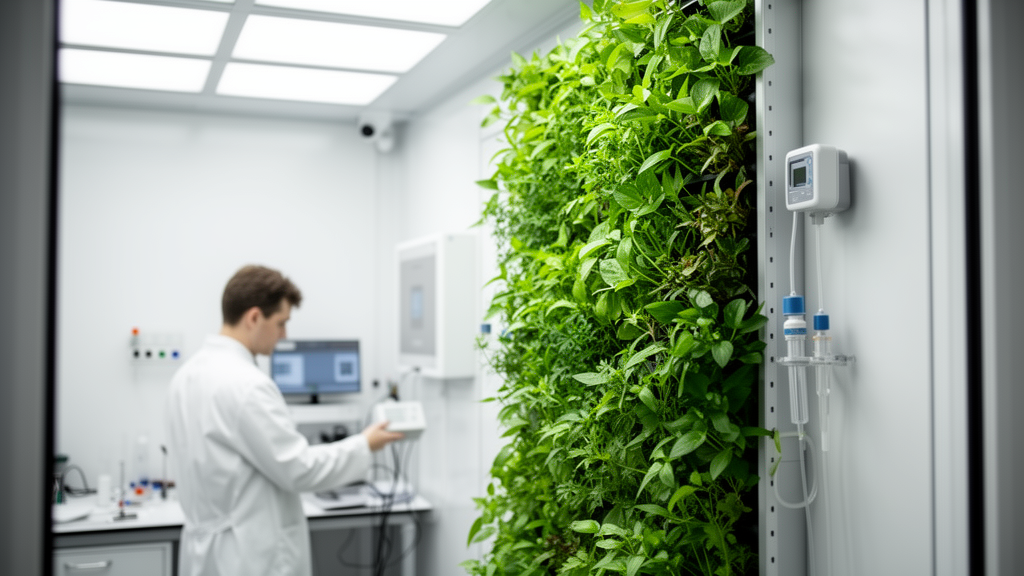
Formaldehyde is one of the most persistent pollutants in the air we breathe indoors, released steadily by engineered wood flooring, adhesives, paints and furniture boards. A new open-access study in the journal City and Built Environment reports that an actively ventilated green wall — a planted module with a fan pushing air through its substrate — can remove a meaningful fraction of this gas in controlled chamber tests, and that a purpose-built computer model can predict how such a system would perform in a small office over a full week of operation.
Researchers Dan Wu, Darui He and Lijun Zuo built a dynamic fumigation system around a 216-litre acrylic chamber, in which a green wall module measuring 350 by 350 by 100 millimetres was installed. The module held nine circular planting compartments filled with a growth substrate of activated carbon particles, pebbles and nutrient soil mixed in a volume ratio of 30:30:40, planted with Epipremnum aureum, a hardy ornamental vine. A fan on the back of the module drew formaldehyde-laden air through the substrate and plants before returning it to the chamber. The whole apparatus was held at 22 degrees Celsius with relative humidity of 40 percent, plus or minus 5 percent, throughout the tests.
The experiments were designed to measure three standard performance metrics. Single-pass removal efficiency, or SPRE, describes how much formaldehyde disappears from the air during one transit through the device. Elimination capacity, EC, expresses the mass of formaldehyde removed per square metre of wall per hour, and the clean air delivery rate, CADR, converts that into an equivalent volume of purified air. Formaldehyde concentrations at the inlet and outlet were measured with a spectrophotometer calibrated against certified standard gas, while substrate moisture and temperature were logged every minute by two soil sensors placed at the upper and lower positions of the bed layer.
Across five air supply velocities ranging from 0.027 to 0.063 metres per second, the team found a clear trade-off. SPRE fell steadily from 34.5 percent at the slowest velocity to 24.75 percent at the fastest, because faster air spends less time in contact with the microbial biofilm and adsorbing surfaces. Yet the total amount of formaldehyde removed per hour rose: EC climbed from 13.51 to 22.63 milligrams per square metre per hour, and CADR increased from 4.14 to 6.93 cubic metres per hour. In other words, pushing more air through the wall removes more pollutant in absolute terms even though each parcel of air is cleaned less thoroughly.
Inlet concentration mattered as well. Holding the airflow at the reference velocity of 0.045 metres per second, the researchers varied the incoming formaldehyde concentration from 0.2 to 1.0 milligrams per cubic metre and observed the elimination capacity rise almost in proportion, from 9.48 to 47.4 milligrams per square metre per hour. The moisture data added a subtle dynamic: over the 24-hour runs the substrate steadily dried out, with the upper sensor reading consistently lower than the lower one because the module lay on its side and gravity drew water downward. As moisture evaporated, less heat was carried away and the bed temperature gradually rose, with the upper layer again running warmer than the lower.
Those moisture measurements were not merely descriptive. The team fed the averaged bed moisture content and temperature into a numerical model built on the open-source finite-element platform FEniCS, written in Python. The model represents the green wall as three coupled phases: gas-phase convection and diffusion of formaldehyde and oxygen through the porous bed, liquid-phase diffusion and microbial degradation within the biofilm coating the particles, and solid-phase adsorption described by a linear Henry isotherm. Microbial degradation follows a Haldane-type kinetic model that accounts for inhibition at high pollutant concentrations, and the biofilm is assumed to cover only part of each particle surface, leaving some area exposed for direct adsorption.
When the model was run against the experimental data, agreement was strongest in the later hours of each run. Quantitative goodness-of-fit metrics showed coefficients of determination between 0.87 and 0.93, root-mean-square errors below 0.02 milligrams per cubic metre, and relative errors under 7 percent. The authors note that the simulation tracked the final four data points of each 24-hour experiment more closely than the earliest hours, which they attribute to initial moisture redistribution, biofilm adaptation and transient adsorption effects during the first six hours. The model was therefore judged suitable for simulating purification over relatively long periods.
Cross-referencing six bed cross-sectional areas with six operating air velocities produced 36 combined scenarios run over 192 hours, including a 24-hour pre-deposition period and a full week of purification. In 32 of the 36 scenarios the indoor formaldehyde concentration remained below the 0.08 milligrams per cubic metre safety threshold of the Chinese national standard GB/T 18883-2022 by the end of the simulation. The four failures occurred mostly where both bed area and airflow were small. Among the qualifying scenarios, 27 kept the total exposure time above the threshold — a metric the authors call TK — under 10 hours, while five conditions, all at the lowest airflow, produced exposure times exceeding 100 hours.
The simulations also revealed an economic operating logic for designers. When the bed cross-sectional area grew from 0.5 to 1.5 square metres, the minimum airflow speed needed to keep exposure times low fell from 0.04 to 0.02 metres per second, and beyond 1.5 square metres the economic speed stabilised. Conversely, raising the operating speed from 0.01 to 0.03 metres per second allowed the required bed area to shrink from 3.0 to 1.0 square metres, after which further speed increases brought no additional savings. A sensitivity analysis indicated the projected number of safe conditions was most sensitive to the assumed formaldehyde emission rate, followed by bed area and airflow, with moisture decline and occupancy assumptions playing smaller roles.
The authors are careful to spell out the boundaries of these findings. The experiments used a constant-velocity air pump at a fixed temperature, with relative humidity neither varied nor controlled as an independent variable; room pressure differentials, variable-frequency fan operation and natural ventilation were excluded from both the chamber work and the simulations. No separate control experiments isolated the individual contributions of substrate adsorption, water-film absorption, microbial degradation and plant uptake, and the pressure drop across the wall was not directly measured. The model assumes constant substrate porosity, constant temperature and one-dimensional gas flow, and does not capture long-term changes in root density or biofilm accumulation. The validation rests on a limited number of experimental data points, and the occupancy assumptions in the sensitivity analysis were based on typical office scenarios rather than measured data. Within those limits, the study offers a quantified, model-backed picture of how actively ventilated planted walls could contribute to indoor formaldehyde control, and a roadmap — humidity-coupled models, natural ventilation scenarios and component-level control experiments — for testing that picture under more realistic conditions.
Subject of Research: Formaldehyde removal performance of actively ventilated green walls measured in chamber experiments and predicted by a numerical model for indoor office environments.
Article Title: Experimental and simulation studies on the formaldehyde purification performance of active green walls
Article References: Wu, D., He, D., & Zuo, L. (2026). Experimental and simulation studies on the formaldehyde purification performance of active green walls. City and Built Environment, 4(1), Article 22. https://doi.org/10.1007/s44213-026-00087-6
Image Credits: AI Generated
DOI: 10.1007/s44213-026-00087-6
Keywords: active green walls, formaldehyde, indoor air quality, phytoremediation, single-pass removal efficiency, clean air delivery rate, CFD simulation, FEniCS, biofilm degradation, substrate moisture content, office ventilation, air purification
News Source: Russell Cooper. (October 28, 2026). Active Green Walls Strip Formaldehyde from Indoor Air in Lab and Simulation Tests. Scienmag.