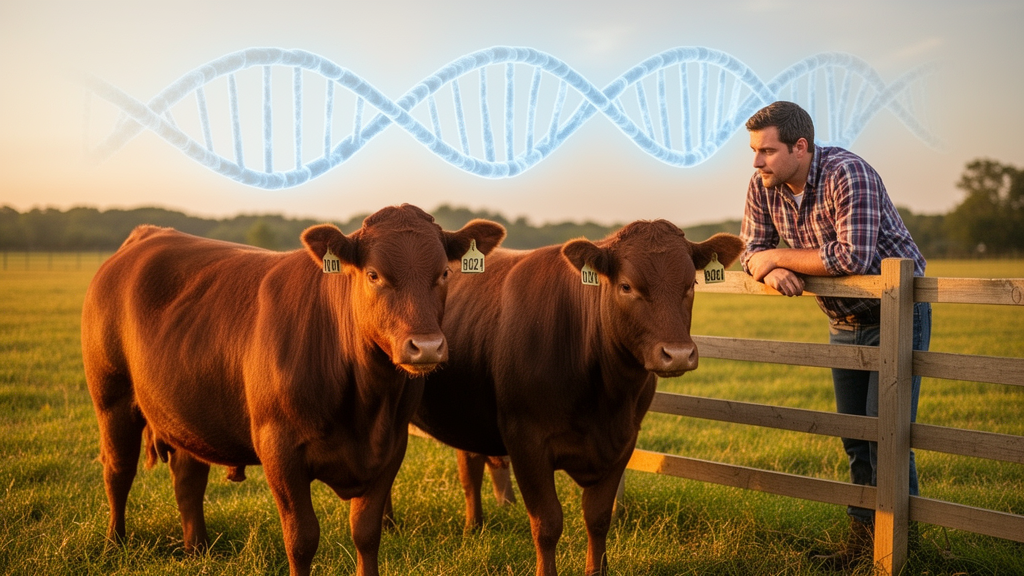
A Brangus animal carrying exactly three-eighths Brahman ancestry is not a single, well-defined genomic entity. A new simulation study published in Genetics Selection Evolution shows that two animals with an identical global breed composition can carry fundamentally different arrangements of ancestry along their chromosomes, and that these hidden differences strongly influence whether their calves fall within the accepted breed-composition range. The work, led by Miguel Gallach, used fully controlled computer simulations rather than real herd data to isolate a problem that has been difficult to disentangle in living populations: the distinction between what an animal is, in terms of nominal ancestry, and what it is likely to produce as a parent.
Composite breeds such as Brangus were developed to combine complementary traits from founder breeds while retaining some of the heterosis generated by the original cross. Brangus is classically defined as five-eighths Angus and three-eighths Brahman, a target Brahman ancestry proportion of 0.375. But the same genome-wide proportion can be assembled in many ways. At any given stretch of DNA, an animal may carry two Angus copies, two Brahman copies, or one of each. Two nominal animals can therefore differ in ancestry heterozygosity, in the amount of Brahman homozygosity, and in the size and distribution of ancestry blocks along chromosomes, even though a breed-composition certificate would describe them identically.
To test whether these architectural differences matter for breeding outcomes, the study simulated two alternative pathways to the same expected Brahman proportion of 0.375. In the direct pathway, Angus and Brahman founders were crossed to produce first-generation hybrids, which were then crossed back to Angus and finally to another set of hybrids. In the indirect pathway, the hybrids were first crossed to Brahman, producing animals with 75 percent Brahman ancestry, and then crossed back to Angus. Both routes converge on the same expected global composition, but they open different genotype spaces: the direct route can produce animals with Angus-homozygous, heterozygous and Brahman-homozygous segments, while the indirect route yields only Angus-homozygous and heterozygous states. The founders were deliberately fixed for alternative ancestry states at 2,900 loci across 29 chromosomes, an idealization that makes every descendant’s ancestry a direct readout of recombination and Mendelian segregation.
At the population level, both pathways hit the target: mean Brahman ancestry was 0.378 in the direct pathway and 0.373 in the indirect pathway across 100 simulated final individuals each. The similarity ended there. The direct pathway produced a much broader spread of individual ancestry values, with a standard deviation of 0.040 versus 0.026, and 54 percent of direct-pathway animals fell outside the nominal interval of 0.350 to 0.400, compared with 32 percent in the indirect pathway. Ancestry heterozygosity also diverged sharply, averaging 0.746 in the indirect pathway against 0.507 in the direct pathway, with the two distributions overlapping only in a narrow band between 0.614 and 0.628. In practice, the authors note, a nominal animal’s heterozygosity could serve as a preliminary genomic diagnostic of which formation route produced it.
The researchers then mimicked a common commercial practice: filtering candidate sires into the nominal ancestry interval before sale. From 5,000 simulated candidate males per pathway, 100 sires within the nominal range were selected for each catalogue. This filtering standardized global ancestry but did not erase the structural footprint of the formation pathway. Direct-derived sires spread across a broad region of possible genomic configurations, varying in both heterozygosity and Brahman homozygosity, while indirect-derived sires clustered at the high-heterozygosity end with no Brahman homozygosity at all. Because the target composition of 0.375 admits a continuum of architectures linked by the constraint that Brahman homozygosity equals 0.375 minus half the heterozygosity, nominal status alone cannot specify a unique genomic state.
Commercial female populations, left unfiltered, retained even more pathway-dependent variation, with direct females spanning Brahman ancestry values from 0.217 to 0.521 and indirect females from 0.292 to 0.449. When simulated herds of these females were renewed for ten generations using only nominal catalogue sires, mean ancestry stayed close to the target throughout, yet individual-level failure persisted. Direct herds began with 52.8 percent of females outside the nominal interval and indirect herds with 35.3 percent; after ten generations the proportions ranged from 43.4 to 49.6 percent across the four sire-by-dam scenarios. Some scenarios improved and others worsened, but none came close to eliminating non-nominal animals. A herd can look correctly centred on average while containing many individuals outside the accepted range, a result that argues against monitoring breed composition through population averages alone.
A longer experiment pushed the question further. Nominal animals from both pathways were combined into a single breeding population and maintained for 100 generations under random inter se mating, in three population-size scenarios ranging from 200 females and 50 sires to 1,500 females and 375 sires. The standard deviation of Brahman ancestry rose to a maximum around generations 10 to 15 and then declined gradually, but at generation 100 it still stood at roughly 0.016 in all scenarios, well above the 0.0064 expected if ancestry loci segregated independently. Non-nominal frequencies also declined from their early peak but remained non-negligible, at 0.132 to 0.182 depending on scenario. Genome-wide ancestry variance, in other words, does not collapse quickly after composite formation, because linked ancestry segments recombine only slowly into smaller, more independent units.
The most striking findings came from the family level. The researchers simulated 1,000 sire-dam pairs per scenario, with both parents required to be nominal, and generated 100 daughters per pair. Even under this strict control, the mean proportion of non-nominal daughters ranged from 0.381 when both parents came from the direct pathway to 0.519 when both came from the indirect pathway, with mixed matings in between. Family means stayed close to the target, so the differences were driven by dispersion around the mean rather than by directional shift. The explanation lay in parental joint-state blocks: consecutive genomic segments sharing the same parental genotype combination. Blocks in which both parents are heterozygous generate the highest segregation variance, single-heterozygote blocks an intermediate amount, and fully homozygous combinations none. Because each block’s contribution scales with the square of its genomic length, one long variance-generating block outweighs several short ones of equal total length. An exploratory quasibinomial model confirmed positive associations between non-nominal risk and both the distance of the expected family mean from the target and the block-weighted segregation potential of the parental genomes.
Finally, the study tested whether this mating-specific information could be put to work. In a proof-of-concept sire-allocation experiment, 1,000 unfiltered commercial dams were matched to sires from three catalogues of increasing ancestry tolerance around the target. Under random allocation, broadening the catalogue made things worse: the proportion of nominal offspring fell from 0.495 in the strict catalogue to 0.451 in the broad one. Under a heuristic-assisted strategy that ranked candidate sires for each dam by expected family centring and segregation potential, then verified the ten best candidates with 50 simulated probe offspring each, nominal yield rose to 0.554, 0.611 and 0.620 in the strict, moderate and broad catalogues respectively, gains of 59 to 169 additional nominal offspring per 1,000 matings. Broader, riskier catalogues became an opportunity rather than a liability once sire choice was informed by the expected outcome of each specific cross.
The authors are careful about scope. The simulation used fully fixed founder breeds, simplified crossing schemes and a fixed nominal threshold, and the segregation-potential index is a heuristic summary rather than a formal variance estimator; the sire-allocation analysis is a proof of concept, not a finished optimization algorithm, and real implementations would need to weigh inbreeding, genetic merit, sire-use constraints and economic objectives. Nor does ancestry heterozygosity measure retained heterosis itself, which is a phenotypic quantity that experimental studies have shown can fall above or below genomic expectations depending on trait and breed combination. Still, the central message stands on its own evidence: within this simulated framework, nominal breed composition is a property of the individual animal, while non-nominal offspring risk is a property of the mating, and managing composite breeds effectively may require evaluating sire-dam pairs, not just the animals that enter them.
Subject of Research: Simulation study of how genomic ancestry architecture affects non-nominal offspring risk in a composite cattle breed
Article Title: Genomic architecture of non-nominal offspring risk in a simulated composite cattle breed
Article References: Gallach, M. (2026). Genomic architecture of non-nominal offspring risk in a simulated composite cattle breed. Genetics Selection Evolution, 58(1), Article 74. https://doi.org/10.1186/s12711-026-01093-2
Image Credits: AI Generated
DOI: 10.1186/s12711-026-01093-2
Keywords: Brangus, composite cattle breeds, genomic breed composition, local ancestry, ancestry heterozygosity, segregation variance, sire allocation, simulation modelling, Bos indicus, Bos taurus, heterosis, animal breeding
News Source: William Thompson. (October 28, 2026). Same Breed Label, Different Genomes: Simulations Reveal Hidden Offspring Risk in Composite Cattle. Scienmag.