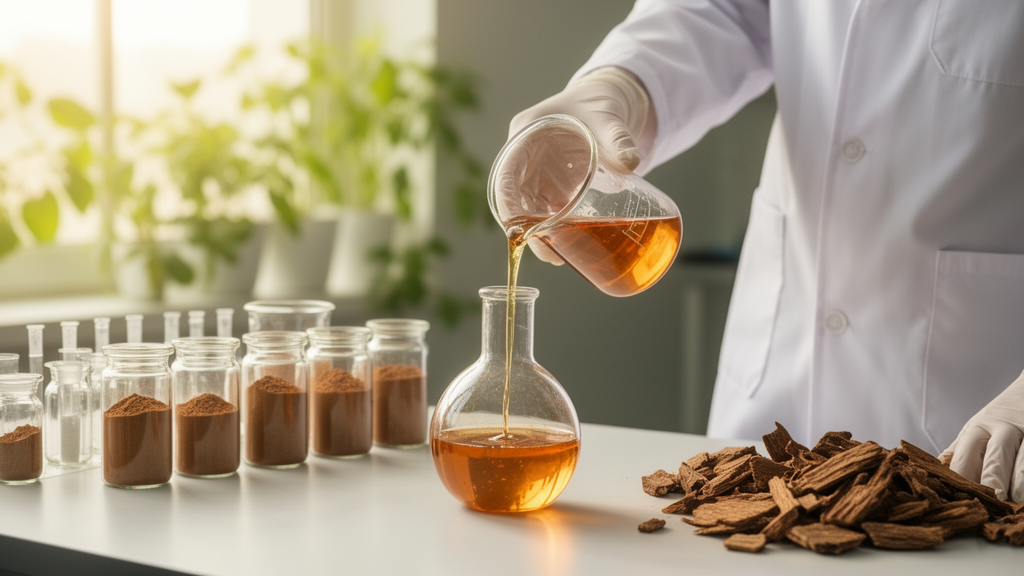
A new review published in Bioresources and Bioprocessing argues that deep eutectic solvents, or DES, could change that picture by extracting lignin from agricultural and forestry residues under far milder conditions than conventional industrial processes, while preserving the reactive chemical structures that make lignin worth upgrading into phenolic chemicals, polymer composites, and carbon materials for energy storage.
The scale of the opportunity is considerable. The review cites estimates that roughly 18.15 billion tons of lignocellulosic biomass are generated globally each year, yet only about 8.2 billion tons are actually utilized. Lignocellulosic biomass consists of cellulose at 30 to 50 percent, hemicellulose at 20 to 30 percent, and lignin at 15 to 30 percent. Lignin is built from three structural units—p-hydroxyphenyl, guaiacyl, and syringyl—linked by ether and carbon–carbon bonds into a highly amorphous, three-dimensional cross-linked network. That aromatic architecture and its rich functional groups make it an ideal renewable feedstock to replace fossil-based phenolic compounds, composites, and high-value chemicals, but only if it can be separated intact.
That separation is the bottleneck. Within the plant cell wall, lignin is tightly bound to hemicellulose and cellulose through complex covalent bonds and hydrogen bonds, forming a robust composite that resists dissolution. Traditional methods such as the Kraft process, though widely used industrially, demand high-temperature, high-pressure, and strongly acidic or alkaline conditions, involve substantial chemical usage and pollution risks, and leave the extracted lignin prone to condensation reactions and structural failure that reduce its activity and limit its applications. Ionic liquids have attracted attention for their biocompatibility and thermal stability, but high costs and difficult recovery have hindered large-scale adoption.
Deep eutectic solvents, first reported by Abbott and colleagues in 2003, are formed by mixing hydrogen bond acceptors and hydrogen bond donors in specific molar ratios. The strong hydrogen bonding between components depresses the mixture’s melting point below that of either pure constituent, typically yielding a liquid at room temperature. The classic example is choline chloride and urea at a 1:2 molar ratio, which melts at approximately 12 °C compared with 302 °C for choline chloride and 133 °C for urea. According to the review, DES can selectively dissolve lignin to separate it efficiently from cellulose and hemicellulose, operate more mildly than strong acid or base treatments to reduce condensation and structural damage, cost less, and—most significantly—preserve the native structural units of the extracted lignin, facilitating subsequent high-value utilization.
Solvent design is highly modular. Choline chloride is currently the most widely used hydrogen bond acceptor thanks to its low cost, biodegradability, and relatively low toxicity, and it can be paired with donors such as urea, glycerol, lactic acid, and carboxylic acids. Organic acid donors like lactic and formic acid disrupt the ester bonds and hydrogen-bond networks within lignin, and acidic DES based on them often show outstanding delignification; choline chloride–lactic acid, with its higher acidity and lower viscosity, effectively decomposes lignin–polysaccharide complexes. Polyols such as glycerol and ethylene glycol form stable hydrogen-bond networks, while betaine, amino acids, and sugar-based donors open routes to natural deep eutectic solvents. Beyond binary systems, adding a third component gives finer control over polarity, acidity, and viscosity: a ternary DES formed by adding p-hydroxybenzoic acid to choline chloride–lactic acid achieved a lignin extraction efficiency of 61.91 percent, roughly a 1.86-fold improvement over the original binary system.
Process parameters then determine how much lignin comes out and in what condition. Extraction time matters in both directions. During choline chloride–lactic acid treatment of willow branches at 120 °C, lignin recovery rose linearly as treatment extended from 6 to 12 hours, reaching 91.80 percent, and hit 94.20 percent at 42 hours. Yet for date palm waste treated with choline chloride–formic acid, yield peaked after about 4 hours and then fell sharply with longer treatment as over-degradation set in; extending reaction time to 6 to 12 hours significantly decreased both lignin yield and purity, with reduced molecular weight and deteriorated thermal stability. Temperature shows a similar dual character. Raising the temperature from 90 to 150 °C during 6-hour choline chloride–lactic acid treatment of wheat straw lifted lignin yield and purity from 9.3 percent and 62.8 percent to 81.5 percent and 91.3 percent, but pushing an acacia wood system to 160 to 180 °C produced a black foamy product attributed to DES degradation or lignin condensation, and red pine lignin treated at 130 °C lost methoxy, phenolic hydroxyl, and aliphatic hydroxyl content while its polydispersity index climbed from 1.6 to 3.4.
Solvent loading and chemical additives offer further levers. In wheat straw extraction with choline chloride–lactic acid, increasing the solid-to-liquid ratio from 1:20 to 1:40 raised the lignin-removal rate from roughly 45 percent to about 83 percent, with diminishing returns beyond that, while excessively high solvent loadings above 1:50 can trigger over-depolymerization of dissolved lignin fragments. Lewis acid additives dramatically accelerate extraction: adding phosphotungstic acid or iron bromide to choline chloride–lactic acid for poplar pretreatment delivered 80.9 to 82.2 percent lignin recovery within 4 to 8 hours, outperforming the 80.4 percent achieved by the additive-free system after 12 hours, and a magnetite–silica–vanadium composite catalyst helped corncob pretreatment reach 98.13 percent recovery at a lower temperature and shorter time. Physical assistance works too. Microwave-assisted choline chloride systems achieved delignification efficiencies of 80 to 90.1 percent within minutes or seconds with purities exceeding 95 percent, cutting processing time by more than 80 percent, while ultrasound at 32 kHz for 30 minutes helped extract cotton stalk lignin at 87.7 percent yield and 97.3 percent purity. The review cautions, however, that microwave penetration depths of only 2 to 10 centimeters and ultrasound energy attenuation make both difficult to scale to industrial reactors.
The structural payoff is what excites researchers most. DES-extracted lignin generally shows lower molecular weight and narrower distributions than lignin from traditional methods: date palm waste lignin extracted with DES had a weight-average molecular weight below 5,000 g/mol and a polydispersity index under 2, versus 10,490 g/mol for commercial lignin, and choline chloride–formic acid extraction yielded lignin of 4,900 g/mol against 8,830 g/mol for sodium hydroxide treatment. Willow lignin treated with choline chloride–lactic acid saw its number-average molecular weight fall from 1,348 to 920 g/mol and its polydispersity narrow from 1.34 to 1.13 over 6 to 24 hours. Functional groups shift in exploitable ways: eucalyptus lignin pretreated with choline chloride–lactic acid saw total phenolic hydroxyl content rise from 0.82 to 2.07 mmol/g through beta-O-4 bond cleavage, while aliphatic hydroxyl content typically declines. The extracted particles self-assemble into spherical nanoparticles—roughly 70 to 90 nanometers for wheat straw lignin, and 21 to 76 nanometers in iron chloride-containing systems—and downstream activation can produce porous carbons with specific surface areas as high as 3,577.3 square meters per gram. Thermally, DES lignin from date palm peaked in decomposition rate around 270 °C versus 236 °C for alkali-extracted lignin, indicating a more stable aromatic skeleton.
Those properties translate into concrete applications. Pyrolyzing willow lignin treated with choline chloride–lactic acid at 450 °C produced volatiles in which total phenolics reached 95.10 percent of detected peak area, with phenol and guaiacol the largest fractions at 20.8 and 24.2 percent; lignin extracted with an alkaline potassium carbonate–ethylene glycol DES yielded about 116 percent more aromatic monomers than conventional alkaline extraction. Lignin–silver core–shell nanoparticles embedded in polyvinyl alcohol films gave a tensile strength of 37.9 MPa along with improved UV blocking and antibacterial efficacy, and esterified DES lignin strengthened polylactic acid composite films. For energy storage, porous carbon nanofibers templated from DES-dissolved lignin achieved a specific capacitance of 237.1 F/g at 0.5 A/g with 97.7 percent retention after 15,000 cycles, while a lignin–agar gel carbon reached 30.2 Wh/kg and stable operation from −25 to 75 °C.
Substantial obstacles remain before any of this leaves the laboratory. DES viscosities reach hundreds to thousands of millipascal-seconds at room temperature, and dissolution of biomass components thickens the mixture further, forcing elevated temperatures and long reaction times. Recovery still relies on energy-intensive reduced-pressure distillation and rotary evaporation, with degradation products from hemicellulose and lignin accumulating over cycles; existing data show delignification performance dropping 14 percent after five recycle loops. Most studies remain bench-scale batch trials without pilot validation, and structural control is still imprecise—researchers optimize yield and purity rather than tailoring molecular weight, functional groups, and condensation degree to specific end uses. The review’s authors argue the field must shift from maximizing extraction efficiency toward application-driven production of functionalized lignin, supported by continuous-flow reactors, techno-economic analysis, and life cycle assessment, before DES-based lignin biorefining can deliver on its green promise at industrial scale.
Subject of Research: Deep eutectic solvent-based extraction, structural modification, and high-value utilization of lignin from agricultural and forestry residues
Article Title: Lignin separation modification and high-value utilization based on low eutectic solvents: a review
Article References: Sun, R., Li, C., Liang, R., Zhang, Y., & Xu, R. (2026). Lignin separation modification and high-value utilization based on low eutectic solvents: a review. Bioresources and Bioprocessing, 13(1), Article 154. https://doi.org/10.1186/s40643-026-01144-y
Image Credits: AI Generated
DOI: 10.1186/s40643-026-01144-y
Keywords: lignin, deep eutectic solvents, biomass, biorefinery, green solvents, phenolic compounds, lignin nanoparticles, supercapacitors, agricultural residues, solvent recovery, biomass pretreatment, carbon materials
News Source: Gregory Coleman. (October 28, 2026). Deep Eutectic Solvents Offer a Greener Route to High-Value Lignin. Scienmag.