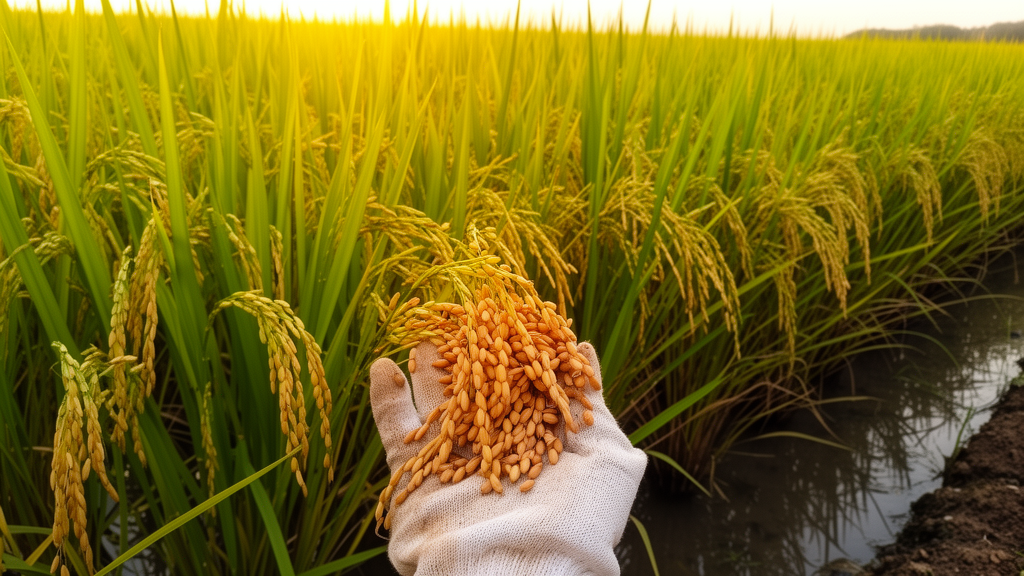
Rice farmers who rely on slow-release nitrogen fertilizer may gain yield and quality benefits by adding a carefully timed foliar spray of nitrogen and phosphorus during the reproductive stage, according to a new field study published in Chemical and Biological Technologies in Agriculture.
The research, led by Mingming Hu, Zhixin Li, and Zhonglin Wang with colleagues under senior author Jun Ma, examined how supplemental foliar nutrients interact with basal slow-release nitrogen fertilizer, a product designed to provide a sustained nitrogen supply throughout the growing season. The team notes that even with this steady baseline supply, precise nutrient regulation during the reproductive stage remains critical for achieving both high yield and superior grain quality.
The experiment was structured as a two-factor field trial with three foliar nitrogen rates and three foliar phosphorus rates. The nitrogen levels were 15, 45, and 75 kilograms of nitrogen per hectare, labeled N1, N2, and N3 respectively, while the phosphorus levels were 0, 15, and 30 kilograms of P2O5 per hectare, labeled P1, P2, and P3. This design produced nine distinct nitrogen-phosphorus combinations that could be compared directly.
Across the trial, foliar nitrogen and phosphorus application significantly affected dry matter accumulation and translocation, nutrient accumulation, grain yield, and grain quality. The researchers detected significant nitrogen-by-phosphorus interactions for several agronomic, physiological, and quality traits, although the interaction for grain yield itself was not statistically significant, meaning the two nutrients did not combine synergistically to drive yield in that specific measure.
Among the nine combinations tested, the moderate treatment N2P2, combining 45 kilograms of foliar nitrogen with 15 kilograms of P2O5 per hectare, produced the highest grain yield. That yield was 18.30 percent greater than that of the lowest-input treatment, N1P1, which received only 15 kilograms of foliar nitrogen and no foliar phosphorus.
The yield advantage was accompanied by measurable changes in the starch biosynthesis pathway. The N2P2 treatment showed higher activities of ADPG, SSS, SBE, and DBE, enzymes involved in building starch, together with lower activity of GBSS. In line with those enzyme shifts, plants under N2P2 accumulated higher total starch and amylopectin contents and lower amylose content.
Grain quality traits also favored the moderate treatment. N2P2 exhibited a higher head rice rate, higher peak viscosity, greater breakdown, and a better taste value, alongside lower chalkiness and lower setback.
When the team applied a comprehensive evaluation across the tested combinations, N2P2 ranked as the best-performing treatment overall. The authors conclude that foliar nitrogen and phosphorus supplementation under basal slow-release nitrogen application improved reproductive-stage nutrient accumulation and was associated with changes in starch synthesis-related enzyme activities and starch composition, contributing to higher grain yield and improved rice quality.
The study was published open access on 18 October 2026, and the released version is a peer-reviewed, accepted manuscript that remains subject to further editorial edits before the final Version of Record appears.
As with any single field experiment, the results reflect the specific conditions, rates, and varieties tested, and the reported associations between enzyme activities, starch composition, and quality traits describe the patterns observed in this trial.
Subject of Research: Effects of foliar nitrogen and phosphorus panicle fertilization on rice yield, starch synthesis, and grain quality under basal slow-release nitrogen
Article Title: Foliar nitrogen and phosphorus panicle fertilization coordinates rice yield and quality by regulating nutrient accumulation and starch synthesis under basal slow-release nitrogen application
Article References: Hu, M., Li, Z., Wang, Z., Chen, Z., Yang, Z., Sun, Y., & Ma, J. (2026). Foliar nitrogen and phosphorus panicle fertilization coordinates rice yield and quality by regulating nutrient accumulation and starch synthesis under basal slow-release nitrogen application. Chemical and Biological Technologies in Agriculture. https://doi.org/10.1186/s40538-026-01129-1
Image Credits: AI Generated
DOI: 10.1186/s40538-026-01129-1
Keywords: rice, foliar fertilization, nitrogen, phosphorus, slow-release nitrogen fertilizer, grain yield, grain quality, starch synthesis, amylose content, chalkiness, panicle stage, nutrient management
News Source: Alan Morgan. (October 28, 2026). Foliar nitrogen and phosphorus boosts rice yield and grain quality in field trial. Scienmag.