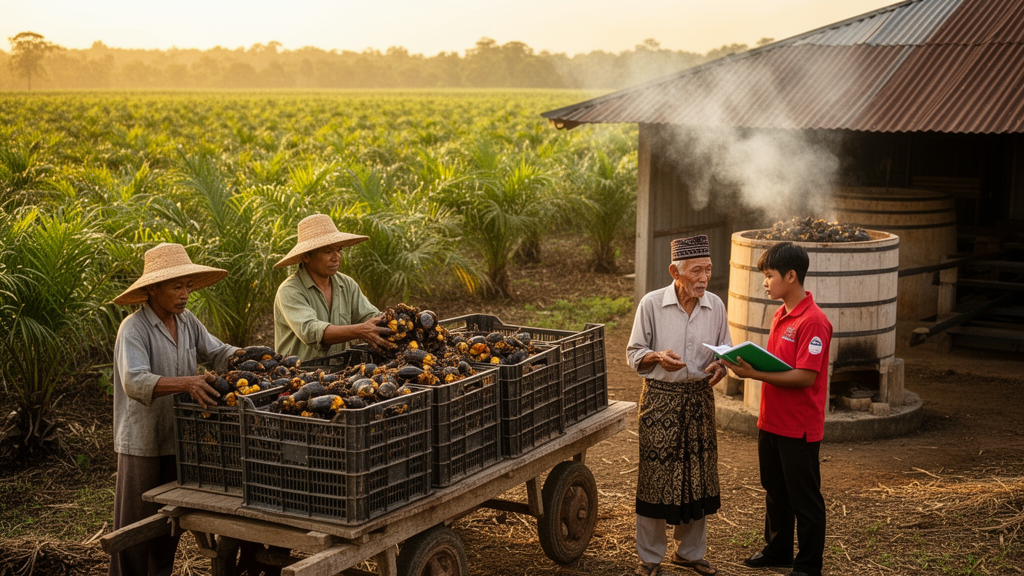
A qualitative case study from Prabumulih City in South Sumatra, Indonesia, finds that the success of agricultural downstreaming in local agrarian communities depends less on machinery and market forces alone than on the interplay of local traditions, customary institutions and trust-based coordination among grassroots actors. The research, published as an open access article in the journal Agricultural and Food Economics, examined how sociocultural institutions mediate farmers’ capacity to adapt to downstreaming, the push to process raw commodities such as rubber, palm oil and rice into higher-value products rather than selling them unprocessed. The authors report that while comprehensive integration of production, distribution and marketing emerged as the dominant theme in their data, this integration was strongly mediated by traditional practices and customary rules, and that gaps in government support and market access continue to constrain the economic resilience of farming households.
The study was conducted by Rudy Kurniawan, Muhamad Chairul Basrun Umanailo, Muhammad Arsyad and Pardamean Daulay, and published on 12 October 2026 as volume 14, article number 82 of the journal. The researchers set out to address a gap they identify in the literature: downstreaming is often promoted as a strategy for value addition, market integration and rural income improvement, yet empirical evidence on how sociocultural institutions shape farmers’ ability to adapt to these transformations remains limited. Their work situates the question in Prabumulih, a region described in the study as an agrarian society with strong local traditions, where communities rely on agriculture as their primary livelihood and where leading commodities include rubber, palm oil and rice.
The methodological design was a qualitative case study. The researchers selected five villages in South Sumatra with strong agricultural potential that are currently facing downstreaming transitions: Karya Mulya, Karang Jaya, Tanjung Telang, Muara Sungai and Pangku. Data came from three sources: in-depth semi-structured interviews conducted until data saturation was reached, participatory observation, and document analysis. Informants were selected through purposive sampling based on criteria aligned with the research objectives, namely direct involvement in the agricultural value chain, traditional leadership, or local governance. The study included 20 informants, of whom 12 were male and 8 female. By age, six informants were between 30 and 40 years old, eleven were between 41 and 50, and three were between 51 and 60.
Analysis was carried out with the qualitative data analysis software QDA Miner 6, produced by Provalis Research, using a hybrid coding approach that combined inductive and deductive coding. The researchers describe a systematic four-stage analytical pattern: category collection, direct interpretation, pattern formation, and the development of naturalistic generalisations. Two members of the research team coded independently and resolved discrepancies through discussion and consensus, and a codebook was developed to guide theme generation and maintain coding consistency. To ensure analytical rigour and trustworthiness, the study triangulated data sources by comparing farmer accounts with those of downstream actors and leaders, and used member checking to validate interpretations. The analysis was guided by three theoretical lenses: Social Capital Theory, Institutional Theory, and Value-Chain Theory. The authors draw on North’s conception of institutions as the humanly devised rules that structure economic exchange, arguing that customary land boundaries, profit-sharing norms and communal decision-making reduce uncertainty and shape farmers’ downstreaming choices.
The results centre on nine coded themes. The most dominant, accounting for 24.4 percent of coded segments, was the integration of production, distribution and marketing, which the authors interpret as indicating that full value-chain integration is the primary focus of the downstreaming process in these communities. Yet informants told the researchers that achieving this integration is difficult at the grassroots level. One local farmer, cited as Informant 4, described relying heavily on gotong royong, the Indonesian tradition of mutual assistance, during the harvest season, but struggling when it came to processing and selling rubber or palm oil because middlemen often dictate prices. The farmer said the village wanted to process raw harvests to increase their value but lacked the necessary equipment and access.
Other prominent themes included coordination between actors at 13.2 percent, interaction between local traditions at 12.8 percent, and the role of customary institutions in downstreaming at 11.2 percent. The authors read these figures as reflecting the necessity of sociocultural synergy, with traditional institutions acting as vital intermediaries in navigating economic change. A traditional leader, cited as Informant 12, explained that customary laws have long taught the community to maintain balance and not exploit nature out of greed, and that traditional institutions strive to keep these rules enforced so that modern processing initiatives entering the village respect both customary land boundaries and the welfare of farmers. Structural themes also appeared: downstream and market response accounted for 9.5 percent of coded segments and government support for downstreaming 8.7 percent. A community leader, cited as Informant 17, noted that government programmes such as the provision of small-scale processing machines are sometimes misaligned with local readiness and customs and lack ongoing training, with the result that the machinery often sits idle. A downstream actor, cited as Informant 13, described how managing collection points for raw rubber and distributing semi-processed materials to regional hubs becomes complicated when market prices drop suddenly, leaving tight margins before smallholders can adjust their output volume.
Beyond the frequency counts, the study used several analytical visualisations to map relationships among themes. A dendrogram built with the Jaccard Coefficient as a measure of proximity showed that the themes of coordination between actors and interaction between local traditions form a very close initial cluster, indicating they frequently co-occur, and that these then merge with the integration theme to form a cluster reflecting synergy between local actors and traditional approaches. The role of customary institutions and government support formed separate clusters, while traditional values and practices and market access and production resources showed relatively weak relationships with other clusters and were incorporated only in the final stages of agglomeration. A correspondence analysis placed the role of customary institutions, downstream and market response, and market access and production resources at the centre of the map, suggesting they frequently appear together in similar narratives, while government support appeared most isolated, in the bottom right corner, a position the authors interpret as reflecting a distinct, more macro or structural policy context.
A network graph of co-occurrence patterns showed the integration theme as a fairly central node with strong connections to coordination between actors and downstream and market response, each at 0.917. Coordination between actors was strongly connected to the role of customary institutions at 0.833 and to interaction between local traditions at 0.909. Interaction between local traditions served as a bridge between the sociocultural and structural dimensions, correlating with traditional values and practices at 0.500, coordination between actors at 0.909, and government support at 0.438. By contrast, market access and production resources correlated weakly with other themes except downstream and market response at 0.455 and the integration theme at 0.471. A threshold graph restricted to coefficients of at least 0.909 showed only four relationships, with interaction between local traditions as the central connecting node, strongly linked to coordination between actors, downstream and market response, and the integration theme. The remaining themes fell below the displayed threshold, which the authors suggest indicates weaker or more segmented direct linkages.
In the discussion, the authors argue that traditional values and practices are not merely cultural artefacts but constitute a strategic foundation for downstreaming. From the perspective of Social Capital Theory, they write, local traditions provide a framework of trust and reciprocal norms that facilitate collective action, and traditional institutions in Prabumulih act as key facilitators bridging proven traditional practices and modern market demands. At the same time, the data reveal what the authors call institutional fragmentation: while farmer-to-farmer and traditional institutional networks are dense, government support occupies a marginal position, indicating a gap in collaborative governance in which state interventions often remain top-down and less adaptive to local dynamics. They frame downstreaming as a systemic agricultural development challenge involving intertwined technical, institutional and social constraints rather than a narrow processing intervention, and note that without tripartite alignment among government, private and community actors, rules and mechanisms from different entities fail to support one another.
On household resilience, the authors draw on Value Chain Theory to argue that comprehensive integration allows farmers to move from being mere producers of raw materials to actors capturing larger profit margins, but they also identify a vulnerability: market access and production resources are not yet fully integrated into the sociocultural or institutional framework of these communities. Invoking Economic Resilience Theory, they argue that if farmers face difficulties accessing profitable markets or lack sufficient processing resources, downstreaming efforts will not yield maximum income impacts. The study concludes that successful downstreaming relies heavily on the integration of production, distribution and marketing, but that this economic integration is fundamentally mediated by local traditions, customary institutions and trust-based coordination, while fragmented government support and limited market access constrain farming households’ economic resilience. The authors acknowledge limitations: the qualitative case-study design focuses on specific villages, making the findings highly context-specific and not statistically generalizable across all agrarian regions, and they recommend longitudinal and mixed-methods follow-up research.
Subject of Research: How local traditions and customary institutions shape agricultural downstreaming in agrarian communities of Prabumulih, South Sumatra
Article Title: Local traditions, customary institutions and agricultural downstreaming in Agrarian communities of Prabumulih, South Sumatra
Article References: Kurniawan, R., Umanailo, M. C. B., Arsyad, M., & Daulay, P. (2026). Local traditions, customary institutions and agricultural downstreaming in Agrarian communities of Prabumulih, South Sumatra. Agricultural and Food Economics, 14(1), Article 82. https://doi.org/10.1186/s40100-026-00526-2
Image Credits: AI Generated
DOI: 10.1186/s40100-026-00526-2
Keywords: agricultural downstreaming, customary institutions, local traditions, Prabumulih, South Sumatra, value chain, social capital, qualitative case study, farming households, agrarian sociology, market access, rural development
News Source: Alan Morgan. (October 28, 2026). Customary Institutions Shape Whether Agricultural Downstreaming Works in South Sumatra. Scienmag.