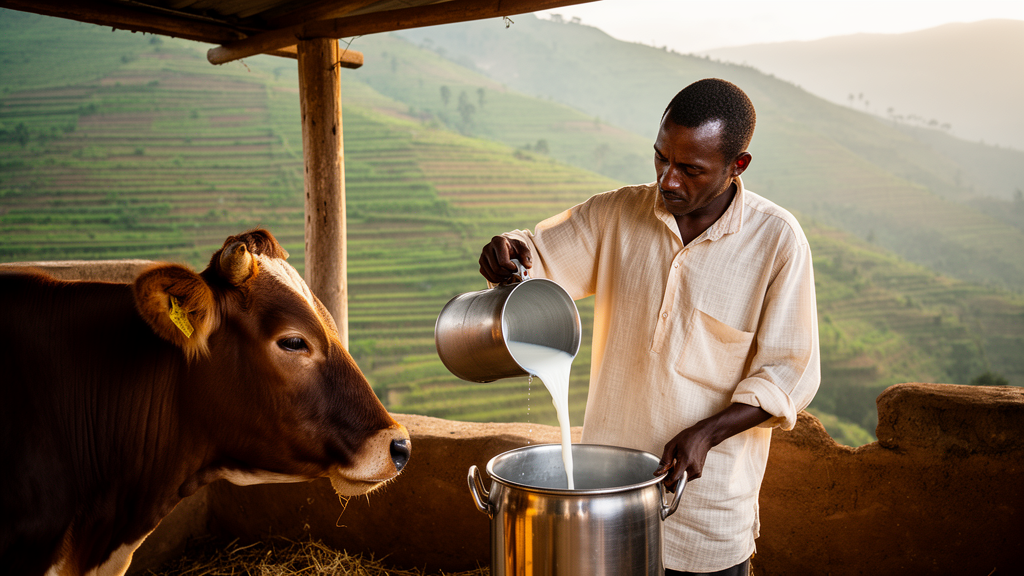
Raw cow milk collected from smallholder farms in Jarso District, eastern Ethiopia, differs markedly in both composition and microbial contamination depending on which agro-ecological zone it comes from, according to a cross-sectional study published in the journal Food Safety and Risk. Milk from the highland zone showed the strongest nutritional profile, with higher fat, protein, and total solids, while milk from the lowland and midland zones carried heavier bacterial loads.
The study was conducted between February and May 2024 in Jarso District, one of 21 districts in the East Hararghe Zone of Oromia National Regional State. The district spans altitudes from 1,500 to 3,060 meters above sea level and encompasses three agro-ecological zones: highland covering 28 percent of its area, midland covering 55 percent, and lowland covering 17 percent. Mean annual rainfall ranges from 500 to 950 millimeters and mean annual temperatures from 14 to 25 degrees Celsius. Because the district contains all three zones within a single smallholder dairy production system, the authors describe it as an appropriate setting to isolate how contrasting environmental conditions relate to milk quality at the district level, something they say previous Ethiopian studies focused on urban milk sheds or market chains have not done.
The team used a multistage sampling design. Jarso was first stratified into highland, midland, and lowland zones, then one representative kebele was chosen from each: Chala from the highland, Waltahi from the midland, and Semen Dabelo from the lowland. From lists of households owning at least one lactating cow, obtained from kebele agricultural offices, households were selected by systematic random sampling. A variance-based sample size calculation, using a standard deviation of 0.15 estimated from a pilot study and a margin of error of 0.05, indicated a minimum of 72 samples; 70 were ultimately collected and analyzed, or 97.2 percent of the target, allocated as 25 highland, 25 midland, and 20 lowland samples.
From each selected household, 450 milliliters of fresh morning raw milk was drawn following ISO 707:2008 sampling procedures, with udder preparation, aseptic collection, and transport in insulated cool boxes at approximately 4 degrees Celsius. Samples reached the Haramaya University Dairy Laboratory within the cold chain and were analyzed within two hours of arrival, each in duplicate. Physicochemical measurements included temperature, pH by calibrated digital meter, titratable acidity by sodium hydroxide titration, specific gravity by lactometer, total solids by AOAC gravimetric method, fat by the Gerber method, protein by Kjeldahl, and ash by incineration, with solids-not-fat and lactose calculated by difference. Microbiological analysis covered total bacterial count, total coliform count, and yeast and mold count, each performed under the relevant ISO colony-count standard.
Statistically, microbial counts were log10(x + 1) transformed, and differences among zones were tested with a general linear model treating agro-ecology as the sole fixed effect, followed by Tukey’s HSD comparisons at a significance threshold of p < 0.05. The results showed that agro-ecology significantly affected every measured physical property. Lowland milk had the highest temperature, pH, specific gravity, and titratable acidity. Mean pH was lowest in the midland at 6.17 ± 0.109, compared with 6.66 ± 0.109 in the lowland, while the highland value of 6.54 ± 0.109 fell in between and did not differ significantly from either. The overall mean pH of 6.46 was slightly below the typical 6.6 to 6.8 range reported for fresh bovine milk.
Titratable acidity told a consistent story about freshness. The lowland mean of 0.21 ± 0.013 percent lactic acid exceeded both the Ethiopian standard maximum of 0.20 percent and the East African Standard limit of 0.17 percent, whereas the highland (0.153 ± 0.013 percent) and midland (0.162 ± 0.013 percent) means complied with the East African limit. The authors attribute the higher lowland acidity to warmer conditions that favor microbial growth when milk is held without adequate cooling, noting that lactic acid bacteria ferment lactose to lactate during storage. Specific gravity followed a different pattern: the lowland mean of 1.028 ± 0.001 g/mL sat at the lower bound of the East African Standard range of 1.028 to 1.036 g/mL, while the midland (1.027) and highland (1.023) means fell below the specified minimum. The researchers caution that low specific gravity alone cannot prove water adulteration, since natural variation in fat and solids-not-fat also affects density.
Chemical composition favored the highland zone. Fat, protein, total solids, and ash differed significantly among agro-ecologies, while solids-not-fat and lactose did not. Protein ranged from 2.97 percent in the lowland to 4.24 percent in the highland, with an overall mean of 3.53 ± 0.24 percent that exceeded the Ethiopian minimum of 3.2 percent for whole cow milk, although the lowland mean fell below that threshold. Total solids ranged from 12.77 percent in the lowland to 14.53 percent in the highland, with the overall mean of 13.71 ± 0.23 percent above the Ethiopian minimum of 12.8 percent but the lowland value slightly below it. Overall mean fat content of 4.72 ± 0.198 percent cleared the 3.5 percent minimum. Solids-not-fat averaged 8.98 ± 0.25 percent, meeting both Ethiopian (8.38 percent) and European Union (8.5 percent) minima in every zone, and lactose averaged 4.67 ± 0.302 percent. Ash was higher in the lowland (0.82 percent) and midland (0.81 percent) than the highland (0.73 percent), a pattern the authors link plausibly, though not definitively, to differences in feed and mineral availability that were not directly measured.
The microbial findings raise the most immediate safety concerns. Total bacterial count was significantly higher in lowland milk at 6.18 ± 0.215 log10 CFU/mL than in midland milk at 5.37 ± 0.215 log10 CFU/mL, and the overall mean of 5.75 ± 0.215 log10 CFU/mL exceeded the Ethiopian Standard limit of 5 log10 CFU/mL for raw milk intended for human consumption. Under the East African Standard classification, the overall count falls in Grade II and the lowland value in Grade III. Total coliform count, an indicator of sanitary quality, exceeded the Ethiopian limit of 3 log10 CFU/mL in all three zones, with the midland highest at 5.65 log10 CFU/mL (roughly 4.5 × 10⁵ CFU/mL), the lowland at 4.88, and the highland at 3.93, the only zone within the good-quality category of 1,000 to 50,000 CFU/mL. Yeast and mold counts did not differ significantly among zones, which the authors interpret as evidence that fungal contamination tracks handling hygiene more closely than altitude.
The authors connect the lowland bacterial burden to the higher milk temperature recorded there, about 27.37 degrees Celsius, citing experimental evidence that warmer storage temperatures accelerate bacterial multiplication while rapid cooling limits it. They also note that the midland’s high coliform count despite a lower total bacterial count suggests coliform contamination responds to different factors, such as fecal contamination, udder hygiene, and the sanitation of water, utensils, and milk-contact surfaces.
The study carries clear limitations that the authors state explicitly. Its cross-sectional design captures milk quality only during February to May 2024 and cannot assess causal relationships or seasonal variation. Animal- and farm-level variables, including breed, parity, lactation stage, milk yield, feeding system, animal health, and farm hygiene practices, were not systematically recorded and could not enter the model, so unmeasured factors may explain part of the observed differences. Somatic cell counts were not determined, leaving udder health unassessed, and the microbiological work identified indicator organisms only, without pathogen-specific testing, which limits conclusions about public health risk from raw milk consumption. The authors recommend longitudinal sampling across seasons, multivariable models incorporating farm-level data, somatic cell counting, and pathogen-specific analyses in future work. In the meantime, they argue their results support agro-ecology-specific interventions, prioritizing hygienic milking, clean water, sanitized equipment, and rapid cooling, particularly in the lowland and midland zones where microbial contamination was highest.
Subject of Research: Physicochemical and microbiological quality of raw cow milk across highland, midland, and lowland agro-ecological zones in Jarso District, eastern Ethiopia
Article Title: Physicochemical and microbiological quality of raw cow milk across agro-ecological zones in Jarso District, Eastern Ethiopia
Article References: Wolkaro, T., Hussen, K., Eshetu, M., & Abdi, M. (2026). Physicochemical and microbiological quality of raw cow milk across agro-ecological zones in Jarso District, Eastern Ethiopia. Food Safety and Risk, 13(1), Article 40. https://doi.org/10.1186/s40550-026-00162-0
Image Credits: AI Generated
DOI: 10.1186/s40550-026-00162-0
Keywords: raw milk quality, agro-ecological zones, Ethiopia, smallholder dairy, food safety, microbial contamination, coliform count, milk composition, titratable acidity, hygienic milking, East Hararghe, dairy value chain
News Source: Daisy Hatcher. (October 28, 2026). Milk Quality Shifts Sharply Across Altitudes in Ethiopian Smallholder Dairies. Scienmag.