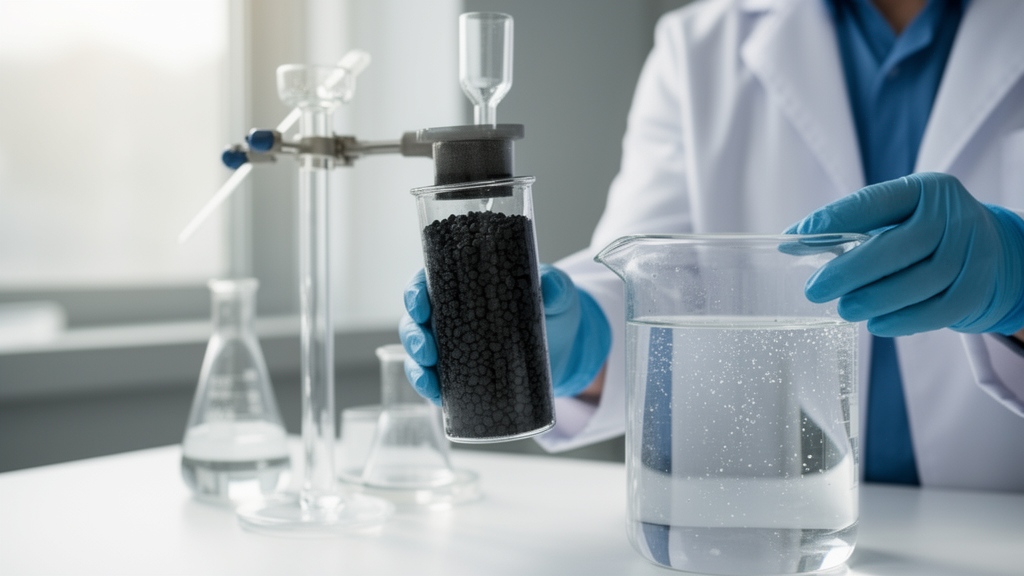
Chemists have found that a simple change in recipe can dramatically improve how a common agricultural waste product cleans polluted water. By adjusting the ratio of nitrogen to boron in biochar made from sawdust, a research team boosted the degradation rate of the antibiotic sulfamethoxazole from 0.20 to 0.47 per minute, a 2.35-fold increase, when the material was used to activate peroxymonosulfate, a widely used oxidant in advanced water treatment. The work, published as an open-access study in the journal Biochar, shows that boron-rich formulations transform the material from a passive adsorbent into an active catalyst.
Biochar, the charcoal-like product of heating biomass, has attracted attention as a sustainable alternative to metal-based catalysts in advanced oxidation processes. These processes rely on peroxymonosulfate activation to generate reactive oxygen species that break down persistent organic pollutants such as antibiotics. Unlike transition metal catalysts, carbon-based materials avoid concerns about metal scarcity, toxicity, and leaching. However, pristine biochar often has too few active sites to be effective, so researchers routinely dope it with heteroatoms such as nitrogen, boron, sulfur, or phosphorus to alter its electronic structure and surface chemistry.
Nitrogen and boron each play distinct roles. Nitrogen incorporation increases electron cloud density, introduces structural defects, and can raise the specific surface area of the carbon framework. Boron-related modification promotes pore development, local charge redistribution, and new electron-transfer pathways. Previous studies of co-doped biochar derived from agricultural and industrial wastes showed efficient removal of pollutants including tetracycline, ciprofloxacin, and acid orange 7, but the composition-dependent mechanism remained unresolved. In particular, it was unclear how the nitrogen-to-boron ratio regulates the balance between adsorption and catalysis, and which structural features dominate activation under different mixing regimes.
To address this, the team synthesized a series of co-doped biochars from sawdust using a one-step calcination method, avoiding the multi-step pyrolysis routes that raise preparation costs and can collapse pore structures. Sawdust made up half of each mixture, while the remaining half consisted of urea as the nitrogen source and boric acid as the boron source, mixed at mass ratios of 4, 2, 1, 0.5, and 0.25. The blends were ball-milled for four hours, then calcined at 700 degrees Celsius for two hours in a muffle furnace. The resulting materials were characterized by electron microscopy, nitrogen adsorption, X-ray photoelectron spectroscopy, X-ray diffraction, Raman spectroscopy, and synchrotron radiation soft X-ray absorption spectroscopy.
The characterization revealed a clear structural trend. The nitrogen-to-boron ratio showed a strong negative linear correlation with specific surface area and pore volume, meaning that lowering the ratio steadily opened up more porous, higher-area materials. Specific surface area climbed from about 409 to 524 square meters per gram across the series. Raman spectroscopy showed that co-doped samples had defect density ratios between 1.40 and 1.50, higher than pristine biochar at 0.96 or singly doped variants, indicating that dual doping creates far more defect sites than either heteroatom alone. X-ray photoelectron spectroscopy confirmed successful nitrogen incorporation, while boron signals were extremely low and largely undetectable, consistent with boron primarily modifying pore structure rather than entering the carbon lattice.
Catalytic testing exposed a striking shift in mechanism. At higher nitrogen-to-boron ratios above 1, the contribution of catalysis was limited compared to adsorption, and sulfamethoxazole removal was mainly governed by surface area and pore structure. As the ratio dropped into the range of 1 to 0.25, catalytic rates increased substantially, and the material transitioned to catalysis-dominated degradation. Pseudo-first-order rate constants for adsorption generally stayed below 0.10 per minute, while catalytic rates reached 0.47 per minute. Adding peroxymonosulfate increased sulfamethoxazole removal rates by 114 percent for pristine biochar and by 248 to 529 percent for the co-doped samples, with the greatest enhancements occurring at the lowest ratios. Boron doping alone produced only modest improvement of roughly 31 percent, suggesting that boron by itself cannot generate effective electron-transfer or reactive sites.
Quenching experiments and electron paramagnetic resonance identified the reactive species driving the process. Hydroxyl and sulfate radicals contributed only 1 to 8 percent and 1 to 5 percent of degradation, respectively, whereas singlet oxygen dominated, accounting for 73 to 82 percent of sulfamethoxazole degradation in pristine and co-doped systems. The exception was the highest ratio formulation, where hydroxyl and sulfate radicals accounted for 22 and 27 percent and singlet oxygen only 20 percent. Replacing ordinary water with heavy water, which extends singlet oxygen lifetime roughly fifteen-fold, significantly increased the degradation rate, further confirming the nonradical pathway. Tests under nitrogen- and air-saturated conditions showed no significant difference, indicating dissolved oxygen contributed little to superoxide formation, which instead acted as a transient intermediate.
The mechanistic picture that emerges links specific surface features to specific functions. Linear fitting indicated that catalytic efficiency was primarily regulated by specific surface area. Carbon-hydroxyl groups acted as electron donors for generating radicals, while ketonic carbonyl groups served as active sites for singlet oxygen generation, with their influence on catalytic rates exceeding their effect on adsorption by more than sixfold. Graphitic nitrogen showed a similarly amplified effect on peroxymonosulfate activation, forming electron-rich domains that strengthen interactions with the oxidant. Correlation analysis revealed that lowering the ratio from 2 to 0.25 enhanced degradation by raising defect density and graphitic nitrogen content, which together boosted electron transfer and singlet oxygen formation.
The study also tested practical robustness. The optimized system maintained more than 91.8 percent degradation efficiency across pH 3 to 9, though carbonate and bicarbonate ions markedly suppressed removal by deactivating the oxidant. Degradation efficiency declined with each reuse cycle, likely because intermediates accumulated on the catalyst surface and blocked active sites. In a continuous-flow reactor with the biochar immobilized on cotton, the system achieved approximately 99.6 percent sulfamethoxazole removal after 200 minutes of operation at a flow rate of 3 milliliters per minute. In real water matrices including drinking water, river water, and secondary effluent, removal still exceeded 70 percent within 20 minutes, though slower than in deionized water due to competitive adsorption and radical quenching by background constituents.
The researchers say their findings establish composition-dependent structure-activity relationships for co-doped biochar and offer a practical strategy for designing efficient catalysts from agricultural waste for water purification. The key insight is that the nitrogen-to-boron ratio is not merely an additive knob but a switch that determines whether the material removes pollutants by soaking them up or by actively tearing them apart.
Subject of Research: Nitrogen and boron co-doped biochar catalysts for peroxymonosulfate activation and antibiotic degradation in water
Article Title: Tailored co-doped biochar by varying the N:B ratio as peroxymonosulfate activator for sulfamethoxazole degradation
Article References: Zhang, J., Gao, Y., Wang, S., Zhang, W., Zhang, X., Wang, C., & Li, H. (2026). Tailored co-doped biochar by varying the N:B ratio as peroxymonosulfate activator for sulfamethoxazole degradation. Biochar, 8(1), Article 138. https://doi.org/10.1007/s42773-026-00647-3
Image Credits: AI Generated
DOI: 10.1007/s42773-026-00647-3
Keywords: biochar, peroxymonosulfate, sulfamethoxazole, singlet oxygen, water treatment, heteroatom doping, sawdust, advanced oxidation, antibiotic degradation, catalysis, defect engineering, wastewater
News Source: Bethany Barker. (October 28, 2026). Boron-Rich Biochar Supercharges Water Purification Catalyst. Scienmag.