Antimicrobial resistance has become one of the most serious global public health problems, contributing to poor treatment outcomes for bacterial infections. A systematic global analysis estimated 1.27 million deaths in 2017 attributable to bacterial AMR, and the World Health Organization has identified antibiotic resistance as one of the top ten worldwide public health issues and development threats. The global burden of AMR has been estimated to cost more than 2.9 trillion dollars by 2050. Against this backdrop, a newly published narrative review in the journal Bioscience Nanotechnology examines metallic and metal-oxide nanoparticles as potential antimicrobial agents, pulling together what is known about how they kill bacteria, what determines their performance, and why laboratory enthusiasm has not yet translated into clinical use.
The review, authored by Fehmida Shams, Haider Ali, Komal Farghama, Muhammad Usman Khan, Muhammad Saleem Khan, Muhammad Wajid, Shifa Shaffique and colleagues and published on 19 October 2026, is explicit about its own limits. It is a narrative review, meaning representative studies were selected to illustrate mechanistic diversity and performance determinants rather than gathered through a systematic search protocol. The authors also caution that findings summarized in the review should not be interpreted as evidence of established clinical efficacy. That framing matters, because the literature they survey is dominated by in-vitro experiments with substantial variation in bacterial strains, inoculum conditions, media, exposure times, nanoparticle characterization and antibacterial assays.
The core of the review is a survey of synthesis routes. Chemical reduction remains one of the most widely used approaches, requiring precursor salts such as cobalt, silver, copper, iron, gold or zinc, a reducing agent such as ascorbic acid, citric acid or glucose, and capping or stabilizing agents such as sodium hydroxide and sodium carbonate. Silver nitrate is frequently used as the metal precursor for silver nanomaterials, with hydrazine hydrate as a reducing agent and sodium dodecyl sulfate or sodium citrate as stabilizing agents. The same general methodology has been applied to gold, copper, aluminum, cadmium, cerium, nickel, magnesium, selenium, titanium, palladium, superparamagnetic iron and zinc materials with reported antibacterial activity.
Green synthesis offers an alternative that uses biological precursors as reducing and stabilizing agents. Plant extracts, microbial sources and biopolymers such as chitosan or starch can supply phytochemicals, including alkaloids, terpenes, saponins, phenols, alcohols and proteins, that reduce metal ions and cap the resulting particles. The review describes several examples: silver nanomaterials synthesized using Gymnema sylvestre leaves; onion broth used to reduce silver nitrate into silver nanoparticles active against Salmonella typhimurium and E. coli; fungal cell-free filtrates of Sclerotinia sclerotiorum producing spherical silver nanoparticles of roughly 10 nanometers with a minimum inhibitory concentration of 100 ppm against both E. coli ATCC 25922 and Staphylococcus aureus ATCC 25923; and a Paenibacillus sp. culture supernatant yielding spherical silver nanoparticles of 15 to 55 nanometers with MIC values of 25 and 12.5 micrograms per milliliter against Salmonella Enteritidis and Candida albicans respectively. Lichen metabolites have also been harnessed, with usnic acid-derived copper nanoparticles and copper-thymol nanoparticles showing MIC and MBC values of 20 and 40 micrograms per milliliter against MRSA. The authors note, however, that green synthesis still faces challenges in validation, large-scale production and industrial acceptance, and that using a biological synthesis approach does not by itself establish that the resulting nanoparticles are biocompatible.
Other routes include microwave-assisted synthesis, which offers rapid heating, shorter reaction times and enhanced yield, as illustrated by zinc oxide nanoparticles tested by well-diffusion against Klebsiella, Salmonella typhi, E. coli and Staphylococcus aureus strains. The hydrothermal method reacts precursors in a closed system at 100 to 300 degrees Celsius under elevated pressure, and was used in one study to produce polyethyleneimine-functionalized silver nanoparticles in a single step, with the polymer acting as both stabilizing and reducing agent. The sol-gel method, preferred for metal oxides and hybrid organic-inorganic materials, proceeds through hydrolysis and condensation of precursors into a three-dimensional gel network, and was used to make metal-substituted cobalt ferrite nanoparticles that showed zones of inhibition of 13.0 millimeters against Bacillus subtilis and Staphylococcus aureus, with gamma-irradiated particles maintaining higher antimicrobial activity than non-irradiated ones.
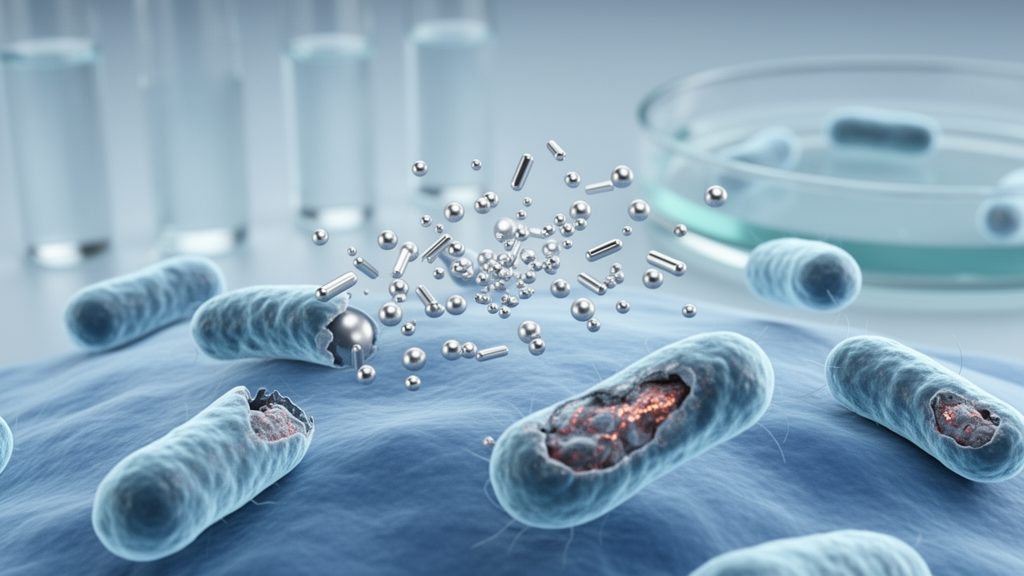
How these particles actually kill bacteria is the review’s mechanistic heart. Nanomaterials can damage bacterial membranes, release metal ions, induce oxidative stress, disrupt proteins and nucleic acids, and interfere with biofilm formation. Gram-positive and Gram-negative bacteria both carry negatively charged cell walls, which facilitates electrostatic interaction with positively charged nanoparticles. Attachment can alter membrane organization and permeability, causing depolarization and leakage of intracellular components. Silver nanoparticles smaller than 10 nanometers have been shown to rupture membranes and penetrate cells, while magnesium oxide and magnesium hydroxide nanoparticles kill cells by adhering electrostatically to the cell wall without actually penetrating the membrane. Inside the cell, free metal ions react with phosphate, amino, carbonyl and sulfhydryl groups on proteins, lipids and DNA; free silver ions can break down chromosomal DNA or halt replication, and thiol groups in enzymes can be disabled when silver ions alter protein structure.
Reactive oxygen species form a second major mechanism. Hydroxyl radicals, superoxide, hydrogen peroxide and singlet oxygen damage membrane lipids through peroxidation, degrade peptidoglycan, and break down nucleic acids and proteins. Different nanoparticles generate different ROS combinations: silver and copper nanoparticles produce all forms, magnesium oxide nanoparticles generate only the superoxide radical, and zinc oxide nanoparticles produce a combination of hydroxyl and hydrogen peroxide radicals. When ROS buildup surpasses the capacity of bacterial antioxidant defenses such as catalase, peroxidase and superoxide dismutase, essential cellular components are damaged and the cell dies. The review also describes interference with proteins, citing work showing that gold nanoparticles lower ATP concentration and collapse membrane potential in E. coli by blocking ATPase activity and ribosomal subunit coupling to tRNA.
Biofilms, in which bacteria encase themselves in a self-produced matrix and become up to 1000 times more resistant to drugs, are a particular target. Silver, copper and zinc oxide nanoparticles can release metal ions that disrupt biofilm formation and kill bacteria within biofilms, and some nanoparticles interfere with quorum sensing or inhibit enzymes responsible for extracellular polymeric substance synthesis. Positively charged nanoparticles tend to attach strongly to the negatively charged DNA, protein and polysaccharide skeleton of biofilms, and particles considerably smaller than 350 nanometers can penetrate biofilm structures. One quantitative example highlighted in the review: a combined silver nanoparticle and curcumin nanoparticle formulation disrupted 50 percent of established Pseudomonas aeruginosa and Staphylococcus aureus biofilms at 100 micrograms per milliliter, whereas at least 500 micrograms per milliliter of curcumin nanoparticles alone was required for the same effect. Silver nanoparticles capped with polymyxin B achieved a three-fold greater reduction in biofilm than pure silver nanoparticles.
Performance, the review stresses, is highly formulation- and context-dependent. Size matters: E. coli showed decreased sensitivity to larger palladium nanoparticles compared with smaller ones, and smaller silver nanoparticles produced more ROS than larger ones. In a systematic single-framework study, silver nanoparticles ranging from 5 to 100 nanometers showed MIC values that increased with particle size, though the magnitude differed by bacterial strain. Surface charge is equally consequential: positively charged magnetic nanoparticles rapidly drew more than ninety percent of E. coli cells, while negatively charged particles showed no association, and positively charged silver-polyethyleneimine particles clung firmly to bacterial surfaces where citrate-coated negative particles did not bind. Yet the pattern is not universal, since citrate-stabilized negatively charged silver nanoparticles also showed potent antibacterial action against both S. aureus and E. coli in another study. Similarly, claims that Gram-negative bacteria are uniformly more susceptible do not hold across all nanoparticle systems, with one study reporting selective toxicity of zinc oxide nanoparticles toward Gram-positive bacteria instead.
The review closes with a sober accounting of translational barriers. Concentrations required for antibacterial activity may overlap with concentrations toxic to mammalian cells, and the same ROS generation and metal-ion release that kill bacteria can damage host membranes, mitochondria, proteins and DNA. Nanoparticle behavior in biological fluids, including protein corona formation, aggregation and surface complexation, can differ sharply from behavior in simple laboratory media, so agar diffusion results should not be assumed to reflect activity in tissues, wounds, blood or implanted devices. Mechanistic claims often rest on correlation rather than pathway-elimination experiments, requiring orthogonal validation with ion controls, ROS scavengers and membrane-integrity assays. Further concerns include uncertain pharmacokinetics and long-term tissue accumulation, environmental persistence, the possibility of bacterial tolerance and cross-resistance through efflux and sequestration, manufacturing scalability and batch-to-batch consistency, and the absence of international legislation regulating nanoparticles in medicine. The authors conclude that the current evidence does not establish that metallic nanoparticles are generally more effective than conventional antibiotics or immediately suitable for clinical application, and that standardized testing, comprehensive safety assessment and well-designed in vivo and clinical studies are necessary before translation can proceed.
Subject of Research: Mechanisms and performance determinants of metallic nanoparticles as antimicrobial agents
Article Title: Performance determinates and mechanism of metallic nanoparticles as antimicrobial agents: a review
Article References: Shams, F., Ali, H., Farghama, K., Khan, M. U., Khan, M. S., Wajid, M., & Shaffique, S. (2026). Performance determinates and mechanism of metallic nanoparticles as antimicrobial agents: a review. Bioscience Nanotechnology, 2(1), Article 28. https://doi.org/10.1186/s44331-026-00037-3
Image Credits: AI Generated
DOI: 10.1186/s44331-026-00037-3
Keywords: antimicrobial resistance, metallic nanoparticles, green synthesis, reactive oxygen species, biofilm, silver nanoparticles, zinc oxide, membrane disruption, biocompatibility, chemical reduction, nanotoxicology, antibacterial mechanisms
News Source: Kristina Jarvis. (October 28, 2026). Metallic Nanoparticles Show Antibacterial Promise, But Clinical Hurdles Remain Vast. Scienmag.