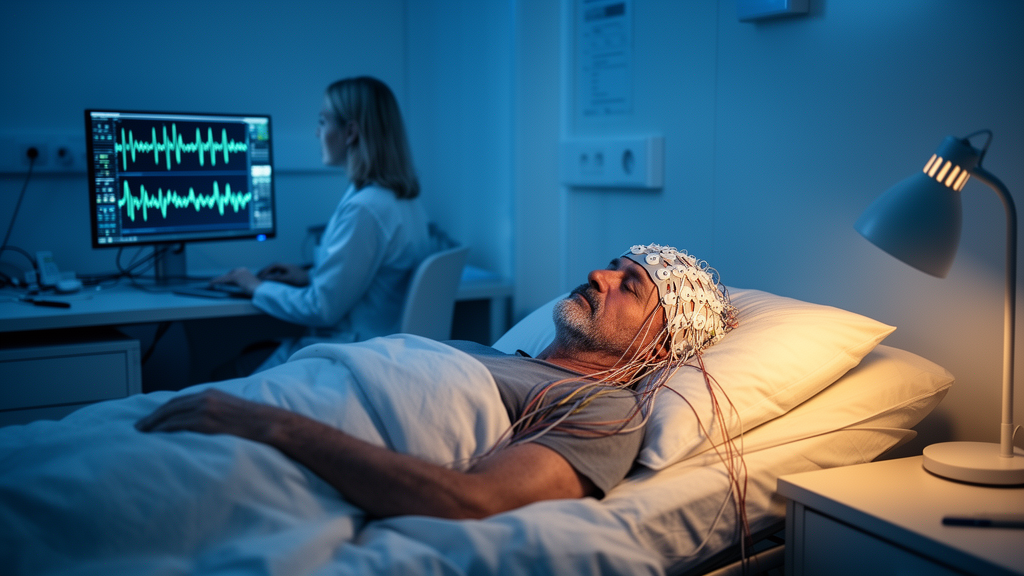
Researchers have unveiled an artificial intelligence framework that identifies REM sleep behavior disorder, a condition widely regarded as an early warning sign of Parkinson’s disease, with high accuracy while running fast enough to imagine future use in clinics and wearable devices. The system, called the Dynamic Compression Transformer Multimodal, or DCTM, achieved an area under the curve of 0.95, a Cohen’s kappa of 0.85, and an F1-score of 0.947 on the label-eligible evaluation split of the CAP RBD dataset, the only dataset in the study that carries explicit RBD diagnostic labels. Under standardized inference settings, the model produced predictions in 28 milliseconds using just 3.02 billion floating-point operations, 360 megabytes of memory, and 0.045 milliwatt-hours of energy.
The work, published in BMC Artificial Intelligence, addresses a persistent bottleneck in sleep medicine. REM sleep behavior disorder is a parasomnia in which the normal paralysis of muscles during rapid eye movement sleep is lost, allowing people to act out their dreams. Because it often precedes α-synucleinopathies such as Parkinson’s disease and dementia with Lewy bodies by years, early and consistent diagnosis matters both for patient care and for identifying people at elevated risk of neurodegenerative disease. Current diagnostic standards, however, depend on manual scoring of polysomnography recordings, particularly the quantification of REM sleep without atonia, a process the authors describe as labor-intensive, time-consuming, and vulnerable to inter-rater variability.
Deep learning has already been applied to automated RBD and RSWA detection, but the researchers argue that most existing algorithms rest on assumptions that fail outside the laboratory: stable signal quality, static multimodal fusion, and fixed full-model inference for every prediction. Transformer-based models can capture long-range temporal dependencies in sleep data and have delivered strong results in sleep staging and apnea detection, yet their substantial computational and memory demands constrain deployment in clinical and low-power wearable contexts. CNN and LSTM baselines run faster but remain sensitive to noise, latency, and overfitting. The gap, the authors contend, is a coherent framework that combines signal-quality awareness, adaptive fusion, and model compression in a single architecture.
DCTM’s pipeline begins with signal quality. Every incoming modality—electroencephalography, electrooculography, electromyography, and optionally oxygen saturation—is assigned a Signal Quality Index. A gating controller uses these indices to modulate how much each modality contributes, suppressing unreliable channels before they can corrupt the final prediction. The gated representations then pass through modality-specific Transformer encoders with six layers and six heads, followed by a cross-attention encoder-decoder that lets queries from one modality attend to keys and values from another, dynamically weighting inter-modal dependencies. A Mixture-of-Experts fusion layer with four experts and top-two routing then activates only specialized sub-networks relevant to each input, a sparse-activation strategy borrowed from large-scale language modeling that lowers computational cost while preserving accuracy.
The compression stage is where the framework earns the first word of its name. During inference, the model applies entropy-based token pruning, attention-head pruning guided by normalized attention entropy, elastic depth and width adjustment, and mixed-precision quantization that converts weights from 32-bit floating point to 8-bit integers. Progressive inference adds a conditional early-exit rule: prediction starts with the lightweight EOG-plus-EMG branches, and additional inputs such as EEG and SpO₂ are activated only when prediction confidence falls below a threshold of 0.8. Training combines supervised cross-entropy loss with knowledge distillation from a full multimodal teacher to the compressed student, weighted by a Kullback-Leibler divergence term, so the smaller network retains the diagnostic fidelity of the larger one.
The datasets were deliberately assigned different roles, a design choice the authors emphasize to avoid overstating results. The CAP RBD dataset, which contains RBD-versus-control diagnostic labels and REM-related EMG annotations, served as the primary label-eligible dataset for all final RBD and RSWA metrics. Sleep-EDF Expanded and the HMC Sleep Database, which lack explicit RBD diagnoses or epoch-level RSWA labels, contributed only to pretraining through masked signal modeling and contrastive learning, normal sleep representation learning, and robustness assessment under heterogeneous PSG conditions. All final RBD-specific performance figures therefore come exclusively from the CAP RBD evaluation splits, evaluated with subject-wise five-fold cross-validation and Leave-One-Dataset-Out testing for cross-dataset generalization.
Preprocessing itself was quantitatively validated using simulated artifact injection. EEG signal-to-noise ratio rose from 8.4 plus or minus 2.1 decibels to 17.6 plus or minus 2.8 decibels, and EEG signal quality increased from 0.62 to 0.86, while artifact-dominant power fell by 61.7 to 70.2 percent across modalities. Signals were resampled to 200 hertz, band-pass filtered, and cut into 30-second epochs, with RSWA classified according to SINBAR criteria: tonic activity defined as a continuous EMG increase spanning at least half the epoch, and phasic activity as rapid bursts lasting 0.1 to 5 seconds that exceed twice the baseline amplitude.
Beyond raw accuracy, the study’s most distinctive contribution is a mechanistic chain linking signal degradation to model behavior. Under controlled degradation, when EEG line noise drove EEG signal quality from 0.88 down to 0.39, the EEG gate weight fell from 0.27 to 0.08 while EOG and EMG contributions increased, and the F1-score slipped only from 0.947 to 0.930. Under EMG motion artifacts, EMG signal quality dropped from 0.90 to 0.36 and its gate weight from 0.32 to 0.09, shifting attention toward EEG and EOG with a larger but still controlled performance decline. Missing channels received near-zero gate values, forcing reliance on the remaining inputs. The largest declines occurred when EMG was missing or when multiple artifacts struck simultaneously, confirming that muscle activity is the physiological backbone of RSWA detection.
Robustness testing under controlled retrospective conditions echoed this pattern. Line-noise contamination reduced AUC from 0.95 to 0.93 and F1 from 0.947 to 0.93, motion-induced EMG artifacts yielded an AUC of 0.92 and F1 of 0.91, and removing EMG entirely produced the steepest fall, to an AUC of 0.89 and F1 of 0.88. Epoch-level RSWA quantification showed an F1-score of 0.947, precision of 0.93, and recall of 0.96, with predicted RSWA percentages correlating at 0.90 with expert interpretations. Bland-Altman analysis found a mean bias of just plus 2 percent with limits of agreement of plus or minus 10 percent, indicating close agreement between automated and manual RSWA quantification across epochs.
The authors are explicit about the boundaries of the evidence. DCTM should be read as a retrospectively evaluated, quality-aware polysomnography model with promising computational feasibility, not a clinically deployed or prospectively validated wearable system. The efficiency figures were measured on a high-performance workstation rather than dedicated wearable hardware, the analysis was limited to laboratory-based PSG recordings, and the multi-artifact condition represents artifact-injection validation rather than an independent prospective deployment experiment. Failure-case analysis showed that performance losses traced to simultaneous multimodal corruption—high-amplitude EMG contamination, EEG baseline drift, and irregular ocular activity—rather than unstable model behavior. The researchers call for prospective multicenter validation, real-world artifact testing, hardware-level implementation studies, and clinician-facing explainability evaluation before any clinical or wearable use can be claimed. Within those limits, the study offers a template for how adaptive, signal-quality-aware inference could make automated sleep-disorder analysis both trustworthy and light enough to leave the sleep lab.
Subject of Research: A multimodal transformer framework for automated detection of REM sleep behavior disorder from polysomnography signals
Article Title: Dynamic compression transformer multimodal for robust and efficient detection of REM sleep behavior disorder
Article References: Huang, J.-J., Chen, S.-C., & Wahyono, I. D. (2026). Dynamic compression transformer multimodal for robust and efficient detection of REM sleep behavior disorder. BMC Artificial Intelligence, 2(1), Article 21. https://doi.org/10.1186/s44398-026-00037-6
Image Credits: AI Generated
DOI: 10.1186/s44398-026-00037-6
Keywords: REM sleep behavior disorder, polysomnography, transformer, signal quality, knowledge distillation, model compression, Mixture-of-Experts, RSWA, Parkinson's disease, sleep medicine, artificial intelligence, wearable devices
News Source: Diana Fleming. (October 27, 2026). AI transformer detects REM sleep behavior disorder with 28-millisecond speed. Scienmag.