


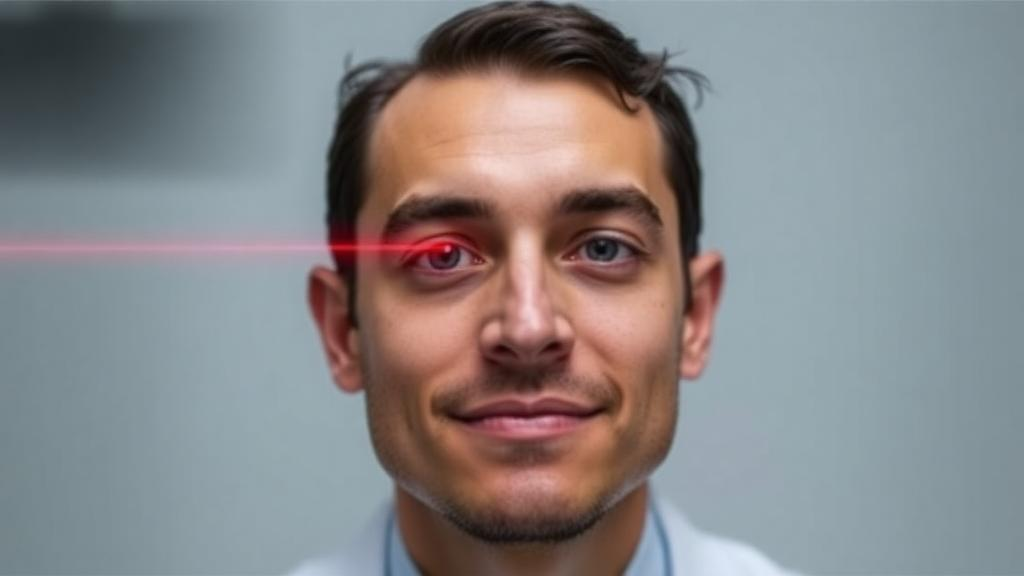
A 23-year-old laser hair removal technician suffered sudden central vision loss in her left eye after an accidental exposure to an alexandrite laser beam while cleaning the probe of the device, according to a case report published in Frontiers in Ophthalmology. The report, authored by researchers affiliated with Al-Quds University Faculty of Medicine, the German Eye Center in Ramallah, and The University of Jordan School of Medicine, documents both the injury and a substantial recovery over five months of follow-up.
At her initial presentation, the patient’s visual acuity in the affected left eye was measured at 0.1.
The scan demonstrated a loss of the normal foveal depression, together with a vertical hyperreflective column extending from the inner retinal layers down to the retinal pigment epithelium.
The injury was complicated by acute anterior uveitis, an inflammatory condition affecting the front portion of the eye.
The recovery was documented through serial examinations, with the authors noting that the improvement unfolded gradually across the follow-up period rather than occurring immediately.
Repeat optical coherence tomography at the later follow-up visits showed residual central foveal disruption, with localized attenuation of the ellipsoid zone and the retinal pigment epithelium. Importantly, these residual changes were confined to a smaller area compared with the baseline imaging obtained at the initial presentation.
The authors emphasize that the case demonstrates the importance of safety protocols when handling laser devices to prevent accidental eye injuries. The authors also note that the case demonstrates the potential for good clinical outcomes with regular evaluation and follow-ups, highlighting the value of structured ophthalmic monitoring after such injuries.
As a single-patient case report, the findings describe one individual’s experience and cannot establish how commonly such injuries occur, what proportion of patients recover comparable vision, or which interventions contributed to the outcome. The report does, however, add to the documented literature on accidental alexandrite laser exposure and provides a detailed imaging record of both the acute injury pattern and the residual changes that persisted after five months.
For clinicians, the case illustrates the imaging signature of photothermal foveal injury on optical coherence tomography, including the hyperreflective column, the disruption of the ellipsoid zone and external limiting membrane, and the pattern of partial structural recovery over time. For workers in the aesthetic laser industry, the report serves as a reminder that beam exposure during device maintenance carries real risk of retinal injury, and that adherence to established safety protocols remains the primary means of prevention.
The article was received on 25 July 2026 and accepted on 7 October 2026, and appears in the Retina section of the journal. The authors state that all claims expressed in the article are solely their own and do not necessarily represent those of their affiliated organizations or the publisher.
Subject of Research: A case report of photothermal foveal injury from accidental alexandrite laser exposure with recovery over five months.
Article Title: Photothermal foveal injury secondary to accidental alexandrite-laser exposure: a case report and literature review
Article References: Allan, M., Muhsen, S., Yaseen, E., Sawafta, N., & Alfoqahaa, M. (2026). Photothermal foveal injury secondary to accidental alexandrite-laser exposure: a case report and literature review. Frontiers in Ophthalmology, 6, Article 1948525. https://doi.org/10.3389/fopht.2026.1948525
Image Credits: AI Generated
DOI: 10.3389/fopht.2026.1948525
Keywords: alexandrite laser, foveal injury, retina, optical coherence tomography, uveitis, laser safety, visual acuity, case report, laser hair removal, ophthalmology, Photothermal, foveal
News Source: Ophelia Keating. (October 28, 2026). Accidental Alexandrite Laser Beam Leaves 23-Year-Old Technician With Foveal Injury, Vision Recovers Over Five Months. Scienmag.



