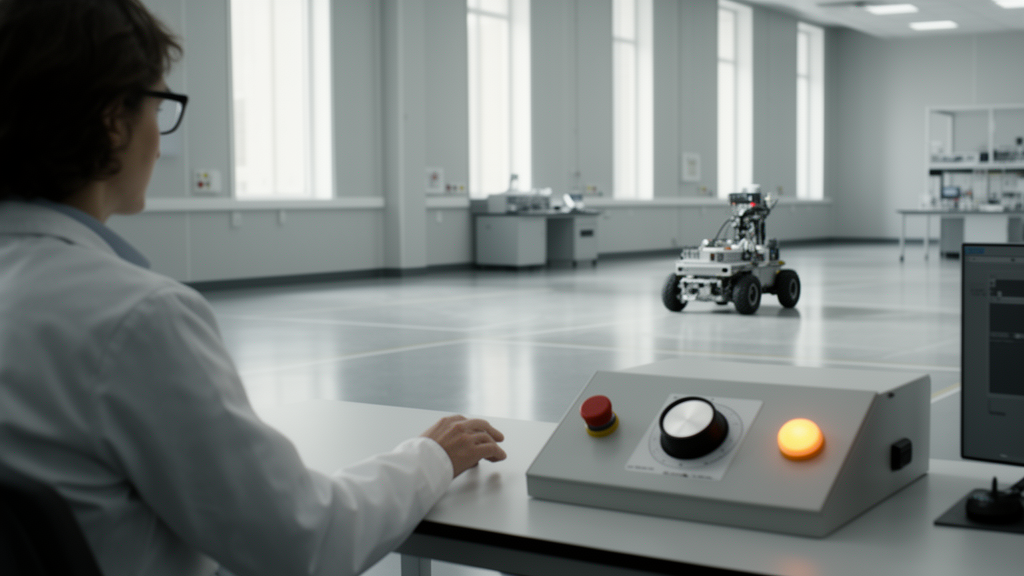
Researchers have unveiled a mathematically guaranteed scoring method designed to help human supervisors decide when a collaborative robot event deserves their attention. The method, called a monotone pairwise redundancy-aware Artificial Age Score (AAS), aggregates six normalized measures of safety and operational burden into a single, transparent event-level score whose behavior can be proved rather than merely observed. The work, published in Discover Robotics, addresses a subtle but consequential flaw in earlier redundancy-adjusted scoring: under certain conditions, adding a new burden signal could actually lower the total score.
The six inputs describe a single decision event in a human–robot collaboration setting. Three are direct safety indicators—task hazard severity, human safety risk, and environmental uncertainty—while three capture operational monitoring demand: task criticality, exposure frequency, and intervention complexity. Each input is normalized to a value between zero and one, with higher values meaning greater burden. The authors stress that these dimensions form a compact design prior, not a universal inventory of workplace risk; human fatigue, robot-motion confidence, staffing, and recovery history are explicitly not claimed to be represented.
The core innovation lies in how overlapping evidence is handled. When several indicators partly describe the same underlying concern, a simple weighted sum can double-count the evidence. An earlier activity-normalized ratio approach tried to correct for this, but it had a structural defect: when no other component was active, the ratio was defined as zero, yet an arbitrarily small overlapping input made it jump to a positive constant. In a boundary example with environmental uncertainty at 0.999, introducing a second input as small as one billionth caused the score to fall from 1.5941 to 1.0627—both a discontinuity and a monotonicity violation that could reverse a high-burden classification.
The new pairwise construction replaces that unstable ratio with a smooth overlap function applied to each pair of related inputs. Each pairwise discount scales with the evidence at both endpoints, so it vanishes smoothly whenever either component vanishes. The authors prove that if the discount strength times the maximum weighted overlap degree stays at or below one, the score is continuous and non-decreasing in every input. A tighter finite-domain condition is shown to be necessary and sufficient when all weights are strictly positive. The demonstrator uses a discount strength of 0.80 against a maximum degree of one, leaving a deliberate margin of 0.2 as a reserve for later changes to the overlap graph.
Explainability is built into the arithmetic. The score decomposes exactly into six non-negative component contributions, each receiving half of every pairwise discount it participates in, so the displayed contributions always reconcile with the total. A two-stage decision architecture then separates a hard safety gate from a supervisory score threshold: if any direct-safety input crosses its mandatory-review threshold, human review is required regardless of the aggregate score, and no amount of redundancy discounting can suppress it. The output record includes the score, all six contributions, the dominant contributor, the gate state, and a configuration version.
To test the method, the researchers generated 65,536 synthetic event profiles across the six-dimensional input space using a scrambled Sobol sequence, then evaluated behavior on held-out data against a separately specified, deliberately non-additive oversight policy. On 13,762 held-out non-mandatory profiles, the pairwise method achieved a receiver operating characteristic area under the curve of 0.892 (95 percent bootstrap interval 0.887 to 0.897) and a balanced accuracy of 0.800, compared with 0.880 and 0.788 for the redundancy-free baseline. The improvement was modest and specific to this constructed benchmark; the logarithmic transformation accounted for most of the gain, with the pairwise discount adding a smaller increment.
The monotonicity audit was exhaustive within the sampled domain. Across 1,179,648 coordinatewise checks—raising one burden input while holding the other five fixed at three different step sizes—the pairwise method produced zero decreases, while the ratio comparator produced 3,484. Stress tests beyond the admissible range showed why the mathematical guard matters: at discount strengths of 1.02 and 1.05, which exceed the refined bound, the broad Sobol sample showed no decreases, but targeted corner checks exposed small score decreases precisely at boundary profiles. A finite sample, the authors note, can miss the region where a guarantee fails.
Measurement-error tests probed how the method behaves when inputs are corrupted. Using 300 noise runs spanning independent and correlated error structures at three amplitudes, the pairwise method retained higher mean score-only balanced accuracy than the redundancy-free baseline in all 15 noise conditions. But the full picture was more nuanced: on a cohort that included mandatory profiles, the baseline method achieved higher mean gate-plus-score balanced accuracy in every noise setting, even though the pairwise method missed fewer clean mandatory profiles on average. Systematic offsets were particularly revealing. Shifting all six inputs down by 0.05 kept the rank correlation with clean scores at 0.9896, yet 20.97 percent of score decisions changed and 5.19 percent of clean mandatory profiles were missed. High rank stability, the authors conclude, does not ensure decision stability or correct sensing.
The authors are explicit about the limits of what these results establish. Every profile and label in the evaluation is synthetic; there are no worker, robot, incident, or field data, so the reported false positives and false negatives are disagreements with a constructed rule, not workplace error rates. The weights and overlap relationships are illustrative design priors, and notably, equal and operations-emphasized weight vectors outperformed the nominal safety-prioritized weights under the benchmark policy. The findings establish mathematical properties and synthetic behavior, not empirical calibration, field effectiveness, or operator understanding. The score is positioned outside safety-rated control: it has no safety integrity level, does not monitor its own sensor chain, and cannot command a stop.
The researchers outline a deployment pathway that would be required before any operational use: defining the decision scope, operationalizing each input with documented measurement rules, eliciting weights and overlaps from multiple stakeholders, specifying hard gates from a formal risk assessment, fitting the threshold on adjudicated cases, and conducting prospective human-in-the-loop evaluation of comprehension, workload, and reliance. The explanation-panel prototype accompanying the paper demonstrates how a supervisor could see whether review was mandated by a direct safety condition or recommended by accumulated operational burden, but it has not been tested with human users. Real human–robot collaboration and human-factors validation, the authors emphasize, remain necessary before the method’s effectiveness as an operational aid can be established.
Subject of Research: A monotone, redundancy-aware scoring method for explainable human oversight decisions in human–robot collaboration, validated on synthetic event profiles
Article Title: A monotone redundancy-aware decision-burden method for explainable human oversight in human–robot collaboration
Article References: Kayadibi, S. Y. (2026). A monotone redundancy-aware decision-burden method for explainable human oversight in human–robot collaboration. Discover Robotics, 2(1), Article 35. https://doi.org/10.1007/s44430-026-00048-y
Image Credits: AI Generated
DOI: 10.1007/s44430-026-00048-y
Keywords: human-robot collaboration, explainable AI, decision support, monotonicity, redundancy discount, oversight, robotics safety, synthetic evaluation, Sobol sampling, measurement error, governance, Artificial Age Score
News Source: Denise Maddox. (October 27, 2026). New Monotone Scoring Method Aims to Make Human Oversight of Robots More Explainable. Scienmag.