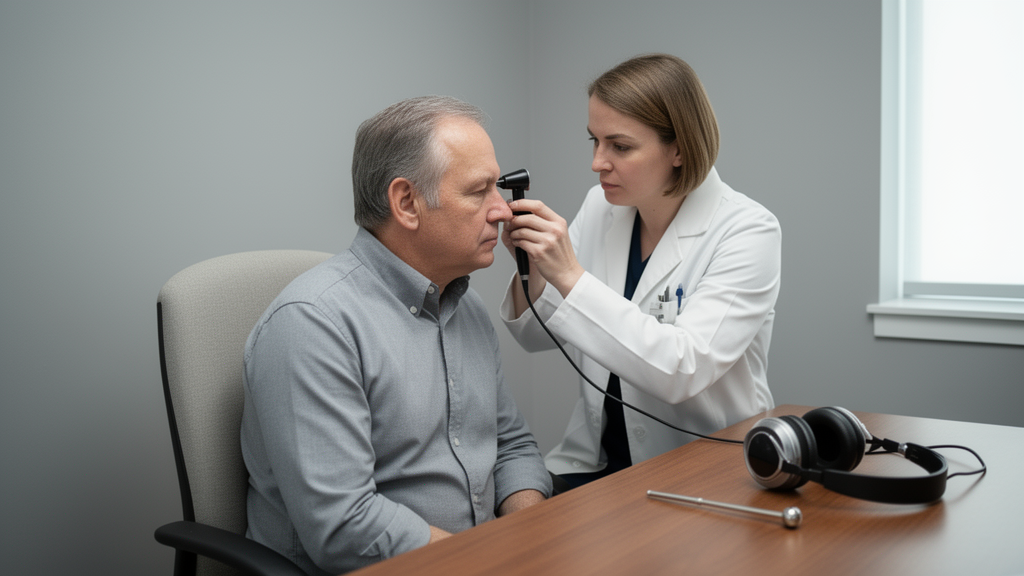
People living with psoriatic arthritis may carry silent damage in their ears and balance organs long before they notice any hearing loss or dizziness, according to a new cross-sectional controlled study published in Egyptian Rheumatology and Rehabilitation. Turkish researchers found that patients with the disease showed measurably poorer hearing, weaker inner-ear balance responses, and abnormal eye-movement patterns compared with carefully matched healthy volunteers, even though none of the participants had been diagnosed with an ear or vestibular disorder beforehand.
Psoriatic arthritis is a chronic immune-mediated inflammatory disease best known for attacking peripheral and axial joints and entheses, often alongside psoriasis of the skin and nails. But clinicians have long suspected that its reach extends further. In related autoimmune rheumatic diseases such as rheumatoid arthritis, systemic lupus erythematosus, and ankylosing spondylitis, inner-ear involvement is well documented, with proposed mechanisms ranging from vasculitis and immune-complex deposition to direct cytotoxic injury of the delicate hair cells and vestibular receptors. Whether the same applies to psoriatic arthritis had been suggested by small earlier studies, but never tested with a full modern battery of hearing and balance instruments in a single cohort.
The new study, conducted between February and May 2025 at Sakarya University’s Faculty of Medicine, enrolled 35 adults with psoriatic arthritis diagnosed under the CASPAR classification criteria and 35 healthy controls. The groups were frequency-matched for age and sex, and participants ranged from 18 to 70 years old. Crucially, anyone with a history of otologic or vestibular disease, neurological balance disorders, significant noise exposure, ototoxic drug exposure, or clinically evident age-related auditory or vestibular impairment was excluded from both groups. The researchers also recorded current medications, including methotrexate, corticosteroids, conventional disease-modifying antirheumatic drugs, and biologic agents, though only documented exposure to a known ototoxic drug would have disqualified a patient.
Each participant underwent an unusually comprehensive workup. Pure tone audiometry measured air and bone conduction thresholds, while speech audiometry assessed the speech reception threshold and word recognition score using standardized Turkish materials. Tympanometry and acoustic reflex testing probed the middle ear. On the vestibular side, the team deployed the video head impulse test, which tracks how well the eyes stay locked on a target during rapid head movements and quantifies the vestibulo-ocular reflex gain of each of the six semicircular canals; cervical vestibular evoked myogenic potentials, which measure electrical responses from the saccule via the tensed sternocleidomastoid muscle; videonystagmography with saccade, smooth pursuit, and optokinetic subtests; and bithermal caloric testing, in which cool and warm air irrigations provoke nystagmus whose slow-phase velocity reveals low-frequency canal function. All recordings were interpreted by a senior audiologist blinded to group allocation.
The auditory results were striking. Patients with psoriatic arthritis had significantly higher pure-tone averages in both ears, lower word recognition scores, and higher, meaning poorer, speech reception thresholds than controls, with p-values at or below 0.001 for the threshold and word recognition measures and p equal to 0.011 for speech reception. The standardized effect sizes were large: Hedges’ g reached 1.36 for the right ear and 1.62 for the left ear pure-tone average, and minus 1.12 for word recognition. Every tympanogram in the study was type A, indicating normal middle-ear pressure, which points the abnormality toward the sensory inner ear rather than the conductive apparatus. Acoustic reflexes were absent on one or both sides in four patients but in no controls, a difference that narrowly missed statistical significance.
The vestibular findings were just as telling. Video head impulse testing revealed lower vestibulo-ocular reflex gains in the right lateral canal, both anterior canals, and the right posterior canal, with the right anterior canal showing an especially large effect size of minus 2.93. Cervical vestibular evoked myogenic potentials showed reduced P1-N1 peak-to-peak amplitudes in both ears of the patients, alongside shorter P1 latencies bilaterally and a shorter right N1 latency, patterns the authors interpret as possible otolith-pathway involvement. On caloric testing, abnormal unilateral weakness appeared in 12 of the 35 patients, or 34.3 percent, and abnormal directional preponderance in 10, or 28.6 percent, while neither abnormality was detected in a single control participant. Mean caloric slow-phase velocities were actually higher in the patients, which the authors caution reflects response magnitude rather than better function, since unilateral weakness is a relative measure of asymmetry between ears. Videonystagmography added further evidence: optokinetic, saccadic, and smooth pursuit abnormalities were all significantly more frequent in the patient group, though spontaneous nystagmus did not differ and positional testing was normal in everyone.
Perhaps the most provocative results are the correlations with disease activity. Within the patient group, higher DAS28 scores were associated with lower right lateral canal vHIT gain, and higher DAPSA28 scores with lower bilateral mean cVEMP amplitude. Disease duration correlated positively with caloric slow-phase velocity responses in both ears, and PASI scores correlated negatively with caloric canal paresis. These associations hint that the inner-ear abnormalities might track with inflammatory activity, but the authors are careful to stress that a cross-sectional snapshot cannot establish causality, cannot identify which end organ or pathway might be injured, and cannot rule out adaptation, technical variability, or chance as explanations.
The study’s authors are equally candid about its limits. With 35 participants per group, the analysis was powered for major between-group differences but not for subgroup, medication-specific, or adjusted multivariable analyses. No formal correction for multiple comparisons was applied, so marginally significant findings carry an elevated risk of being false positives. Two variables, left lateral vHIT gain and left N1 latency, showed such skewed distributions that they were reported descriptively only. Normalized cVEMP amplitudes could not be calculated because background EMG values were not retained, and the vHIT records lacked complete rejected-impulse counts and corrective-saccade data. Age-stratified analysis was impossible, medication effects cannot be excluded, and central auditory pathways were never assessed because auditory brainstem responses and neuroimaging were not performed.
What emerges is a coherent but preliminary picture: subclinical cochlear and vestibular dysfunction in a substantial fraction of psoriatic arthritis patients, detectable with objective instruments before symptoms appear, and tentatively linked to measured disease activity. The authors suggest that targeted audiovestibular evaluation may be worth considering for patients who report relevant hearing, vestibular, or balance complaints, while explicitly stating that the data do not support routine screening or drug treatment of asymptomatic patients. Whether these subtle abnormalities progress over time, fluctuate with inflammation, or improve with systemic therapy or vestibular rehabilitation will require the larger, longitudinal, standardized studies the researchers say are now needed to confirm their findings.
Subject of Research: Audiovestibular function in patients with psoriatic arthritis
Article Title: Assessment of audiovestibular function in patients with psoriatic arthritis: a cross-sectional controlled study
Article References: Eğilmez, O. K., Dilekçi, A., Şahin, M. Z., Çoruh Kınalı, K., & Nas, K. (2026). Assessment of audiovestibular function in patients with psoriatic arthritis: a cross-sectional controlled study. Egyptian Rheumatology and Rehabilitation, 53(1), Article 88. https://doi.org/10.1186/s43166-026-00452-7
Image Credits: AI Generated
DOI: 10.1186/s43166-026-00452-7
Keywords: psoriatic arthritis, hearing loss, vestibular dysfunction, audiometry, video head impulse test, cVEMP, caloric testing, videonystagmography, autoimmune disease, inner ear, disease activity, cross-sectional study
News Source: Ophelia Keating. (October 27, 2026). Psoriatic Arthritis Linked to Hidden Hearing and Balance Abnormalities in New Study. Scienmag.