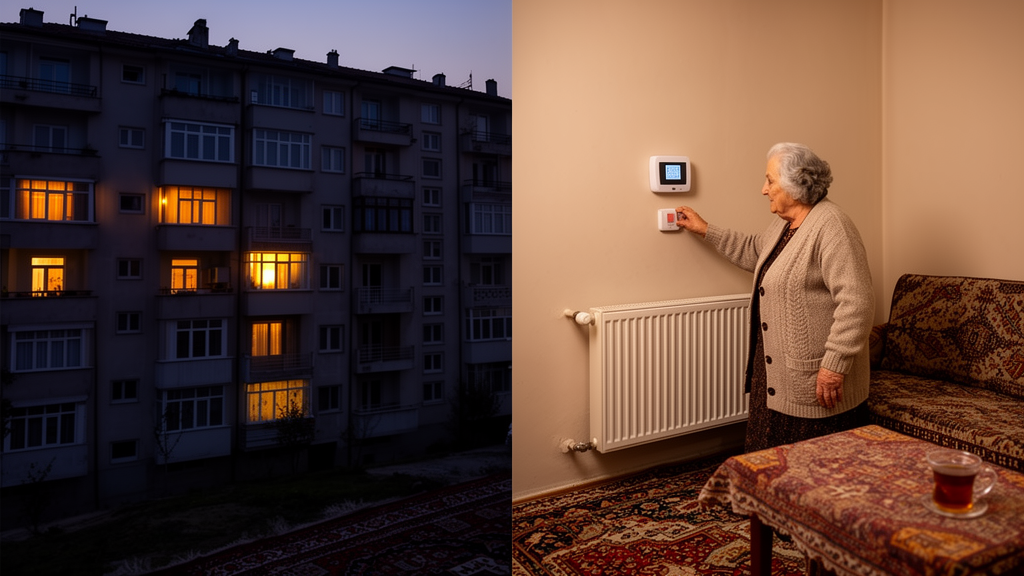
Türkiye’s nationwide building energy performance regulation, introduced in 2011, is associated with measurable reductions in several dimensions of household energy poverty, according to a new quasi-experimental study published in Energy, Sustainability and Society. The research, led by Egemen İpek with Elisenda Jové-Llopis and Elisa Trujillo-Baute, analysed nationally representative survey data spanning nearly two decades to isolate the effects of the policy.
The regulation in question is Türkiye’s Regulation on Energy Performance in Buildings (REPB), which took effect in 2011. The study asked whether households potentially exposed to the regulation’s insulation-related mechanism experienced different post-policy changes in energy poverty compared with similar households that were not exposed. Because the policy rolled out nationwide, the researchers used a difference-in-differences design, a natural-experiment approach that compares changes over time between an exposed group and a comparison group.
The data came from the Income and Living Conditions Survey covering 2006 to 2023, giving the team a long pre-policy baseline and an extended post-policy observation window. To strengthen the comparison, the authors complemented the difference-in-differences framework with propensity score matching and entropy balancing, statistical techniques designed to make the exposed and comparison groups more comparable on observed characteristics before estimating the policy’s association with outcomes.
The results point to statistically significant post-policy reductions across several measures of energy poverty. Relative to the comparison group, the share of households reporting utility bill arrears fell by 1.8 percentage points, poor housing conditions by 5.2 percentage points, and inadequate heating by 10.6 percentage points. The 10 percent expenditure-burden indicator, which flags households spending more than a tenth of their income on energy, declined by 2.2 percentage points. A multidimensional energy poverty index also fell significantly, with a difference-in-differences coefficient of −0.189.
Not all measures responded equally strongly. The evidence for expenditure-based energy poverty was weaker than for the subjective and multidimensional measures, a pattern the authors highlight in their distributional analysis. They also found heterogeneous associations across income groups, suggesting the regulation’s effects were not uniform across the income distribution.
The timing of the improvements matters as well. Dynamic estimates indicated stronger gains during the early post-policy period, followed by attenuation over time. In other words, the largest observed reductions in energy poverty occurred soon after the regulation’s implementation, with the association weakening in later years. This pattern underpins the authors’ caution that regulation alone may be insufficient to ensure persistent and inclusive improvement.
The study’s findings were tested against a battery of robustness checks. The authors report that the results are broadly robust to propensity score matching, entropy balancing, alternative definitions of the treated group, placebo tests, alternative expenditure-based measures, and coefficient-stability tests. These checks are intended to guard against the possibility that the estimated associations are artefacts of particular modelling choices.
Because the design is quasi-experimental and the treatment is defined as potential exposure to the regulation’s insulation-related mechanism, the findings describe associations with post-policy change rather than definitive causal proof of the regulation’s effect on every household. The analysis relies on survey-based measures of energy poverty, spanning subjective indicators such as inadequate heating, expenditure-based indicators such as the 10 percent burden threshold, and a multidimensional index combining several dimensions.
The authors conclude that building energy performance regulation may contribute to both social and environmental sustainability by addressing structural deficiencies in housing, improving thermal conditions, and supporting a more equitable transition toward energy-efficient housing. They suggest that complementary measures, including targeted retrofit support, financial incentives for vulnerable households, maintenance, enforcement, and energy-saving information, may help sustain energy efficiency gains and ensure that the benefits of the energy transition are more widely shared. The article, published open access on 7 October 2026, is being shared early as a peer-reviewed accepted manuscript subject to further edits before the final version of record.
Subject of Research: The association between Türkiye's 2011 building energy performance regulation and household energy poverty.
Article Title: Building energy performance regulation and energy poverty: evidence from a natural experiment
Article References: İpek, E., Jové-Llopis, E., & Trujillo-Baute, E. (2026). Building energy performance regulation and energy poverty: evidence from a natural experiment. Energy, Sustainability and Society. https://doi.org/10.1186/s13705-026-00615-6
Image Credits: AI Generated
DOI: 10.1186/s13705-026-00615-6
Keywords: energy poverty, building energy performance, Türkiye, difference-in-differences, housing insulation, energy efficiency policy, thermal comfort, utility bill arrears, quasi-experiment, Income and Living Conditions Survey, energy transition, household energy expenditure
News Source: Sloane Callahan. (October 27, 2026). Türkiye’s building energy rule linked to lower household energy poverty. Scienmag.