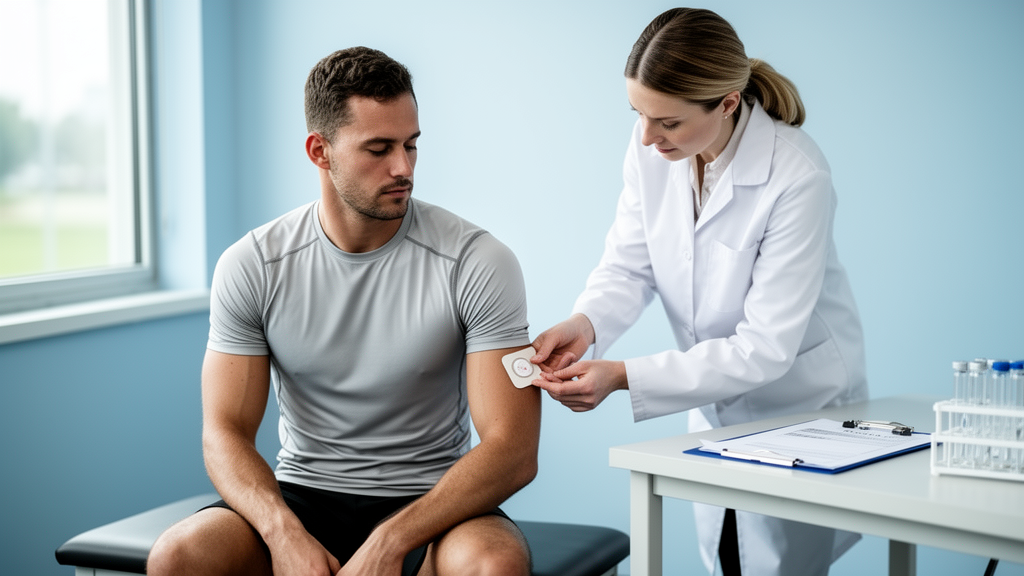
Heat acclimation reliably lowers the sodium concentration of sweat, a measurement that endurance athletes and their support teams frequently use to individualize fluid and electrolyte replacement. A new mini review published in Frontiers in Physiology argues that the real question is not whether this adaptation is genuine, because it has reproduced across protocols and decades, but whether a second measurement can actually resolve it. According to the review, the effect sits between roughly 9 and 23 mmol/L across studies, or approximately 15 mmol/L when compared at a matched local sweat rate, yet several sources of measurement variance rival or exceed that signal in size.
The review, authored by researchers at Woosuk University in the Republic of Korea and Pingdingshan University in China, frames the debate as a disagreement about what a sweat sodium number is meant to estimate rather than a dispute about the underlying evidence. One interpretation holds that the adaptation is rapid and heterogeneous between athletes, so serial measurement is the only way to keep a replacement plan current. The other notes that sweat sodium concentration predicts neither hydration status nor sweating rate, does not by itself stratify hyponatremia risk, and therefore rarely changes a decision. The authors conclude that these positions differ in the quantity they estimate, not in their reading of the data.
The physiological adaptation itself has a well-defined locus and a consistent direction. Across studies spanning four decades, repeated exercise-heat exposure has lowered sweat sodium concentration while raising sweat rate, a combination that reflects increased ductal reabsorption of sodium rather than simple dilution. In one study of eight men completing ten days of exercise in the heat, acclimation lowered the y-intercept of the relationship between sweat sodium concentration and sweat rate by 15 mmol/L without altering its slope, placing the change in ductal reabsorptive capacity rather than in flow. Another study reported a fall from 54.5 plus or minus 16.2 to 36.2 plus or minus 7.2 mmol/L over ten days, while whole-body sweat rate rose by only about six percent and not significantly, which the authors say excludes dilution as the explanation.
The time course of the adaptation is protocol-dependent, and this matters directly for the retest question. Sodium conservation is the earliest sudomotor adaptation to appear: in one controlled protocol, sweat sodium and chloride concentrations fell to approximately sixty percent of day one values by day ten, with conservation detectable from day three, before local sweat rate increased on day eight at the arm and day seven at the back. At a two-week training camp in natural heat, concentration fell from 75 plus or minus 22 to 52 plus or minus 24 mmol/L within the first five to six days, with no further change thereafter, even though power output continued to improve. The review emphasizes that this dissociation means the marker can saturate while the broader phenotype it indexes is still developing.
Decay of the adaptation is equally informative but poorly characterized. The only direct observation of decay in sodium conservation, involving 15 participants, found the adaptation no longer detectable after 28 days without heat exposure, with five days of re-acclimation restoring it; controlled hyperthermia conserved more sodium than hot water immersion or no re-exposure. In 20 male elite cyclists, five weeks of acclimation lowered sweat sodium concentration by 14.1 mmol/L, and performance and total hemoglobin mass returned to baseline two weeks after withdrawal. The magnitude of the effect depends on the stimulus and, less than is often assumed, on the athlete: isothermic conditioning targeting a gastrointestinal temperature of at least 38.5 degrees Celsius reduced thigh-predicted sweat sodium concentration by 9 mmol/L, significantly more than a military acclimatization program, while age did not blunt the response in a comparison of young men and highly fit and normally fit older men.
Against that signal, the review sets a catalogue of variance sources that can rival the acclimation effect itself. Raising exercise intensity from 45 to 65 percent of maximal oxygen uptake shifted whole-body sweat sodium concentration from 32.6 plus or minus 14.3 to 52.7 plus or minus 14.6 mmol/L in the same participants, and total sodium loss from 659 plus or minus 340 to 1,565 plus or minus 590 mg. A repeat test performed at a different workload can therefore manufacture or erase an apparent adaptation larger than the adaptation itself. Anatomical site adds further structure: eccrine gland density varies from 16 to 530 glands per square centimeter across the body surface, and uncorrected chest and upper-back patches overestimated whole-body concentration by a mean of 22 to 23 mmol/L, whereas validated prediction equations reduced mean bias to 5 mmol/L or less.
Notably, the analytical step is not the weak link. Comparing five instruments on 70 samples, one study found within-instrument coefficients of variation of 2.6 percent or less and between-instrument standard errors of 2.8 to 3.8 mmol/L, imprecision the authors judged trivial in most exercise circumstances. The variance that threatens a repeat test is procedural and biological instead. Habitual sodium intake is a confounder specific to serial testing: with daily intake controlled at 348.4, 174.1, and 66.3 mmol, the reduction in sweat sodium secretion during heat exposure was greatest on the lowest intake, with potentiated aldosterone secretion, so an athlete who changes sodium intake between two tests changes the result independently of acclimation state. Collection technique, sample handling, and the flow dependence of ductal reabsorption, which makes expected concentration span 26.5 to 49.7 mmol/L across a fivefold range of whole-body sweat rate, add further variance.
The review’s central inferential argument concerns the smallest detectable change, the quantity needed to interpret a difference between two tests. At 95 percent confidence, this equals 1.96 times the square root of two times the typical error of repeated tests. Test-retest estimates exist for some exercise-heat protocols: over two five-hour cycling trials in the heat, predicted whole-body concentration had a between-trial typical error of 5.6 mmol/L, which would imply a smallest detectable change of approximately 15 mmol/L for that protocol, comparable to the acclimation effect itself. The authors identified no such estimate for the heat stress tests used to monitor acclimation, and they stress that a commonly cited normal variability of approximately plus or minus 12 percent describes expected fluctuation, not a decision threshold. Without a smallest detectable change, they argue, no numerical threshold for acting on a change between tests can be recommended.
The case for repeat testing is not dismissed outright. The trajectory is concentrated in the induction period, so measurement must fall within that window if the aim is to describe it or estimate cumulative sodium loss across a program. The magnitude is heterogeneous, with group mean reductions ranging from 9 mmol/L in a field program through 14.1 mmol/L over five weeks of laboratory acclimation to 23 mmol/L at a training camp, where between-participant standard deviations of 22 mmol/L before and 24 mmol/L after were as large as the mean change itself, making a group mean a poor substitute for an individual value. The measurement can also be consequential in identifiable subgroups: an adult with cystic fibrosis and a baseline concentration of 70 mmol/L who had previously cramped during exercise in the heat reduced it by 18 mmol/L over ten sessions, retained the adaptations for at least seven days, and showed no cramping on follow-up heat stress testing, though this remains a single case.
The case against rests on the weakness of the link between the number and any outcome. Sweat and blood concentrations have not been shown to correspond for most solutes, and the third international consensus conference on exercise-associated hyponatremia attributes that disorder principally to fluid intake in excess of losses combined with non-osmotic vasopressin-mediated water retention, so a sweat sodium value does not by itself stratify risk. The review identified no study that has manipulated acclimation-induced changes in sweat sodium concentration and measured performance or heat illness as an outcome, meaning the proposition that tracking the marker improves either remains an untested inference. On the present evidence, the authors take a conservative position: characterize the athlete once while unacclimatized under a reproducible heat stress test, report the whole-body rate of sodium loss alongside sweat rate rather than concentration alone, and consider one additional measurement, for example around day seven, only when the explicit aim is to describe the induction trajectory. Retest when the premises change, such as after a substantial alteration in training intensity or environment, or after a period without heat exposure long enough for decay to be plausible, though the authors emphasize that a four-week interval remains a hypothesis rather than an evidence-based trigger. What would overturn this position, they conclude, is a reliability estimate showing that a standardized protocol resolves changes appreciably smaller than the 15 mmol/L matched-rate effect, together with a trial in which replacement guided by serial testing improved an outcome that matters to athletes. Until both exist, the burden of proof lies with repeated testing rather than against it.
Subject of Research: Whether endurance athletes should repeat sweat sodium testing after heat acclimation
Article Title: Do endurance athletes need repeat sweat sodium testing after heat acclimation? Separating physiological adaptation from measurement variability
Article References: XiaoTian, H., Wook, Y., Sen, Z., & LiFang, J. (2026). Do endurance athletes need repeat sweat sodium testing after heat acclimation? Separating physiological adaptation from measurement variability. Frontiers in Physiology, 17, Article 2002403. https://doi.org/10.3389/fphys.2026.2002403
Image Credits: AI Generated
DOI: 10.3389/fphys.2026.2002403
Keywords: heat acclimation, sweat sodium concentration, endurance athletes, hydration, electrolyte replacement, measurement variability, smallest detectable change, sudomotor function, exercise physiology, hyponatremia, sodium loss rate, wearable sensors
News Source: Drew Townsend. (October 27, 2026). Heat acclimation lowers sweat sodium, but repeat testing may not change decisions. Scienmag.