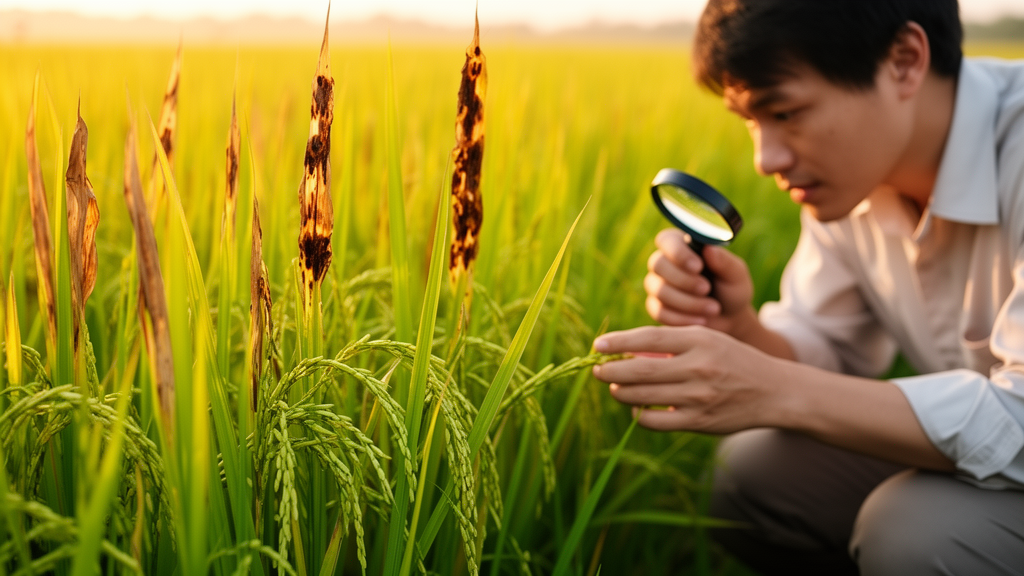
University of Missouri researchers have created rice plants that resist bacterial blight, a devastating disease that threatens one of the world’s most important food crops. The work, led by Bing Yang, a Curators’ Distinguished Professor in the College of Agriculture, Food and Natural Resources and an investigator in the Bond Life Sciences Center, is described as a breakthrough that could help farmers in parts of Asia and Africa, where the disease can destroy harvests and threaten livelihoods.
At the heart of the advance is OpenCRISPR-1, a gene-editing tool designed using artificial intelligence. Gene editing allows researchers to make targeted changes to an organism’s DNA, such as altering genes that make plants vulnerable to disease. OpenCRISPR-1 was originally developed by the California biotechnology company Profluent and had previously been demonstrated in animal cells.
The resulting study, “AI-designed OpenCRISPR-1 enables efficient targeted mutagenesis and prime editing in rice,” was published in the journal aBIOTECH on 1 July 2026. According to the release, the research is classified as an experimental study, and the reported achievement is the demonstration that the AI-designed editor can carry out efficient targeted mutagenesis and prime editing in rice.
“Bacterial blight can wreak havoc on rice crops, reducing both yield and quality, which creates serious challenges for farmers who depend on the staple grain,” Yang said. “Our lab investigates how bacterial blight interacts with rice at the genetic level — knowledge that helps us identify ways to strengthen the plant’s natural defenses.”
One practical advantage of the tool highlighted by the team is its accessibility. “Unlike proprietary gene-editing tools that may require licensing agreements for commercial use, OpenCRISPR-1 is open source and free for research and commercialization of crop genome editing,” Yang said. “That accessibility gives researchers and companies greater flexibility to explore new genetic solutions and develop crop varieties with valuable agricultural traits.”
The findings could help farmers protect their harvests while opening new possibilities for developing stronger crops. Because the editor is open source, the researchers argue that it lowers a barrier that often slows the translation of gene-editing discoveries into commercial crop varieties, giving both academic laboratories and companies room to experiment with new genetic approaches.
Farmers will not see these plants in their fields immediately. Before the benefits can reach growers, the Mizzou team must first transfer its findings from a laboratory line into rice varieties grown commercially. Researchers also need to conduct additional testing, navigate regulatory requirements and find industry partners to help commercialize any resulting varieties. The university notes that it may be several years before farmers can grow the rice plants developed at Mizzou.
Yang also sees opportunities to apply the same approach beyond rice, including to crops such as corn and soybeans. “Our recent breakthrough paves the way to explore genetic solutions to a range of challenges that farmers face across Missouri and nationwide, from devastating plant diseases to drought and extreme temperatures,” he said. “By developing crops that are better equipped to withstand these stresses, we can help farmers protect yields, strengthen agricultural resilience and prepare for an increasingly challenging growing environment.”
For now, the demonstrated result is confined to the laboratory: an AI-designed, open-source gene editor that works efficiently in rice, applied to build plants that resist bacterial blight. The path from that laboratory line to farmers’ fields runs through variety transfer, further testing, regulatory review and commercial partners — steps the team says remain ahead before the technology can protect harvests in the regions where bacterial blight hits hardest.
Subject of Research: Use of the AI-designed OpenCRISPR-1 gene-editing tool to create rice plants resistant to bacterial blight
Article Title: Mizzou researchers create rice plants that fight off devastating disease
Article References: Mizzou researchers create rice plants that fight off devastating disease. Original publication (Bibliographic details unavailable.)
Image Credits: AI Generated
DOI: Not provided
Keywords: rice, bacterial blight, gene editing, CRISPR, OpenCRISPR-1, artificial intelligence, University of Missouri, crop disease resistance, aBIOTECH, agricultural biotechnology, prime editing, food security
News Source: Juliet Wilcox. (October 27, 2026). AI-Designed Gene Editor Helps Rice Resist Bacterial Blight. Scienmag.