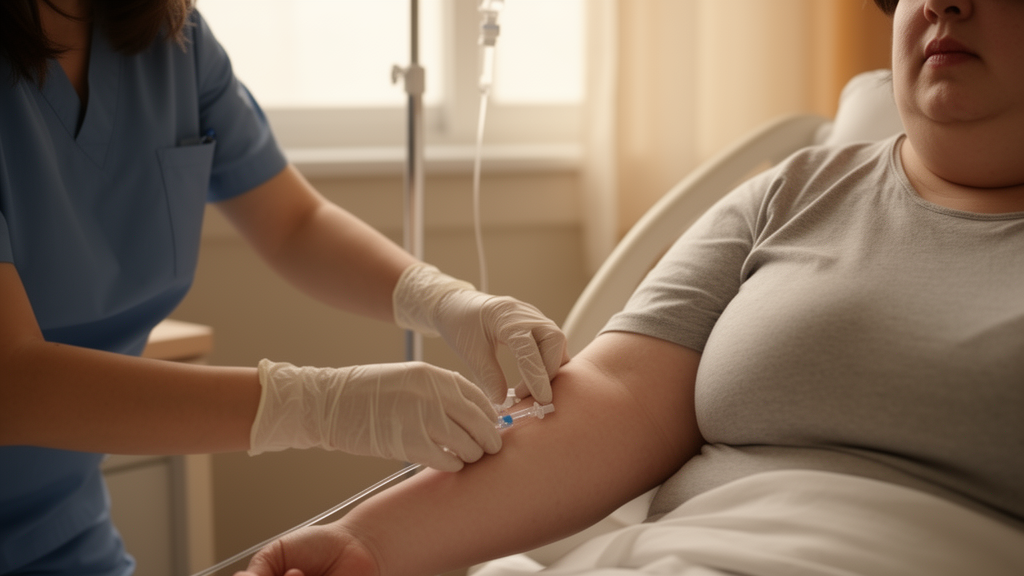
Perioperative patients with obesity would pay roughly 1,366 Chinese yuan, about 198 US dollars, out of pocket to cut their risk of catheter complications from 50 percent to 10 percent, according to a preliminary stated-preference study published in BMC Health Services Research. The finding comes from a discrete choice experiment conducted in the metabolic and bariatric surgery department of a tertiary public hospital in eastern China, where 215 patients with obesity completed face-to-face surveys, producing 1,290 choice observations for analysis. Patients with obesity frequently experience difficult intravenous access during the perioperative period.
Traditional short peripheral intravenous catheters are commonly linked to an increased risk of repeated punctures and associated complications. Although novel longer catheters, including mini-midline and midline devices, may improve the reliability of vascular access, evidence has been limited on how patients with obesity actually weigh the risks, benefits, costs, and physical characteristics of these devices against one another. To address this, the research team designed a cross-sectional discrete choice experiment examining seven catheter attributes: maximum dwell time, insertion site, total cost, blood sampling capability, complication risk, catheter length, and insertion time.
In each choice task, participants selected between hypothetical catheter profiles that differed across these attributes. The data were analysed using a mixed logit model. The analysis showed that complication risk was the most important attribute driving patient choices, accounting for a relative importance score of 31.85 percent. Blood sampling capability ranked second at 25.93 percent, followed by total cost at 20.98 percent and catheter length at 11.13 percent.
The marginal willingness-to-pay estimates quantified just how much patients valued improvements in each attribute. Beyond the 1,366.18 yuan figure for reducing complication risk from 50 percent to 10 percent, participants were willing to pay 659.35 yuan, or 95.6 US dollars, for a smaller reduction from 50 percent to 30 percent.
The ability to draw blood through the catheter itself was worth 1,112.27 yuan, approximately 161.2 US dollars, to the average respondent. Not every attribute improvement was viewed as a benefit. Patients required compensation of 477.64 yuan, or 69.2 US dollars, to accept a 25-centimetre catheter rather than a 3-centimetre one, indicating that longer devices were perceived as a burden rather than an advantage, even though longer catheters are typically associated with more reliable access in this population.
This trade-off between clinical reliability and patient-perceived burden is one of the study’s more striking results. When the researchers assembled the attribute estimates into predicted choice probabilities for three predefined catheter profiles, the mini-midline catheter came out on top with a predicted probability of 50.3 percent. The midline catheter profile followed at 42.3 percent, while the traditional short peripheral intravenous catheter profile was predicted to be chosen by only 7.4 percent of patients.
The two longer catheter designs, despite their greater length, offered attribute combinations that patients preferred over the standard short device. Cost emerged as a powerful lever for shifting choices between the two leading alternatives. Changes in total cost primarily moved predicted choice probabilities between the mini-midline and midline catheter profiles rather than drawing patients back toward the short peripheral catheter.
The authors frame these findings as an essential patient-preference evidence base for vascular access decisions, nursing practice, institutional procurement planning, and future reimbursement assessments. Because the study captured what patients themselves value, rather than relying solely on clinician judgment or cost analyses, the results could help hospitals and policymakers align device purchasing and care protocols with the priorities of the people who actually receive the catheters. As the researchers note, this is a preliminary analysis with inherent limitations of the stated-preference approach: participants evaluated hypothetical scenarios rather than making real decisions with real money, and the sample was drawn from a single tertiary hospital department in eastern China.
Generalisation to other settings and to actual purchasing behaviour will require further work. Nevertheless, the study offers one of the first quantified pictures of how perioperative patients with obesity trade off safety, cost, comfort, and function when it comes to the devices placed in their veins before and after surgery.
Subject of Research: Patient preferences and willingness to pay for peripheral intravenous catheter attributes among perioperative patients with obesity
Article Title: Preliminary analysis of perioperative peripheral intravenous catheters preference and willingness to pay in patients with obesity
Article References: Zhu, H., Cao, X., Zeng, X., Wang, J., Wang, X., Xu, J., Sun, J., Zheng, S., & Zhao, L. (2026). Preliminary analysis of perioperative peripheral intravenous catheters preference and willingness to pay in patients with obesity. BMC Health Services Research. https://doi.org/10.1186/s12913-026-15433-x
Image Credits: AI Generated
DOI: 10.1186/s12913-026-15433-x
Keywords: obesity, peripheral intravenous catheters, discrete choice experiment, willingness to pay, vascular access, patient preferences, perioperative care, mini-midline catheter, midline catheter, mixed logit model, health services research, Preliminary
News Source: Daisy Hatcher. (October 27, 2026). Patients with Obesity Would Pay Hundreds of Dollars for Safer IV Catheters, Survey Finds. Scienmag.