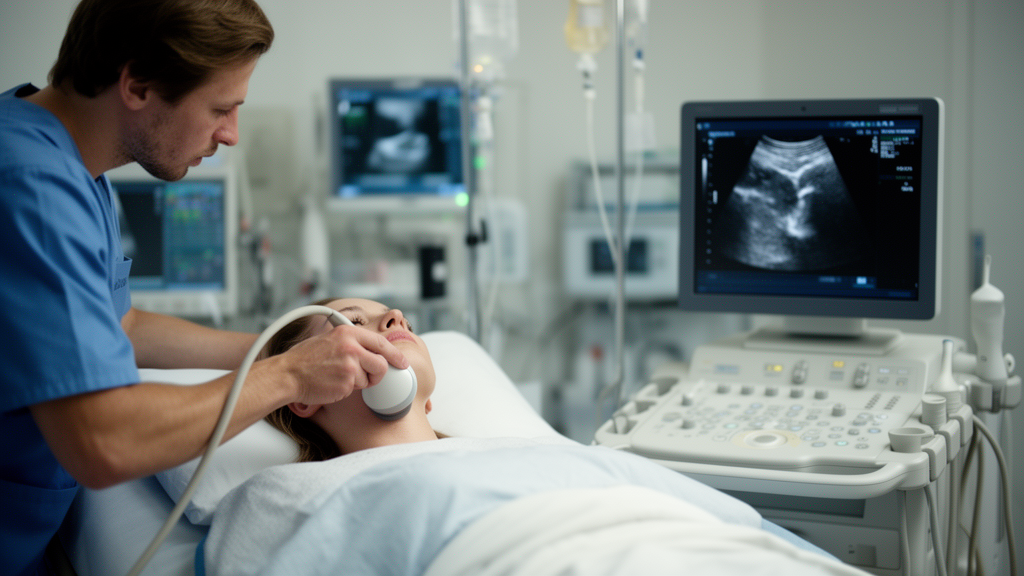
Heart surgery saves lives, but the days that follow in the intensive care unit carry their own quiet dangers. A prospective cohort study now published in BMC Anesthesiology reports that a modified bedside ultrasound score, designed to detect severe venous congestion, identifies a group of postoperative patients at markedly elevated risk of kidney injury and other adverse outcomes.
The study enrolled 199 patients admitted to the intensive care unit after elective coronary artery bypass grafting and/or aortic valve replacement. The key modification is the replacement of the static inferior vena cava diameter with dynamic indices: the collapsibility index in spontaneously breathing patients, or the distensibility index in those on mechanical ventilation.
This modification addressed a known limitation of the traditional static criterion. In the cohort, 25 percent of patients showed a statically dilated inferior vena cava of 20 millimetres or more, yet had no Doppler-defined congestion. In other words, a quarter of the patients would have been misclassified by the traditional static criterion alone. By incorporating dynamic indices, the modified score aimed to separate true venous congestion from mere anatomical distension, sharpening the tool’s diagnostic resolution at the bedside.
Severe congestion, defined as M-VExUS grade 3, was present in 18.1 percent of patients. In univariate analysis, this severe congestion was associated with cardiac surgery-associated acute kidney injury, with an odds ratio of 2.6 (95 percent confidence interval 1.07 to 6.07; p = 0.03). The association deepened when the researchers looked at persistence. Patients whose M-VExUS grade 3 congestion persisted over time had a substantially increased risk, with an odds ratio of 6.76 (95 percent confidence interval 2 to 22.91; p = 0.007), and their kidney injury shifted toward more advanced KDIGO stages (p = 0.005). Persistence, rather than a single snapshot, appears to carry the prognostic weight.
Beyond the kidneys, severe congestion traced the outline of a distinct high-risk phenotype. These patients showed hemodynamic vulnerability, required increased vasoactive-inotropic support, spent longer on mechanical ventilation, and suffered significantly higher rates of major complications, including myocardial infarction and atrioventricular block. The downstream consequence was measurable in bed days: longer intensive care unit stays and longer hospital admissions overall. In this sense, the score functioned less as a kidney-specific predictor and more as a window onto systemic postoperative physiology.
However, the multivariable analysis tempered the enthusiasm. When the investigators adjusted for baseline clinical risk, preoperative creatinine emerged as independently associated with acute kidney injury during the intensive care stay (adjusted odds ratio 4.75, 95 percent confidence interval 1.74 to 12.94; p = 0.002), as did cardiopulmonary bypass time (adjusted odds ratio 1.02, 95 percent confidence interval 1.003 to 1.033; p = 0.018). M-VExUS grade 3 itself did not reach independent statistical significance.
The authors’ conclusion is carefully calibrated. M-VExUS does not, after adjustment for baseline risk, stand as an independent predictor of kidney injury. What it does offer is real-time physiological insight into a patient’s volume tolerance, identifying an exhausted venous reserve during the early postoperative phase.
The researchers are explicit that a therapeutic question remains open. Whether M-VExUS-guided fluid or diuretic management can safely improve clinical outcomes is a hypothesis that has not been tested and, they argue, warrants prospective interventional evaluation. This study was observational by design: it demonstrates association and risk stratification, not that acting on the score changes outcomes. Published on 27 October 2026 as an open-access research article, the work adds a technically refined ultrasound instrument to the postoperative toolkit, one whose clinical value will now be decided not by what it can see, but by whether seeing it early enough changes what clinicians do.
Subject of Research: A modified bedside ultrasound score for venous congestion after cardiac surgery and its association with acute kidney injury and adverse outcomes
Article Title: Modified VExUS score for cardiac surgery-associated kidney injury and adverse outcomes: a prospective cohort study
Article References: Berrocal, L. B., Tomasa Irriguible, T. M., García, E. B., Casado, J. M. T., Dianderas, F. C., Pardo, L. R., Torres, C. B., Armadans, I. S., Llach, J. F., & Moltó, H. P. (2026). Modified VExUS score for cardiac surgery-associated kidney injury and adverse outcomes: a prospective cohort study. BMC Anesthesiology. https://doi.org/10.1186/s12871-026-04342-5
Image Credits: AI Generated
DOI: 10.1186/s12871-026-04342-5
Keywords: venous congestion, M-VExUS, cardiac surgery, acute kidney injury, point-of-care ultrasound, inferior vena cava, ICU, prospective cohort, KDIGO, hemodynamics, fluid management, BMC Anesthesiology
News Source: Ophelia Keating. (October 27, 2026). Ultrasound Score Flags Dangerous Venous Congestion After Heart Surgery. Scienmag.