• HOME
  • NEWS
  • EXPLORE
    • CAREER
      • Companies
      • Jobs
    • EVENTS
    • iGEM
      • News
      • Team
    • PHOTOS
    • VIDEO
    • WIKI
  • BLOG
  • COMMUNITY
    • FACEBOOK
    • INSTAGRAM
    • TWITTER
Thursday, October 29, 2026
BIOENGINEER.ORG
No Result
View All Result
  • Login
  • HOME
  • NEWS
  • EXPLORE
    • CAREER
      • Companies
      • Jobs
        • Lecturer
        • PhD Studentship
        • Postdoc
        • Research Assistant
    • EVENTS
    • iGEM
      • News
      • Team
    • PHOTOS
    • VIDEO
    • WIKI
  • BLOG
  • COMMUNITY
    • FACEBOOK
    • INSTAGRAM
    • TWITTER
No Result
View All Result
Bioengineer.org
No Result
View All Result
Home NEWS Science News Health

Transgenic hamster model recreates New World hemorrhagic fever infection

by
October 27, 2026
in Health
Reading Time: 2 mins read
0
Transgenic hamster model recreates New World hemorrhagic fever infection

Transgenic hamster model recreates New World hemorrhagic fever infection

Share on FacebookShare on TwitterShare on LinkedinShare on RedditShare on Telegram

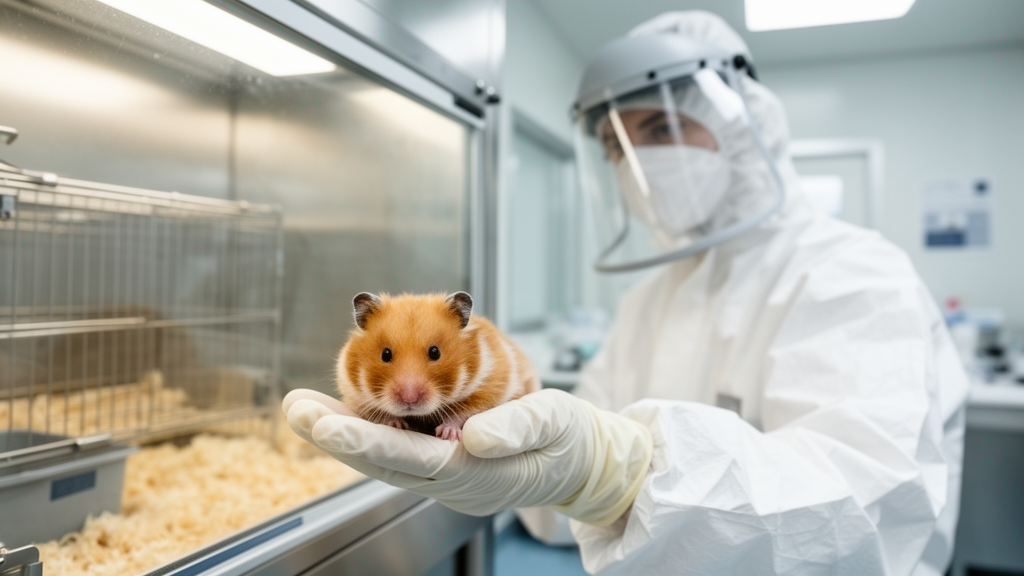
Researchers have developed a golden Syrian hamster line engineered to carry the human transferrin receptor 1 gene, creating a new small-animal model for studying New World hemorrhagic fever mammarenaviruses. The work, published in npj Viruses, addresses a long-standing obstacle in the field: the scarcity of small-animal models that faithfully reproduce the severe, life-threatening hemorrhagic fever syndrome these viruses cause in humans.

Mammarenaviruses are endemic in rodent populations worldwide, and their zoonotic transmission can lead to hemorrhagic fever. In the Americas, five New World mammarenaviruses are known to cause this syndrome. Because vaccines and antiviral therapy options remain limited, these pathogens represent a significant public health risk and, according to the authors, a threat to national security. Research into how these viruses cause disease, and into the development of effective countermeasures, has been restricted by the shortage of suitable animal models.

A key biological detail underpins the new model. The pathogenic New World mammarenaviruses use human transferrin receptor 1 as the receptor for cellular entry. The team created an hTfR1 knock-in golden Syrian hamster line and tested its susceptibility to Junín virus infection, one of the pathogenic New World mammarenaviruses. According to the study, the transgenic hamster infection model supports transferrin receptor 1-mediated entry as an essential step in Junín virus pathogenesis.

The authors report that the model provides a novel small-animal platform intended to advance the development of host receptor-directed therapies and direct-acting antivirals aimed at improving outcomes for patients with severe disease caused by pathogenic New World mammarenaviruses. The article was published under open access on 27 October 2026 and is being shared early to provide faster access to peer-reviewed, accepted research; this version remains subject to further edits before the final Version of Record replaces it.

Subject of Research: Development of a human transferrin receptor 1 knock-in Syrian hamster model for New World hemorrhagic fever mammarenavirus infection

Article Title: A transgenic Syrian hamster model for New World hemorrhagic fever mammarenavirus infection

Article References: Wasson, S. R., Liu, Y., Li, M., Bailey, K. W., Westover, J. B., Landinez-Aponte, J., Van Wettere, A., Siddharthan, V., Davies, C. J., Daniels-Wells, T. R., Li, R., Penichet, M. L., Wang, Z., & Gowen, B. B. (2026). A transgenic Syrian hamster model for New World hemorrhagic fever mammarenavirus infection. npj Viruses. https://doi.org/10.1038/s44298-026-00252-y

Image Credits: AI Generated

DOI: 10.1038/s44298-026-00252-y

Keywords: mammarenavirus, Junín virus, hemorrhagic fever, Syrian hamster, transferrin receptor 1, animal model, transgenic, zoonotic, antiviral development, pathogenesis, npj Viruses, Syrian

News Source: Kristina Jarvis. (October 27, 2026). Transgenic hamster model recreates New World hemorrhagic fever infection. Scienmag.


Tags: animal modelantiviral developmenthemorrhagic feverJunín virusmammarenavirusnpj VirusespathogenesisSyrianSyrian hamstertransferrin receptor 1Transgeniczoonotic
Share12Tweet7Share2ShareShareShare1

Related Posts

Cadaver study maps how anterior clinoidectomy widens the surgical corridor for clipping PCom aneurysms

Cadaver study maps how anterior clinoidectomy widens the surgical corridor for clipping PCom aneurysms

October 29, 2026
Doppler Ultrasound Could Measure Artery Stiffness Directly, Exploratory Study Suggests

Doppler Ultrasound Could Measure Artery Stiffness Directly, Exploratory Study Suggests

October 29, 2026

Older Patients May Fare Better After Trigeminal Neuralgia Surgery, Study Finds

October 29, 2026

Diabetes insipidus unmasked after steroids for pembrolizumab hypophysitis

October 29, 2026

POPULAR NEWS

  • Machine learning digital twin predicts electric powertrain efficiency in real time

    Machine learning digital twin predicts electric powertrain efficiency in real time

    29 shares
    Share 12 Tweet 7
  • Photon-counting CT outperforms dual-energy scanners at detecting tiny iodine traces

    29 shares
    Share 12 Tweet 7
  • Gut microbiome shifts in fibromyalgia track symptom severity, study finds

    29 shares
    Share 12 Tweet 7
  • Ball milling tunes nickel–ceria interfaces for cleaner methane reforming

    29 shares
    Share 12 Tweet 7

About

We bring you the latest biotechnology news from best research centers and universities around the world. Check our website.

Follow us

Recent News

Cadaver study maps how anterior clinoidectomy widens the surgical corridor for clipping PCom aneurysms

Securing Next-Gen Wireless Networks Against AI and Quantum Threats

Doppler Ultrasound Could Measure Artery Stiffness Directly, Exploratory Study Suggests

Subscribe to Blog via Email

Enter your email address to subscribe to this blog and receive notifications of new posts by email.

Join 85 other subscribers
  • Contact Us

Bioengineer.org © Copyright 2023 All Rights Reserved.

Welcome Back!

Login to your account below

Forgotten Password?

Retrieve your password

Please enter your username or email address to reset your password.

Log In
No Result
View All Result
  • Homepages
    • Home Page 1
    • Home Page 2
  • News
  • National
  • Business
  • Health
  • Lifestyle
  • Science

Bioengineer.org © Copyright 2023 All Rights Reserved.