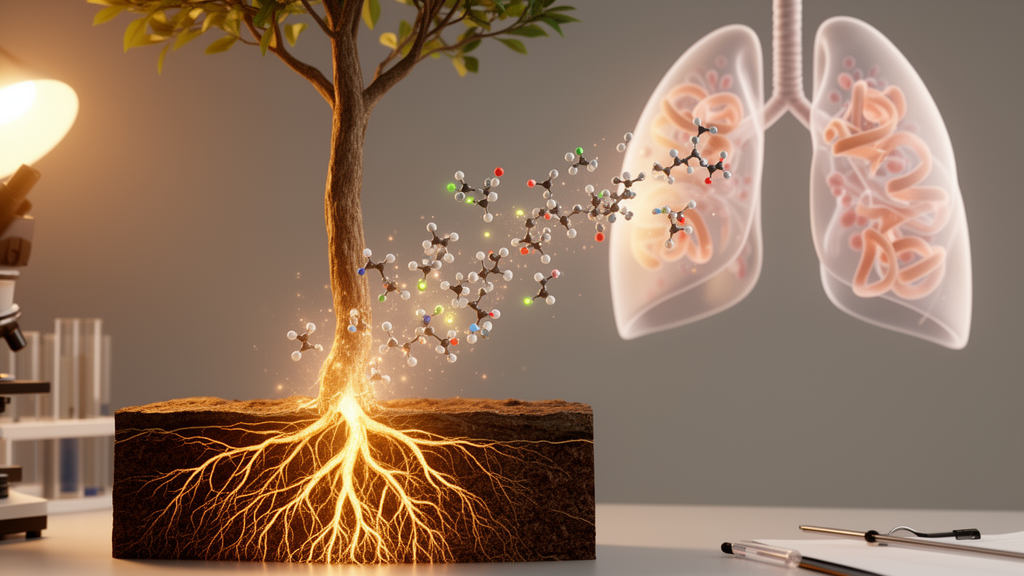
Chemists working in Indonesia have pulled five dammarane-type triterpenoids from the roots of Aglaia cucullata, a member of the mahogany family that has been chemically explored in its stem bark and exocarp but rarely in its roots. Among the isolates was shoreic acid, reported from this species for the first time, which showed the strongest — though still weak — cytotoxic effect against A549 human lung adenocarcinoma cells in laboratory screening. The team then used network pharmacology and consensus molecular docking to build hypotheses about which cancer-related proteins the compound might touch, identifying EP300, HSP90AA1, STAT3, PPARG, and AR as candidate targets within a cancer signaling pathway.
The roots themselves came from an unusual place. Roughly 6.7 kilograms of air-dried root material was collected in December 2020 from the Manggar River area near Balikpapan, East Kalimantan, and identified by a botanical expert at the Herbarium Wanariset, with a voucher specimen deposited at Mulawarman University. After powdered maceration in 70% ethanol at room temperature, the crude extract weighed 545 grams and was partitioned successively into n-hexane, ethyl acetate, and n-butanol fractions. The n-hexane fraction, weighing 47.2 grams, became the working material for chromatographic separation.
That separation was painstaking. Vacuum liquid chromatography split the hexane extract into five fractions, and repeated rounds of silica gel column chromatography, reversed-phase chromatography, and recrystallization yielded five pure compounds in modest quantities: cabralealactone at 16.0 milligrams, cabraleone at 35.9 milligrams, ocotillone at 15.2 milligrams, eichlerianic acid at 30.6 milligrams, and shoreic acid at 23.6 milligrams. Structures were confirmed using high-resolution mass spectrometry, infrared spectroscopy, and nuclear magnetic resonance at 700 megahertz for proton spectra, then matched against previously published data. The authors report that all five compounds were confirmed pure, with no evidence of mixed components.
Structurally, the five molecules share the dammarane triterpenoid framework but differ in telling ways. Cabralealactone is a C27 trisnor-dammarane bearing a gamma-lactone, identified partly by an ester carbonyl signal at 176.9 parts per million and a ketone carbonyl at 218.1 parts per million in its carbon spectrum. Cabraleone and ocotillone turned out to be epimers, differing in the stereochemistry of the 20,24-epoxy side chain. Eichlerianic acid and shoreic acid are seco-dammarane derivatives that also differ only in side-chain configuration, at carbon 24, where the two carry opposite orientations. That subtle stereochemical difference, the authors note, was supported by the single-crystal X-ray structure of the corresponding methyl ester reported in earlier work.
Biological testing followed a standard MTT viability assay. A549 cells, obtained from the European Collection of Authenticated Cell Cultures, were seeded into 96-well plates and treated with each compound at concentrations from 6.25 to 100 micrograms per milliliter for 48 hours, with cisplatin at 10 micrograms per milliliter as a positive control and 1% dimethyl sulfoxide as a negative control. Cisplatin reduced cell viability to 43.64%, corresponding to 56.36% growth inhibition, confirming the assay could detect a strong response. Each concentration was tested in triplicate, and half-maximal inhibitory concentrations were calculated by nonlinear regression with 95% confidence intervals.
The headline result was modest. Shoreic acid registered an IC50 of 123.05 micromolar, which the authors themselves classify as weak cytotoxicity in in vitro screening terms, though it was comparatively more active than the other four isolates. The team attributes the relative advantage to the carboxylic acid and hydroxyl groups on shoreic acid’s side chain, which increase polarity and hydrogen-bonding capacity, and to a more flexible side chain compared with the rigid cyclic or lactone-containing side chains of cabralealactone, cabraleone, and ocotillone, which showed lower cytotoxic effects. Structural orientation in triterpenoids has been reported to strongly affect biological activity, and the authors suggest the specific position and stereochemical orientation of substituents in eichlerianic acid may explain why it, despite carrying an acidic group, performed worse than its epimer.
To move beyond the phenotype and ask what the compound might be doing mechanistically, the researchers turned to network pharmacology, a database-driven approach that predicts which human proteins a small molecule might engage and where those proteins sit in disease networks. NSCLC-related target genes were pulled from the GeneCards, OMIM, and Therapeutic Target databases in August 2026, yielding 8,198 genes after deduplication. SwissTargetPrediction returned 97 predicted shoreic acid targets, and the two lists overlapped in 81 genes. A protein-protein interaction network built in the STRING database at high confidence, then analyzed in Cytoscape with the CytoHubba plugin using four topological algorithms, consistently ranked STAT3, EP300, ESR1, RELA, HSP90AA1, NR3C1, PGR, AR, STAT1, and PPARG as hub genes. Gene Ontology and KEGG enrichment analyses, with a false discovery rate threshold of 0.05, narrowed the focus to five key proteins within the pathways-in-cancer category: STAT3, PPARG, HSP90AA1, EP300, and AR.
Consensus docking then tested whether shoreic acid could actually fit into these proteins’ binding pockets. The team used three docking programs — RxDock, AutoDock Vina, and Smina — through the DockingPie plugin in PyMOL, and combined their rankings with Rank-by-Rank, auto-scaled average, and Z-score consensus methods. Redocking of co-crystallized ligands produced root-mean-square deviation values below 2 angstroms for most targets, validating the protocol, with PPARG, EP300, and AR achieving values below 1 angstrom in at least one program. The predicted binding energies for shoreic acid were strongest for EP300, at -9.3 to -9.5 kilocalories per mole, and HSP90AA1, at -8.5 to -8.8 kilocalories per mole — notably stronger than the natural ligand ATP’s -7.3 to -7.7 kilocalories per mole at HSP90AA1. Interactions with STAT3, at -5.8 to -6.1, and PPARG, at -5.3 to -5.8, were moderate, with PPARG docking comparable to its natural ligand arachidonic acid. AR was the outlier: shoreic acid scored only -2.5 to -2.6 kilocalories per mole, with an unfavorable steric contact at residue Thr877 that the authors say likely explains the poor fit.
The docking detail is where the mechanistic story gets specific. At STAT3, shoreic acid was predicted to bind the SH2 domain, forming hydrogen-bond contacts with Gln635, Glu625, and Tyr657, plus hydrophobic interactions with Ile659 and Trp623 — a pattern the authors suggest could block STAT3’s recruitment to cytokine receptors and downstream transcription of survival and proliferation genes. At HSP90AA1, the compound formed a hydrogen bond with Tyr139 and sat within a hydrophobic pocket lined by Val150, Leu107, Phe138, and Met98, without the donor-conflict interactions that ATP showed at Asp93. At EP300, a transcriptional coactivator and histone acetyltransferase, shoreic acid contacted active residues Gln1455 and Ser1400 directly, mimicking the co-crystallized ligand’s hydrogen-bonding pattern.
The authors are careful about what these results do and do not show. The molecular interactions are computational predictions, they write, and should not be interpreted as evidence of direct target inhibition or protein suppression. Given the weak cytotoxic activity in A549 cells, the findings should be considered preliminary and hypothesis-generating rather than indicative of a potent therapeutic effect. What the study does establish is that the roots of Indonesian A. cucullata are a source of bioactive dammarane-type triterpenoids, that shoreic acid appears in the species for the first time, and that its predicted multitarget profile — particularly at EP300 and HSP90AA1 — merits follow-up. The team calls for in vitro and in vivo studies, including target-specific gene or protein expression analyses, functional inhibition assays, and combination or synergy testing, to confirm the predicted targets and clarify the compound’s biological relevance, selectivity, and safety.
Subject of Research: Isolation of dammarane-type triterpenoids from Aglaia cucullata roots and computational analysis of shoreic acid's potential targets in lung cancer
Article Title: Dammarane-type triterpenoids from the roots of Aglaia cucullata: mechanistic insights into the multitarget activity of shoreic acid in lung cancer
Article References: Martiningsih, N. W., Pramitha, D. A. I., Putra, A. B. N., Palupi, K. D., Sinaga, S. E., Safriansyah, W., Juliansyah, E., Maharani, R., Nurlelasari, Fajriah, S., Supratman, U., & Harneti, D. (2026). Dammarane-type triterpenoids from the roots of Aglaia cucullata: mechanistic insights into the multitarget activity of shoreic acid in lung cancer. Applied Biological Chemistry, 69(1), Article 80. https://doi.org/10.1186/s13765-026-01149-3
Image Credits: AI Generated
DOI: 10.1186/s13765-026-01149-3
Keywords: Aglaia cucullata, dammarane triterpenoids, shoreic acid, A549 lung cancer cells, network pharmacology, molecular docking, STAT3, EP300, HSP90AA1, PPARG, cytotoxicity, natural products
News Source: Nathaniel Bowman. (October 27, 2026). Tree Root Compound Shows Weak Lung Cancer Activity but Multitarget Docking Promise. Scienmag.