• HOME
  • NEWS
  • EXPLORE
    • CAREER
      • Companies
      • Jobs
    • EVENTS
    • iGEM
      • News
      • Team
    • PHOTOS
    • VIDEO
    • WIKI
  • BLOG
  • COMMUNITY
    • FACEBOOK
    • INSTAGRAM
    • TWITTER
Tuesday, October 27, 2026
BIOENGINEER.ORG
No Result
View All Result
  • Login
  • HOME
  • NEWS
  • EXPLORE
    • CAREER
      • Companies
      • Jobs
        • Lecturer
        • PhD Studentship
        • Postdoc
        • Research Assistant
    • EVENTS
    • iGEM
      • News
      • Team
    • PHOTOS
    • VIDEO
    • WIKI
  • BLOG
  • COMMUNITY
    • FACEBOOK
    • INSTAGRAM
    • TWITTER
No Result
View All Result
Bioengineer.org
No Result
View All Result
Home NEWS Science News Biology

Centromeres may explain suppressed recombination in sex chromosome evolution

by
October 27, 2026
in Biology
Reading Time: 2 mins read
0
Centromeres may explain suppressed recombination in sex chromosome evolution

Centromeres may explain suppressed recombination in sex chromosome evolution

Share on FacebookShare on TwitterShare on LinkedinShare on RedditShare on Telegram

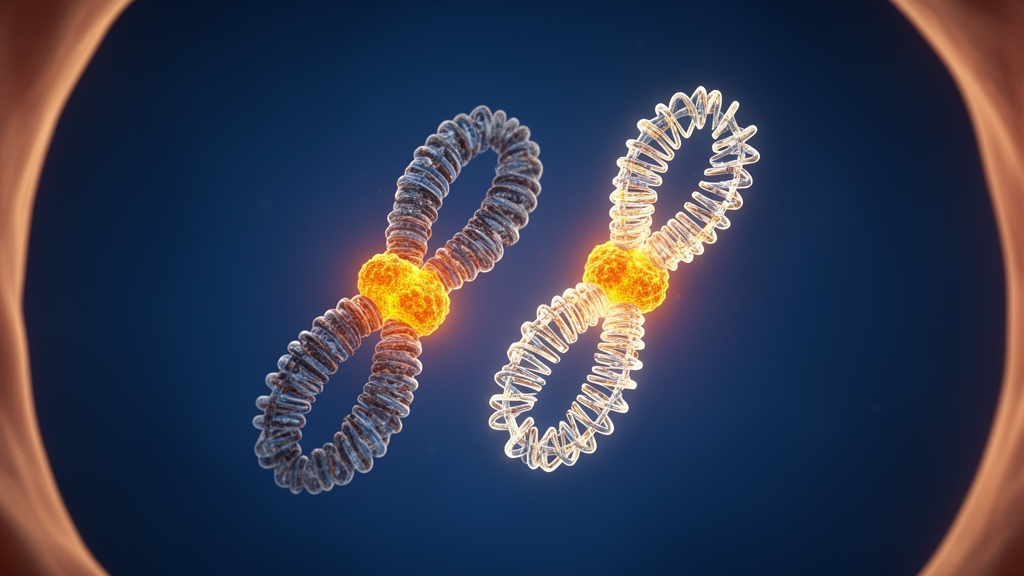
Recent genome sequences lend support to a long-debated idea in sex chromosome evolution: the extensive sex-linked regions seen in some species may not require any active recombination suppression process at all. Instead, according to a review by Deborah Charlesworth published in PLOS Genetics, the sex-determining locus may simply sit near a centromere, where the well-known “centromere effect” keeps recombination rates low.

Centromere-proximal regions of chromosomes recombine rarely as a general property of genomes. If a sex-determining gene lies in or near such a pericentromeric region, the surrounding stretch of DNA can become sex-linked without invoking any special evolutionary mechanism. On this view, debates about which types of selection might drive the spread of recombination suppression become unnecessary, because the low recombination is a pre-existing feature of the genome region itself.

The review outlines the properties of genome regions that recombine rarely, including pericentromeric regions, and examines sex-linked regions that overlap with them. Charlesworth notes that it is difficult to distinguish special features of such sex-linked regions that would indicate they have undergone an active recombination suppression process. One property most likely to be specific to completely sex-linked regions is major gene loss from Y- or W-linked regions of genes that are still present in their X- or Z-linked counterparts, an asymmetry observed in many species.

However, if pericentromeric regions are characterised by ephemeral gene content and low gene expression, asymmetry between the sex chromosomes in pericentromeric sex-linked regions might be less pronounced than in sex-linked regions elsewhere in the genome. The review reports that similar levels of Y and X degeneration are indeed documented in several species, consistent with this expectation. In addition, some sex-linked regions overlapping pericentromeres may not be completely sex-linked, which could explain findings of extensive sex-linked regions showing low Y-X or W-Z divergence. The work suggests that where a sex-determining locus lies near a centromere, genome geography alone may shape the evolution of sex chromosomes.

Subject of Research: The role of pericentromeric genome regions and the centromere effect in sex chromosome evolution

Article Title: The peculiar properties of pericentromeric regions of genomes and their influence on sex chromosome evolution

Article References: Charlesworth, D. (2026). The peculiar properties of pericentromeric regions of genomes and their influence on sex chromosome evolution. PLOS Genetics, 22(10), e1012333. https://doi.org/10.1371/journal.pgen.1012333

Image Credits: AI Generated

DOI: 10.1371/journal.pgen.1012333

Keywords: sex chromosomes, pericentromeric regions, centromere effect, recombination suppression, sex-linked regions, Y chromosome degeneration, genome evolution, PLOS Genetics, Deborah Charlesworth, Y-X divergence, peculiar, properties

News Source: Juliet Wilcox. (October 27, 2026). Centromeres may explain suppressed recombination in sex chromosome evolution. Scienmag.


Tags: centromere effectDeborah Charlesworthgenome evolutionpeculiarpericentromeric regionsPLOS Geneticspropertiesrecombination suppressionsex chromosomessex-linked regionsY chromosome degenerationY-X divergence
Share12Tweet7Share2ShareShareShare1

Related Posts

Alpine leaf-mining moth found on Alpenrose points to ancient postglacial host shift

Alpine leaf-mining moth found on Alpenrose points to ancient postglacial host shift

October 27, 2026
Vampire moths: a lifetime of night observations reveals how Calyptra drinks blood

Vampire moths: a lifetime of night observations reveals how Calyptra drinks blood

October 27, 2026

Receptor promiscuity in bat sarbecoviruses exposes conserved spike targets

October 27, 2026

Single Gene Drives Male Mosquitoes’ Attraction to Female Flight Sounds

October 27, 2026

POPULAR NEWS

  • Blood test tracks sarcoma progression closely alongside imaging in real-world cohort

    Blood test tracks sarcoma progression closely alongside imaging in real-world cohort

    29 shares
    Share 12 Tweet 7
  • CAR T-cell therapy takes heaviest toll on patients around discharge, study finds

    29 shares
    Share 12 Tweet 7
  • Alpine leaf-mining moth found on Alpenrose points to ancient postglacial host shift

    29 shares
    Share 12 Tweet 7
  • Vampire moths: a lifetime of night observations reveals how Calyptra drinks blood

    29 shares
    Share 12 Tweet 7

About

We bring you the latest biotechnology news from best research centers and universities around the world. Check our website.

Follow us

Recent News

Blood test tracks sarcoma progression closely alongside imaging in real-world cohort

CAR T-cell therapy takes heaviest toll on patients around discharge, study finds

Alpine leaf-mining moth found on Alpenrose points to ancient postglacial host shift

Subscribe to Blog via Email

Enter your email address to subscribe to this blog and receive notifications of new posts by email.

Join 85 other subscribers
  • Contact Us

Bioengineer.org © Copyright 2023 All Rights Reserved.

Welcome Back!

Login to your account below

Forgotten Password?

Retrieve your password

Please enter your username or email address to reset your password.

Log In
No Result
View All Result
  • Homepages
    • Home Page 1
    • Home Page 2
  • News
  • National
  • Business
  • Health
  • Lifestyle
  • Science

Bioengineer.org © Copyright 2023 All Rights Reserved.