A new species of warty newt has been described from the mountain streams of Chongqing Municipality in southwestern China, following a combined analysis of body form and DNA that places the animal firmly within one of Asia’s most recently diversifying salamander lineages.
The genus Paramesotriton, commonly known as Asian warty newts, belongs to the salamander family Salamandridae and is endemic to East Asia. Fifteen species are currently recognized, distributed primarily from southwestern to central-southern China and into northern Vietnam. The group has a tangled taxonomic history, having previously absorbed several names now treated as synonyms, and its internal relationships have long challenged researchers. Molecular work over the past two decades has progressively clarified which lineages belong in the genus and how species diversity is arranged within it, with recent studies revealing cryptic lineages that look superficially similar yet are genetically and morphologically distinct.
The specimens behind the new species were collected during amphibian surveys on 18 May 2023 and 30 June 2025, when researchers searched stream bottoms between 19:00 and 02:00. One individual was taken on the first date and five on the second. After photography, the animals were euthanized in a 0.1 percent benzocaine solution, muscle tissue was sampled from the hindlimb and preserved in 95 percent ethanol, and the bodies were fixed in 10 percent formalin for 24 hours before long-term storage in 75 percent ethanol. All six vouchers are deposited at the Chongqing Natural History Museum under catalogue numbers CMNH 1575 and CMNH 1658 through 1662. The work was carried out under an animal care protocol and with permissions from the Chongqing Municipal Forestry Bureau.
To determine where the unknown animals sat within the genus, the team sequenced two mitochondrial genes, ND2 and Cytb, and one nuclear gene, POMC, and combined these with sequences retrieved from GenBank for 32 ND2, 32 Cytb and 26 POMC samples. The final concatenated matrix comprised 38 individuals and 2,549 base pairs, including 912 variable sites and 696 parsimony-informative sites. Bayesian inference and maximum likelihood analyses produced nearly identical trees, with two outgroup species anchoring the root. The monophyly of Paramesotriton itself was strongly supported, and the genus split into two major clades corresponding to the P. chinensis group and the P. caudopunctatus group.
The new samples fell squarely inside the P. caudopunctatus group, forming a strongly supported monophyletic unit distinct from every recognized species lineage in the analysis. This novel lineage emerged as sister to the clade containing P. maolanensis, P. wumengshanensis and P. longliensis, with Bayesian posterior probability of 0.91 and maximum likelihood bootstrap support of 74. P. zhijinensis sat on an external branch of the same cluster. Within the new population, genetic distance was zero, confirming a single homogeneous evolutionary unit rather than a mixture of divergent lineages.
Genetic distances between the new species and its relatives were small but diagnostic. The minimum distance to its closest relative, P. maolanensis, reached 0.78 percent based on Cytb p-distances. That figure exceeds the intraspecific variation reported in several congeners, including 0.16 percent in P. longliensis and zero in P. maolanensis and P. zhijinensis, and it surpasses the 0.63 percent interspecific distance measured between P. maolanensis and P. longliensis. The authors argue that this combination of phylogenetic placement and divergence metrics justifies recognizing the Pengshui population as a distinct species.
Morphology reinforced the molecular case. The holotype, an adult male designated CMNH 1662, was collected at the type locality at 718 meters elevation and measures 77.2 millimeters in snout-vent length with a 56.5 millimeter tail, giving a tail-to-snout-vent ratio of 0.69. The head is slightly flattened and longer than wide, the snout is truncate and projects beyond the lower lip, and vomerine teeth are arranged in a wedge shape. The skin is rough, the vertebral ridge is prominent, and the tail is cylindrical at its base before becoming laterally compressed toward a bluntly rounded tip. When the forelimbs and hindlimbs are pressed along the body, the palm and tarsus overlap, and fingertips extend beyond the anterior corner of the eye when the forelimb is stretched forward.
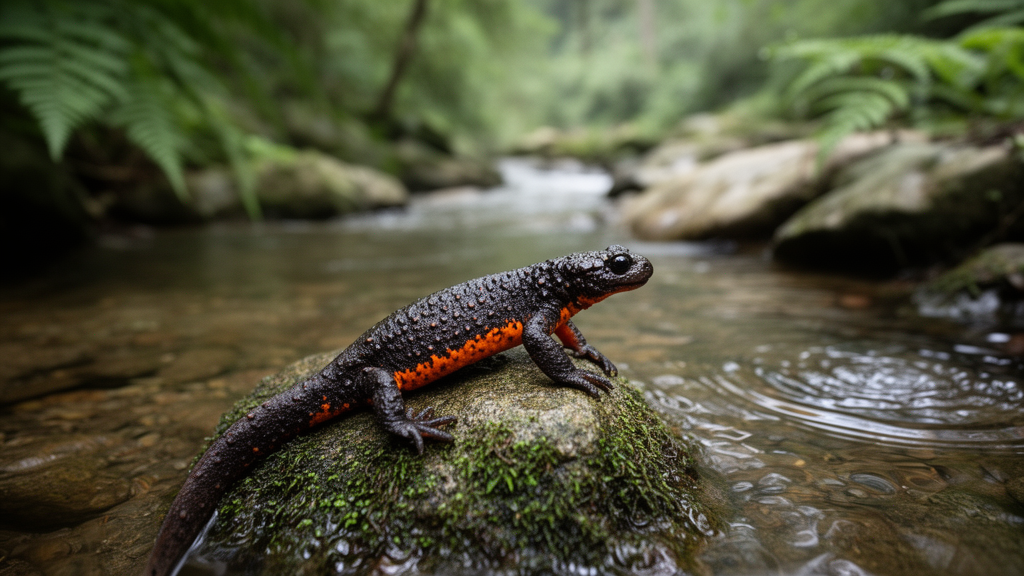
The most striking diagnostic features are visual. Both sexes carry horn-like projections on the posterodorsal surface of the head, a trait otherwise known in the group only from P. maolanensis and P. longliensis. The throat and venter are black, marked with irregular orange-red or orange-yellow spots and streaks, and a yellow-white stripe runs along each side of the tail. Adults lack vestigial gills and gill filaments, and there is no spotting on the cheeks, the lateral sides of the dorsum and tail, or the limb bases. In life, the dorsal surfaces are tawny yellow, and an orange-red stripe extends from the cloaca along the underside of the tail, either reaching the tip or fading at roughly one-eighth of its length. The specific epithet chongqingensis honors the type locality, and the authors suggest Chongqing Warty Newt as the English common name.
The small mitochondrial divergences within this species group raise a question the authors address directly: how much genetic difference is enough to call something a species? Recent commentary cited in the paper argues that mitochondrial DNA alone is an insufficient marker for species delimitation because of cytonuclear discordance, historical introgression and the fact that a single maternally inherited locus cannot reflect biparental gene flow. Relying on mitochondrial thresholds alone can split structured populations or lump genuinely independent lineages that have exchanged mitochondria. The authors therefore frame their conclusion as integrative, resting on morphology together with molecules rather than on a barcoding gap. They note that related work on this species group, drawing on more than 1.47 million nuclear single nucleotide polymorphisms alongside mitochondrial data, found the constituent species to be consistently distinct lineages, and they point to parallel cases elsewhere in southwestern China where mitochondrial divergence is minimal while nuclear and morphological differences are substantial.
Small genetic distances, the authors add, are not unusual in rapidly radiating lineages and often reflect recent speciation. Among toads of the genus Oreolalax, for example, interspecific 16S rRNA distances as low as 0.6 percent and 0.4 percent pair with pronounced morphological differentiation. Mitogenome introgression in the Odorrana grahami complex produced cytochrome oxidase subunit I differences of only 0.3 to 0.8 percent despite significant nuclear divergence. In such recently split lineages, where genetic drift may not yet have accumulated deep mitochondrial signal, consistent morphological differences remain a fundamental basis for species recognition.
Ecologically, P. chongqingensis is known from cold, clear, slow-flowing montane streams between 700 and 1,000 meters elevation, with substrates of sand, leaf litter, rocks and aquatic plants, and densely vegetated evergreen riparian zones. The streams measured five to ten meters wide, mostly shallow except for scattered pools up to two to three meters deep, and the newts hide by day at the stream bottom or edges. Despite multiple surveys of the surrounding region and a review of existing literature, only a single occurrence locality is known, leading the authors to suggest the species may be a point endemic. Its specialized habitat requirements leave it vulnerable to habitat fragmentation from hydropower development and tourism infrastructure, and its brightly patterned venter could make it a target for the illegal pet trade. The authors recommend categorizing the species as threatened and urge immediate steps including population assessments, delineation of its distribution boundaries and inclusion of its habitat in priority conservation networks. The discovery, they note, underscores how much cryptic diversity likely remains in the karst mountains of southwestern China, where fragmented habitats may have driven repeated speciation in this newt lineage.
Subject of Research: Description of a new salamandrid newt species from Chongqing, China, based on morphology and multi-gene phylogenetics
Article Title: Morphological and molecular evidence reveal a new species of the genus Paramesotriton ( Caudata , Salamandridae ) from Chongqing, China
Article References: Ma, Q., Li, S.-Z., Yang, X., Wan, L.-P., Ma, C.-C., Shi, S.-C., & Wang, Z.-J. (2025). Morphological and molecular evidence reveal a new species of the genus Paramesotriton (Caudata, Salamandridae) from Chongqing, China. Zoosystematics and Evolution, 101(4), 2207-2220. https://doi.org/10.3897/zse.101.168621
Image Credits: AI Generated
Keywords: Paramesotriton, new species, salamanders, Chongqing, phylogenetics, mitochondrial DNA, cryptic diversity, Wuling Mountains, taxonomy, conservation, karst habitats, herpetology
News Source: Margaret Porter. (October 27, 2026). New Warty Newt Species Hidden in Chongqing’s Mountain Streams. Scienmag.